Simplifying My Digital Analyst Life: A Daily ChatGPT Adventure

Management Summary
You know that feeling when you stumble upon something so cool that you can’t wait to share it with everyone? That was my first thought when I started to work with ChatGPT. It’s like having a chat buddy who’s not just good with words, but can also open up doors to a whole new level of creativity and connection. ChatGPT is that digital discovery, turning everyday conversations into a playground of possibilities.
Leverage ChatGPT for Digital Analytics Tasks
So, I had this lightbulb moment: what if I brought ChatGPT into my daily routine to up my efficiency game? Being in the world of data analysis, Google Tag Manager, and all that jazz—testing environments, Java Script, and ReGex included—I realized ChatGPT could be my secret sauce for getting things done. It’s like having a super-smart assistant, ready to lend a hand with the nitty-gritty of implementing tags and making my work life a bit smoother.
First challenge – Regular Expressions
What are Regular Expressions (ReGex)?
If you check for a good definition on Google – Regular Expression, or regex or regexp in short, is extremely and amazingly powerful in searching and manipulating text strings, particularly in processing text files. One line of regex can easily replace several dozen lines of programming codes.
When implementing some tags in Google Tag Manager, we need the use of ReGex.
The second definition that comes with the explanation – Regex is supported in all the scripting languages (such as Perl, Python, PHP, and JavaScript); as well as general purpose programming languages such as Java; and even word processors such as Word for searching texts. Getting started with regex may not be easy due to its geeky syntax, but it is certainly worth the investment of your time.
Here ChatGPT comes in hand, and I will explain with an example:
Recently we had an implementation where we need to use the ReGex to add multiple domains of one client. So, I ask ChatGPT.
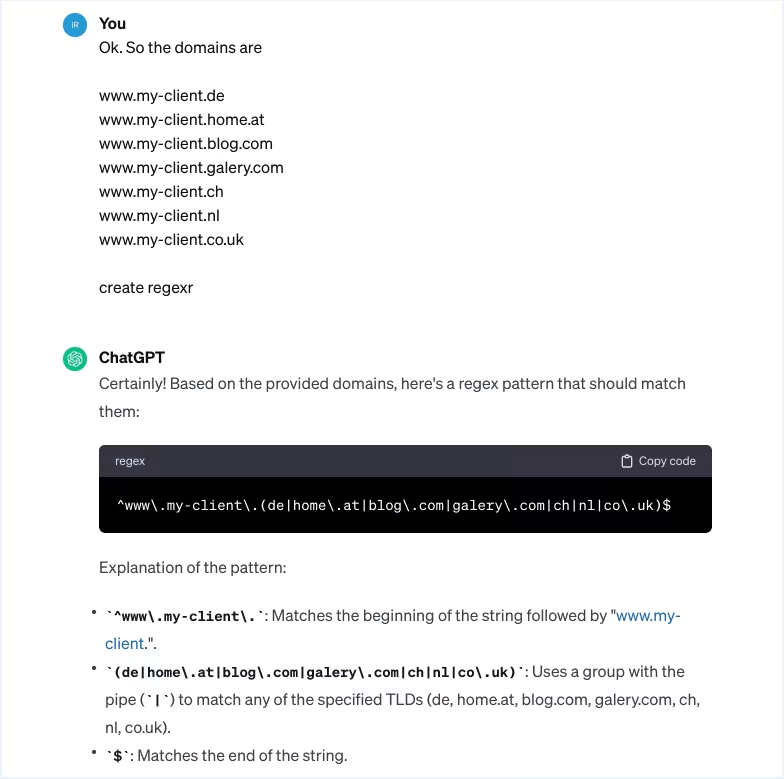
After it, I copy the code and check on regexr.com. You can see the code from ChatGPT has the ^ sign on the beginning and $ sign on the end. When copying the website to test, there was no match, but after removing those signs, the ReGEx expression was right with all the domains.

Alright, so diving into the world of regex, having a bit of know-how is handy. With ChatGPT being your tech sidekick, it’s like having a friendly AI wizard around. But here’s the friendly reminder from the data neighborhood: test things out before going all-in. Even with our magical AI friend, it’s always good practice to double-check and make sure your spells work as expected in the coding mix.
Second challenge – JavaScript
So, in this coding scenario, having a bit of knowledge about JavaScript is a must. The task was to set up a blocking trigger for specific tags, making them fire only when the cookies get the approval. While we can easily check the cookie value, the tricky part is getting the JavaScript code right for the trigger. The good news? We can break it down for ChatGPT, explain the situation, and it’ll give us the code we need.
We can always use some examples of javascript, so ChatGPT will know the syntax.
Here is an example:
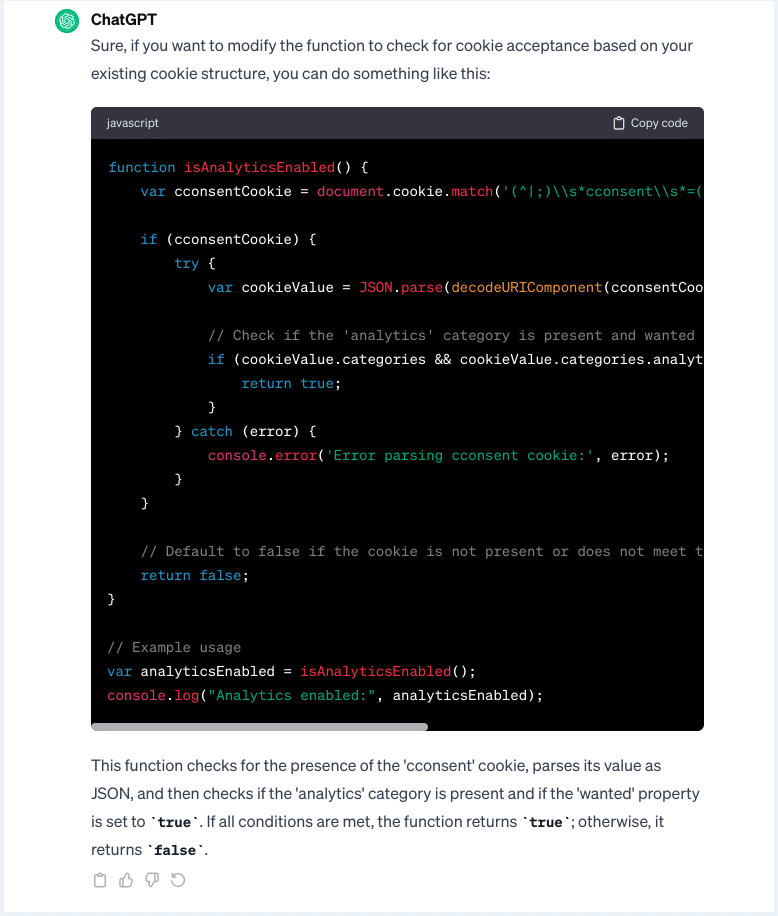
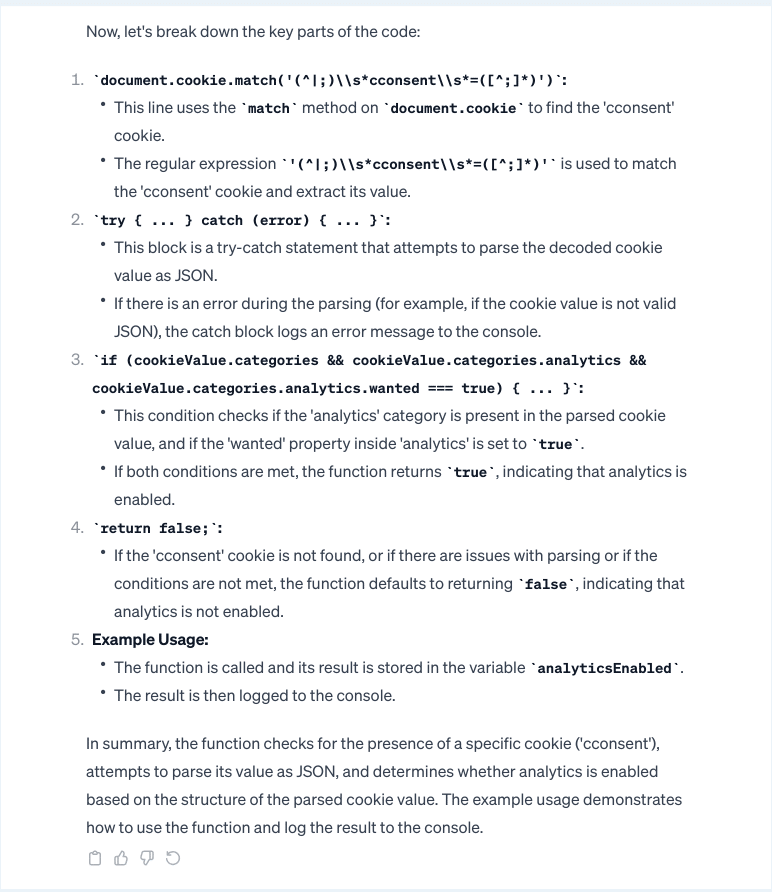
As I already mentioned, basic knowledge of Java Script is required for solving this type of task. Or, you can also always ask ChatGPT what the meaning of the code is.
Conclusion
In conclusion, incorporating ChatGPT into the day-to-day operations with Google Tag Manager or ReGex, offers a pragmatic and efficient solution for navigating the intricacies of data management. The synergy between human decision-making and artificial intelligence proves invaluable in tasks ranging from refining data structures to crafting intricate tags. This integration not only enhances workflow efficiency, but also positions itself as a forward-looking approach to adapting to the evolving dynamics of the digital landscape.