Safari Itp 2 1 How Does This Affect My Tracking
Management Summary
What effects does Safari ITP 2.1 have? Update?
After the cookie period has expired, users will no longer be recognized in Safari and will be counted as new users. The effect is greater the more users allow more than 7 days to pass between two visits. The update probably affects the website of a daily newspaper, whose users visit the website several times a week, less severely than a B2B website.
In Google Analytics, the following effects on data can be expected:
1. Impact on user-based metrics
- a higher oneShare of Safari users, as these are counted again and thus multiple times in Safari after the cookie expiry (however, the evaluation according to sessions is not affected by this)
- for the same reason: a higher oneProportion of new usersor a lower oneShare of returning users
- fewerSessions per user, as sessions in Safari are reassigned to new users after the cookie expiry of 7 days
2. Impact on user-based reports
- lesserCustomer Lifetime Value(LTV)
- lower historical data from 7 days onwardsCohort report
- in theAcquisition reports(last non direct), a larger proportion of conversions are attributed to the “Direct” marketing channel because they can no longer be attributed to a previous channel after the cookie term has expired
- in the Multi-Channel Funnel Report”Assisted conversions” fewer prepared conversions occur because the paths end after the cookie term expires
- for the same reason: in theAttribution reportingThis creates an undervaluation of marketing channels that cannot be assigned to the conversion path due to the expired cookie term
3. Impact on segments and audiences
Scenario: A Safari user buys a product for 500 euros. The same Safari user buys another product 10 days later for 600 euros. A remarketing campaign should target users who have generated at least 1,000 euros in sales.
Variant 1: If no further session took place between the two purchases, then the two purchases cannot be assigned to the same user because the cookie expires after 7 days of inactivity. The user is not included in the target group “with a turnover of at least 1,000 euros”.
Variant 2: If additional sessions have taken place between the two purchases, the cookie is renewed and the duration is reset in each of these sessions. In this case, both purchases can be assigned to one user. For this reason, the user is included in the target group.
What is the extent of ITP 2.1.?
The scope is currently limited to Safari users. In the D-A-CH region, around one in five users uses Safari. Detailed information is deliberately omitted here because the proportion varies depending on the company. It’s a good idea to check your web analytics tool’s browser report to see how many Safari users are on your website.
Another browser could soon follow suit, Firefox, which limits the cookie duration for client-side 1st party cookies to 7 days. About firstTestshas already been reported.
What can I do about it?
Option #1: Use the User ID feature
Users are identified via browser cookies, which are aClient IDsave. If a user deletes their cookies, they will receive a new client ID on their next visit and will be recorded as a new user. If a user changesBrowseror thatDevice, he receives a new client ID and is therefore not identified as the same user.
TheUser ID featureallows data from different devices and from different sessionsunique IDsto assign. For example, a login can be used to uniquely identify users across different devices.
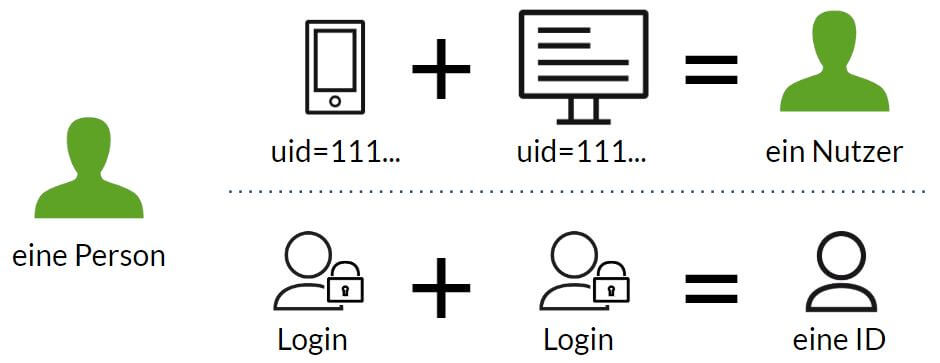
Safari users will receive a new one after the 7 day cookie period has expiredClient IDand will be discussed at the next meetingnewUser recorded. In the case ofUserIDAfter the 7 days, logged in users will continue to receive the same ID because they are identified via the login. Consequently, they are consideredrecurringUser recorded.
The prerequisite for the User ID feature is that there is an incentive for users to identify themselves – as in the case of login.
The User ID feature is limited to the User ID data view, which only contains data for access by users with User ID.
Option #2: Save client ID in local storage
If you use client-side 1st party cookies as before, the cookie lifespan in Safari is limited to 7 days. A longer cookie duration allows youlocal storage. However, local storage comes with the limitation that cross-subdomain tracking is not possible. If you just have a domain likee-dialog.groupand do not use subdomains like blog.e-dialog.at, this variant is suitable for you.
Option #3: Generate cookies on the server side
The cookie duration of 7 days in Safari only applies to cookies that are set with document.cookie – i.e. on the client side. A complex solution is to save the client ID with a server-side cookie. This requires a well-thought-out concept that enables a smooth changeover. Access to the web server and knowledge of backend programming are also required.
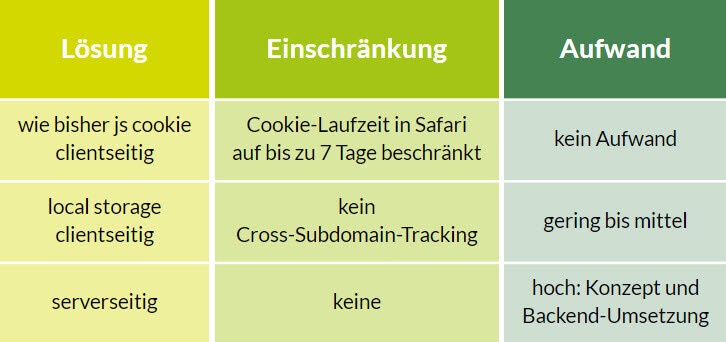
Here is an overview of the different solutions and the associated restrictions and effort: