Adpc 8211 The New Standard For Consent Management

Management Summary
status quo
You probably know it: as soon as you open any website, you are asked for your consent to tracking and analysis tools. This is usually done using a banner or pop-up and distracts from your actual goal – visiting the website. Some website operators even use so-called dark patterns to increase consent opt-in rates. This often makes it impossible for users to make an uninfluenced decision about their preferences. ADPC, short for “Advanced Data Protection Control”, is trying to get this challenge under control – with the aim of making cookie banners obsolete.
What can ADPC do?
ADPC makes it possible to specify a granular selection of tracking preferences in a user-friendly, uniform interface provided by a browser plugin. Furthermore, this information is requested from or exchanged with the websites visited using HTTP headers or JavaScript. There is already a prototype available for download on the project website, which can be used to try out how it works.
How does ADPC work?
For ADPC to work, two things are necessary. Firstly, the user’s browser must be able to process the standard – this is currently ensured by installing the prototype browser plugin. Second, the website must support and have implemented the standard. If this is not the case, the following message appears in the plugin: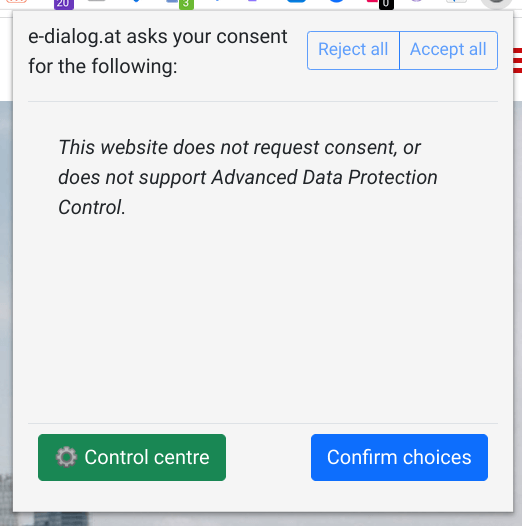 On a website that supports the standard, options for granular consent selection appear. ADPC supports three essential functions: request consent, give consent, revoke consent.
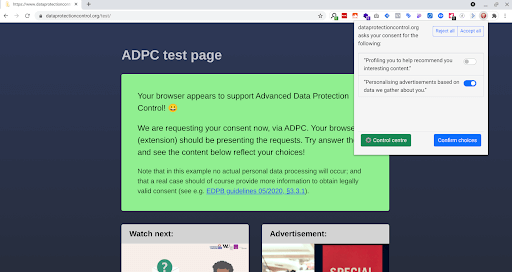
The functionalities described so far are very reminiscent of a “normal” consent banner, but what are the differences?
Difference to conventional consent banners
The biggest differentiator lies in the approach to how consent is managed. While a conventional banner offers the option of storing consent information for a website, thanks to ADPC it is possible to do this for several pages and sometimes even automatically. These settings are managed in the Control Center.
The prototype has an option to only be asked via a pop-up after a certain number of visits to a website. Furthermore, all previous decisions are stored centrally and can also be edited from here. A “whitelisting” option has already been announced for the future, which is equivalent to an automatic opt-in for a defined list of websites.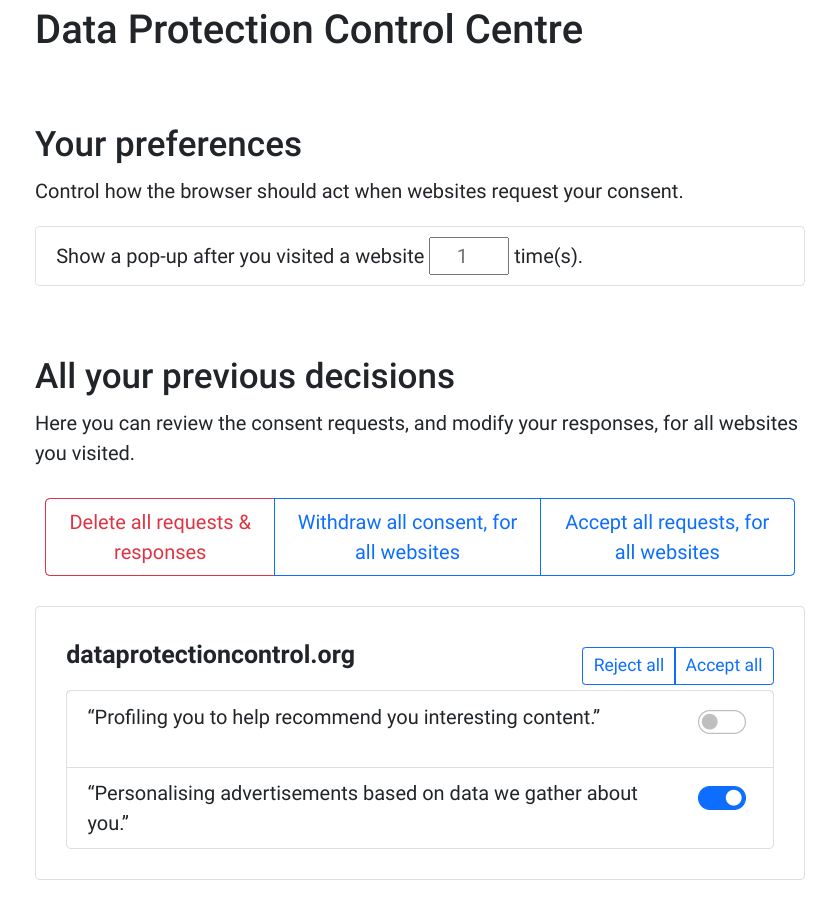
Conclusion
It is difficult to say at this point in time whether ADPC will be able to establish itself as the standard for consent management in the future. A critical factor is how many website operators implement the standard on their sites and whether existing consent management platforms (CMP) integrate this standard into their own solutions. The latter is not intended to be replaced by ADPC, but rather expanded – with the aim of making consent management more fluid and problem-free overall. This process could be accelerated by new legal frameworks.
Further information:
Project website including prototypeADPC specificationsArticle by noyb