Audience Management 8211 Use Your Companys Data Treasure For Personalization

Management Summary
Targeted audience management is one of the levers for success for campaigns – or larger, for the entire company. But let’s start from the beginning.
Your company’s data treasure
Companies – be they large or small – are sitting on a more or less large treasure trove of data. They collect data from their customers via various data sources (CRM, email marketing, web analysis, ad server). This leads us to the first, and if not the most important, point in audience management. Data must be collected in a targeted, structured, clean and central manner. This is the be-all and end-all for successful audience management, otherwise it will be difficult, if not impossible, to carry out AM. The data forms the basis for all future steps.
Form segments – recognize patterns in the data
After collecting and processing the data, the analysis begins. The analysis is intended to identify certain patterns in order to be able to draw conclusions based on them. The data can be sampled manually or using artificial intelligence. For example, statistical relationships between certain customer segments and purchase or churn probabilities can be calculated. And now we are in the middle of audience management. The first thing to do is to use the data to create segments with certain properties that have characteristics that distinguish them from other segments. These can subsequently be used as audience lists. The lists are further “pushed” into various tools to make them usable in campaign management. For example, an audience can be created in GA360, a data management platform (DMP) or directly in a demand-side platform (DSP) such as Display and Video 360. Proper documentation should be a given here to ensure traceability for other people.
Use segments – but please do so based on data
You then have to think about how you want to deal with these segments. This decision should not simply be made based on gut feeling, but should also have a data-based basis.
An example: segment – bouncer of a website
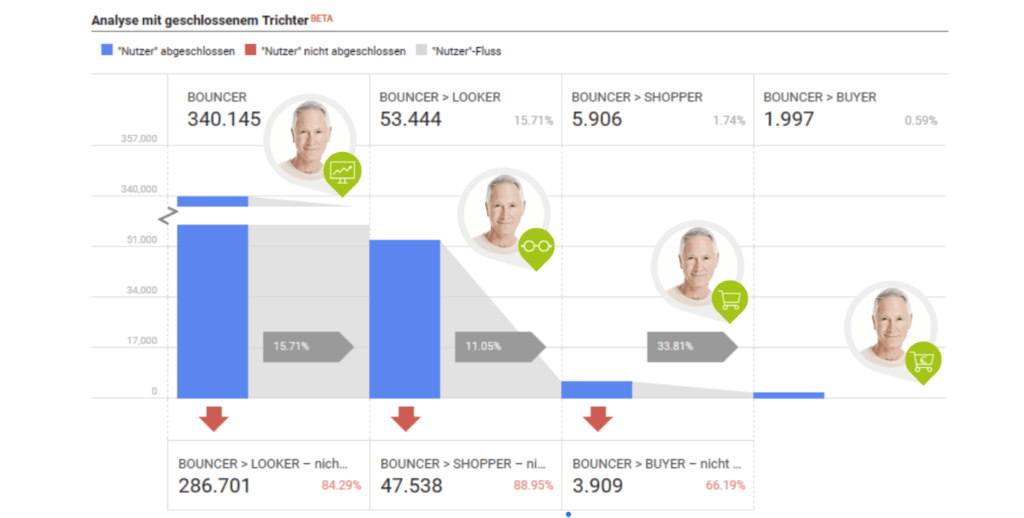
This data analysis shows that bouncers are an extremely weak remarketing segment in terms of conversion generation. Do we now want to completely remove this segment from our campaign concept? The answer is: no! Although we don’t consider the bouncer to be as valuable as other remarketing segments (e.g. shopping cart abandoners), we don’t want to do without it completely either! Because we also saw in the analysis that a significant proportion of the bouncers later convert to buyers. That’s why we deal with it differently in campaign management and subsequently adapt, among other things, messages, the amount of money used and the frequency cap for the bouncer (unlike, for example, a shopping cart abandoner).
Audience management for a uniform campaign concept
And so the circle closes in terms of personalization: Once we have formed segments from our data pool after extensive analysis and defined how we want to deal with them, appropriate measures must also be taken in order to be able to respond to these segments and the associated characteristics in the most targeted way possible. In other words, the work doesn’t stop when the segments are formed. This is where it really begins – at least for the campaign managers ;) You have to constantly test segments, including adapted messages, bidding strategies and frequency caps. Let’s use the technical possibilities and look at the various features of the segments in campaign management! This allows us to get the most out of the advertising dollars we spend. Dynamic advertising materials, for example, make it child’s play to create x variants for different audiences. A uniform campaign concept (banners etc.) without taking the various segments into account would ruin the best audience management.
Summary
In summary, audience management starts with intelligent segmentation of data. These segments are pushed further in the form of audience lists in campaign tools such as Display and Video 360 and thus made usable. By combining differentiated target group lists and campaign concepts based on them, we manage to increase the success of a campaign through data-supported personalization.