Checkout Insights through Multi-Funnel Analysis

Management Summary
The Limitations of Traditional Checkout Funnels
Checkout funnels are among the central tools for analyzing and optimizing user behavior in e-commerce. They provide a structured overview of how many users remain or drop off at each stage of the purchase process. At first glance, they seem to be an indispensable basis for data-driven optimizations – however, a closer look reveals significant weaknesses.
The reality of user behavior is more complex than a single linear funnel can depict. While traditional funnel representations aim to illustrate an idealized process, the actual user flow is often significantly more diverse: users jump between pages, skip steps, or return later to continue their checkout. This dynamic means that simple funnels overlook important aspects of user interaction – with far-reaching consequences for the quality of the analysis.
-
01
Problem 1: Skipped Steps and Incorrect Drop-Offs
A core problem lies in the rigid structure of traditional funnel representations. In Google Analytics 4 (GA4), for example, any step skipped by a user is counted as a drop-off – regardless of whether the checkout is successfully completed later. Imagine a user skipping a voluntary registration page and proceeding directly to enter payment details. For the funnel, this means a supposed abandonment, even though the user remains in the checkout process. Such misinterpretations distort the data basis and make it difficult to identify actual problem areas.
-
02
Problem 2: Simplification Leads to Loss of Information
To avoid the problem of incorrect drop-offs, many companies reduce their funnels to a minimum number of steps. For example, they focus only on essential phases such as the shopping cart, payment information, and order completion. While this partially solves the problem of incorrect abandonments, it comes with a significant loss of detail: Which pages do users interact with? Where do difficulties arise? Which optional offers, such as a discount code field, influence the conversion rate? Such questions remain unanswered.
-
03
Problem 3: No Representation of Real User Flows
Simple funnel representations provide a highly simplified picture of reality and neglect the diversity of possible checkout paths. Users have different needs and behavioral patterns: some thoroughly review their options, while others prefer a quick, direct purchase. This variety cannot be captured by a single general funnel, which means important insights remain hidden.
A Solution: The Multi-Funnel Approach
To adequately represent the complexity of modern checkout processes, a more flexible analytical approach is needed: the multi-funnel approach. Instead of relying on a single universal funnel, multiple specific funnels are defined, each mapping different user flows and behavioral patterns. These granular funnels enable more precise analysis by specifically illustrating the various paths users can take during checkout.
The multi-funnel approach requires careful preparation: it is necessary to identify all potential paths users can take during checkout. From users who register, for example, to those who proceed directly as guests – each path is mapped in a separate funnel. This allows for a differentiated analysis without distorting the data due to skipped steps. This way, real drop-offs can be reliably identified, while alternative behavioral patterns that also lead to success become visible.
This approach not only provides a more realistic representation of user behavior but also delivers deeper insights for optimization. Companies can precisely understand which paths are particularly successful and where users actually encounter obstacles. The multi-funnel approach thus transforms the abstract picture of a single funnel into a dynamic map of user flows – an indispensable basis for data-driven decisions.
Implementing Multi-Funnel Analysis in GA4
Importance of Detailed Planning for the Multi-Funnel Approach
A precise outline of user flows is the basis for successful multi-funnel analysis. Only through detailed planning can the diverse behavioral patterns of users be realistically mapped and valuable insights for checkout optimization be gained.
Strategies for Identifying Different User Flows
-
01
Using Historical Data from GA4
Analyzing historical data in GA4 provides valuable insights into typical user paths. Through segmentation and exploration, recurring patterns and exceptions can be identified, serving as a basis for funnel definition. This can be practically represented using Path Exploration Reports, which provide an overview of event sequences.
-
02
Analysis of Typical User Behavior Patterns in the Checkout Process
Observations of common behavioral patterns, such as jumping between pages or skipping optional steps, help to outline relevant user flows. Special attention should be paid to critical drop-off points and their causes.
-
03
Workshops with Stakeholders to Define All Possible Paths
Involving stakeholders – such as from product management, marketing, or UX – ensures a holistic perspective. In workshops, all potential paths users could take during checkout can be systematically developed and validated.
Execution and Visualization Using a Hypothetical Example
Defining the Different Funnels
This chapter illustrates an example to clarify the procedure. A webshop with four different checkout options is assumed. This is a simplification – real examples can be more complicated and show further nuances. The art lies in reasonably consolidating these nuances.
For our example, the following four checkout paths were identified. Uncolored events represent steps that must always be completed, regardless of the user flow. Colored events are only necessarily completed within their respective user flow or funnel.
1. Guest Order

2. Registration/Login During Checkout

3. Logged In

4. Logged In + Address and Payment Information Stored in Account
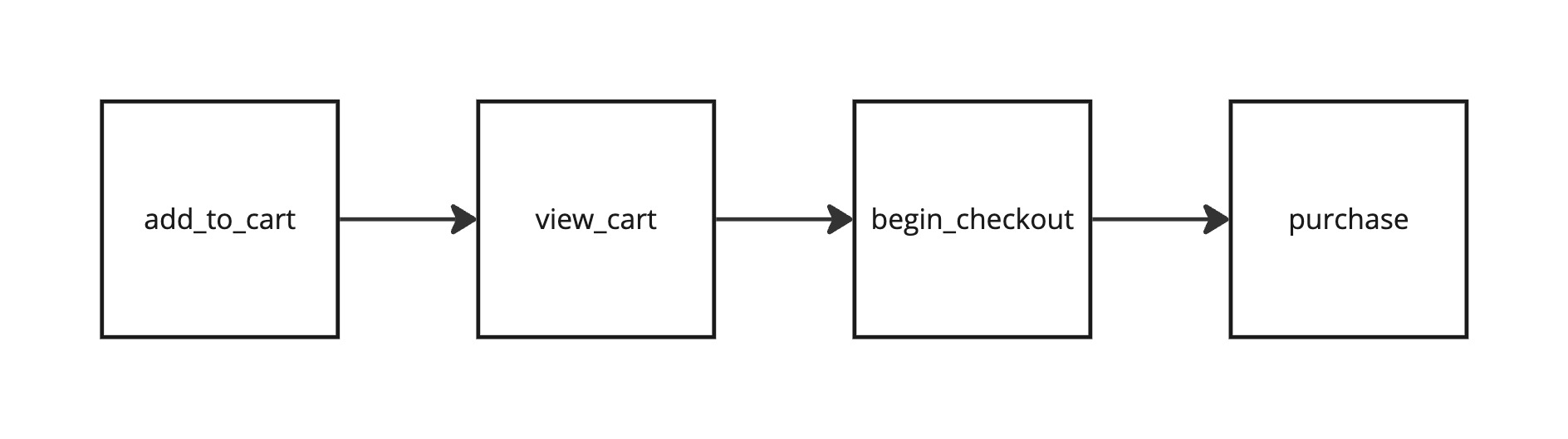
Note on Funnels 1 and 3: The pure event sequence does not differ here in the example. However, there is a hypothetical assumption that different behavior of the two groups could be observed, and therefore a split is considered useful. Whether this is considered useful in a productive application must be decided on a case-by-case basis.
Definition of Filters and Segments in GA4 Explore Reports
The following describes a definition of filters and segments using GA4 Exploration Reports. It is assumed that creating reports with GA4 Explore Reports is familiar. It is important to know that funnel exploration in GA4 is user-scoped. Thus, cross-session events are also counted in the funnel.
The funnel events capture a user_status parameter. Funnel steps are defined as follows:
- Event Name = add_to_cart; user_status = guest
- Event Name = view_cart; user_status = guest
- Event Name = begin_checkout; user_status = guest
After the begin_checkout event, there is the option to log in or proceed with the order as a guest. The light and dark gray areas in the following visualization symbolically represent quantities between logged-in and non-logged-in users.
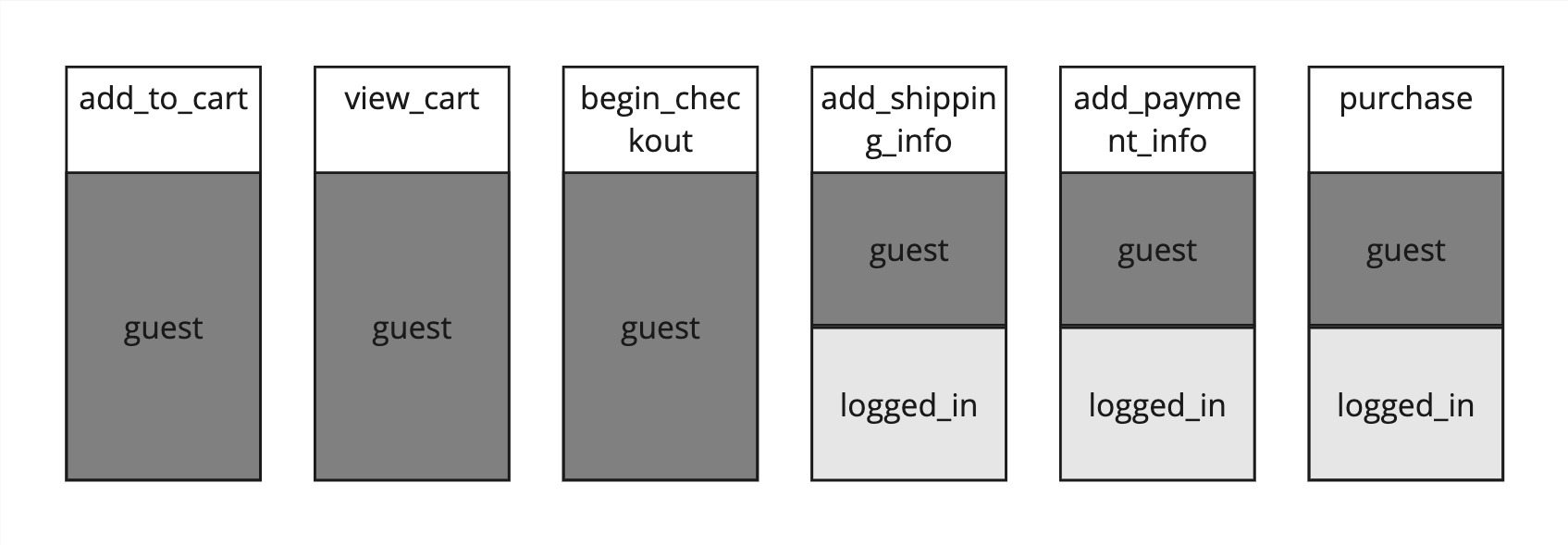
The visualization clarifies the following: Applying simple event filters (user_status = guest) to each event in the sequence will create an artificial drop-off between begin_checkout and add_shipping_info. The reason for this: The potential number of users between add_to_cart and begin_checkout is different from the potential number of users between add_shipping_info and purchase. The explanation: The potential number of users here refers to the maximum number of users that can be reached in a funnel step. Logically, this is set by the conditions of the first event – thus, the potential number of users is equal to the number of users at the add_to_cart event and user_status = guest. The following funnel steps must be defined so that this number remains constant in a hypothetically perfect funnel (0% drop-off). From the visualization, it is clear that this is not the case from add_shipping_info onwards. Even with 0% drop-off, add_shipping_info would generate fewer users than begin_checkout, because from that point users who were not previously logged in could be logged in again and would be filtered out. Therefore, an artificial drop-off is to be expected here, which is not meaningful and does not suggest any need for action. To avoid this, the consistency of potential users must be maintained across all funnel steps.
The visualization clarifies that for events from add_shipping_info onwards, simple event filters are no longer sufficient, as otherwise a distorted representation of the funnel would result. This creates an artificial drop-off between begin_checkout and add_shipping_info, due to the fact that the potential number of users between add_to_cart and begin_checkout is different from the potential number of users between add_shipping_info and purchase. In the latter case, logged-in users who were previously counted as guests in the funnel would be filtered out. The drop-off between begin_checkout and add_shipping_info thus does not represent a valuable insight and does not suggest any need for action.
A correction of the representation is achieved through segmentation. By segmenting the steps from add_shipping_info to purchase by user_status = guest, consistency of potential users is achieved. The following visualization clarifies this:
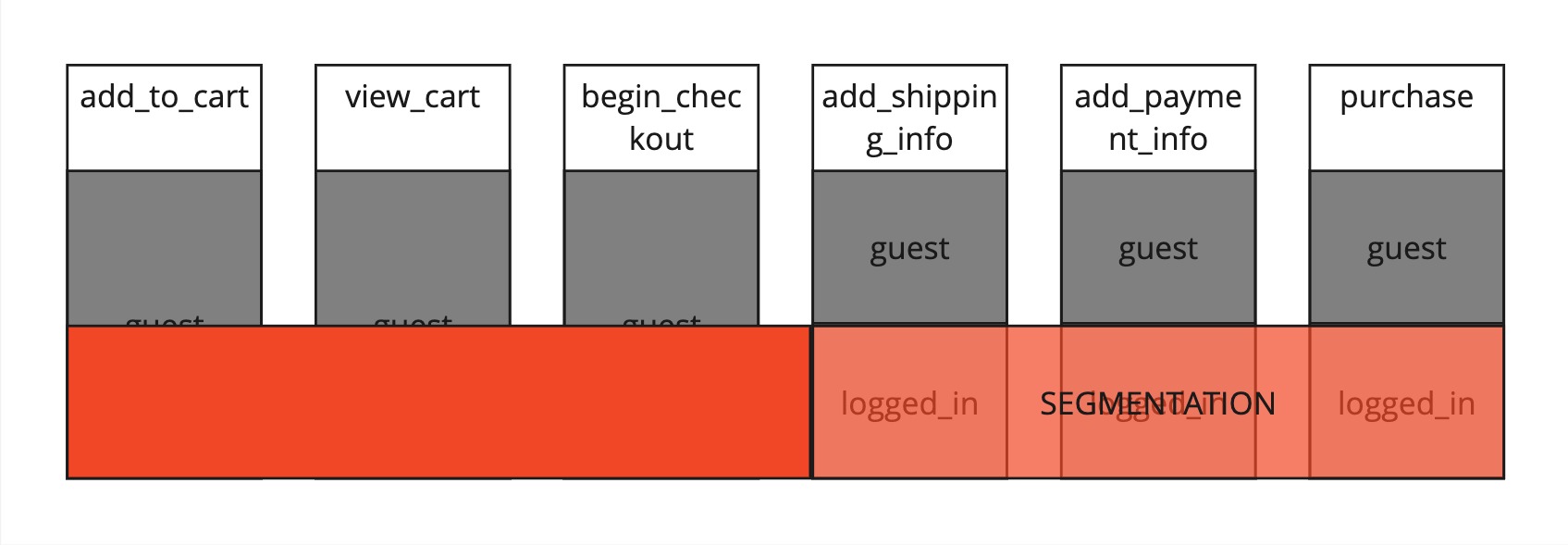
Segmentation is based on the following rules:
- The segment is session-based and, compared to the funnel itself, not user-based. This is to keep users in the funnel who may have triggered add_shipping_info and add_payment_info via user_status = logged_in, but still completed the funnel as a guest at another time.
- The “Exclude Sessions when” rule is applied. An Include filter would render the funnel obsolete, as sessions with only preceding events (e.g., before the purchase) would no longer be counted.
- In the Exclude rule, the events add_shipping_info, add_payment_info, and purchase are linked by an “OR” condition.
- All three events must additionally meet the condition user_status = logged_in for the Exclude filter to apply.
Ensuring Data Quality
From the preceding explanations, an important principle emerges that must be met to instill confidence in the displayed data: consistency of potential users. The potential user count across all funnel steps must remain constant, otherwise distorted drop-offs will occur.
Another way to verify the data is to compare it with absolute numbers. To stick with the executed funnel: According to its definition and the definitions of the other funnels, this funnel must map all purchases made as a guest. Thus, a comparison can be made between the user count of the last funnel step and the total user count of all events where Event Name = purchase and user_status = guest. These must match. If this is not the case, it can be assumed that the funnel rules were created incorrectly or that events were implemented incorrectly.
It is also advisable to create a “General Funnel”. This consists of the steps that must always be completed, regardless of the user flow. In this scenario, these would be: add_to_cart, view_cart, begin_checkout, and purchase. 100% of users enter these. A breakdown by user_status, for example, allows for further verification of the granular funnels.
User recognition must also be mentioned. User breaks cause a distortion of the funnel if a break occurs between two funnel steps. This can be checked by opening the funnel. There is an option “Make open Funnel” in the Explore Reports for this. A relatively high number of entries into the middle funnel steps indicates frequent user breaks. The quality of user recognition can be somewhat improved by various technologies such as server-side tracking or First Party Mode.
Inaccuracies
Of course, certain inaccuracies arise, primarily from the creation of funnel rules and segments, but also from potentially faulty event implementations. Therefore, the comparisons with a “General Funnel” or absolute metrics listed in the previous chapter are essential. These comparisons should not exceed a tolerable degree of inaccuracy, whereby the measure for “tolerable” can be individual. A precise formulation of user flows is also essential. The more conscientiously this is done, the fewer inaccuracies applied filters and segments will generate.
Conclusion
When correctly implemented, the multi-funnel approach significantly increases the potential for analysis and allows hypothesis-driven analyses and checkout optimizations to be elevated to a new level. We are happy to provide consulting and implementation services for any realization.