Customer Match In Dv360 8211 Similar Audiences Without Cookies

Management Summary
Customer Match is a function within the Google Marketing Platform (GMP) that has been around for a few years. The process has been improved by Google during this time and now offers user-friendly upload options using APIs. This blog article provides an introduction to the topic.
What is Customer Match and how does it work?
Customer Match is a feature in which 1st party data is uploaded to DV360 from people who have directly interacted with your company online and offline. These can be, for example, existing customers or newsletter subscribers.
This data upload enables 2 things:
- Those people who are part of this 1st Party Audience list can be directly addressed in advertising campaigns or excluded.Classic remarketing audience lists are based on cookies. Due to the elimination of cookies, the audience lists and the number of users that can be addressed in advertising campaigns will also shrink. With Customer Match I have an opportunity to expand my pool of remarketing users.
- These uploaded1st party data canin a scalable and privacy-focused mannercan be matched with registered Google users and thus enable new users to be addressed who have similar interests (match). These matched users are collected as a customer match list and, based on this, a similar audience list is generated (users with similar interests and behaviors). These can be addressed directly in advertising campaigns. In contrast to classic Similar Audiences, these lists work without cookies.
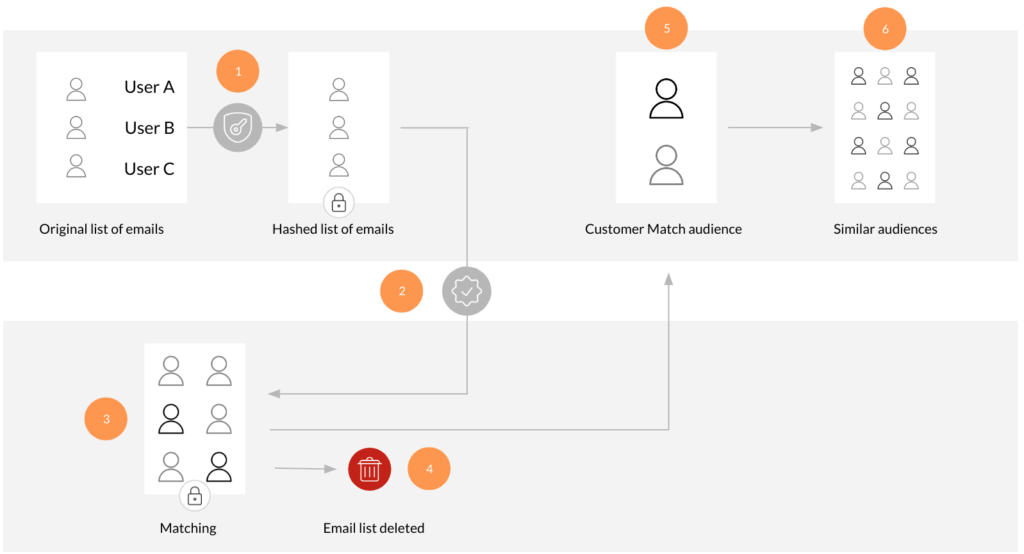 Customer Match Upload Process in DV360, Source: e-dialog
Is this even data protection compliant?
At this point, some are probably wondering whether this is even compliant with data protection regulations – after all, customer data is uploaded to DV360.
Of course, no clear data (information that is stored about a specific natural person) will be transmitted. The uploaded data is first “hashed” – in other words – encrypted and anonymized. This encryption makes it impossible for third parties to determine the original data. After the data has been encrypted, the matching process is carried out and the customer match list is generated. The originally uploaded 1st party data will be deleted immediately.
Unfortunately, in the past it was only possible to upload the 1st party data to DV360 manually. This process was quite problematic because many companies do not carry out DV360 campaign management in-house, but outsource it to agencies. The sensitive data therefore first had to be transmitted to the agency so that it could upload it. There is also the aspect that customer match lists should be updated regularly (approx. every 2-3 months). This process was therefore unsustainable for some companies, which is why Customer Match was rarely implemented.
Google has since revised and improved this process. In addition to the manual upload, it is nowpossible, theDatadirectly as a companyupload to DV360 via API. Be available
- the free DV360 API (you can find more informationhere)
- or a Customer Match Uploader API (CMU API) from other providers.Hereyou will find a list of the CMU providers that are currently integrated into DV360.
You can find out more about how Google and how the Google Marketing Platform (GMP) uses customer match datahereread up.
Which 1st party data can/should be uploaded?
Customer Match is based on persistent identifiers. These can be email addresses, telephone numbers or physical addresses.
When this data is uploaded via manual DV360 upload, DV360 automatically hashes the existing data.
For example, if the DV360 API is used, the sensitive data must first be hashed using the SHA256 algorithm.
What limitations need to be taken into account?
- The maximum number of users per audience list is 5 million users
- Customer Match lists are not compatible with HTML5 or rich media creatives if the list is targeted inclusively. Only display, image, standard video, GIF, native, and audio creatives can be used. However, this restriction does not apply to Similar Audiences that are based on the Customer Match lists or if the Customer Match list is exclusively targeted.
- Synchronization between Campaign Manager 360 and DV360 is required.
In addition to the limitations stated, it is also a prerequisite that there have been no violations of Google guidelines or payment problems in the DV360 account used. Details of the guidelines can be found here.
Conclusion
The post-cookie age is forcing us all to look at alternative targeting options that do not rely on cookies. Customer Match is a possible option, which Google also offers us other platforms such as Meta in order to best address our target group, be it existing customers or new users. The upload process is now much more user-friendly for advertisers and nothing stands in the way of an initial test of Customer Match.