Effective tracking in international and multilingual markets

Management Summary
Companies operating globally or in countries with multiple official languages face the challenge of accurately capturing language preferences and user behavior. Language-specific tracking helps companies better understand local markets, improve the user experience, and tailor marketing campaigns and content in a targeted manner.
Why is tracking multilingual websites crucial?
Tracking multilingual websites brings both challenges and immense opportunities. It is the key to better understanding the needs of local markets and the individual preferences of users. These insights enable well-founded decisions in the areas of business development, marketing, and technical implementation.
-
01
Business perspective
For business decision-makers, multilingual tracking offers valuable insights to compare the performance of different regions at a high level. Growth potential in new markets and regions can thus be identified more easily. Data on revenue, user interactions, and customer loyalty support strategic decisions for international expansion and drive data-driven growth.
-
02
Marketing perspective
Marketing teams benefit from the ability to analyze user behavior in different regions in detail. This allows for the development of targeted campaigns that are perfectly aligned with the linguistic and cultural preferences of the target groups. This leads to more targeted personalization and more effective content optimization. Conversion rates increase, while the effectiveness of A/B testing is significantly improved. At the same time, tracking enables a more efficient distribution of marketing budgets.
-
03
Developer perspective
For developers, implementing a tracking system for multilingual websites is a demanding but crucial task. It involves ensuring that language versions and regionally specific data are accurately recorded. Clean technical implementation guarantees not only the reliability of the collected data but also a consistent user experience across all language versions.
Multilingual tracking: An overview of Who, What, How, When, and Where
Who?
Companies with an international target audience or those operating in multilingual countries.
What?
The precise recording and analysis of user behavior based on language groups.
How?
With tracking tools like GA4, GTM, and BigQuery, data can be filtered by language and optimized in a targeted manner.
When?
Implementable immediately, especially after the introduction or expansion of multilingual content.
Where?
On international and/or multilingual websites, in app analytics, and anywhere language influences the user experience.
Two scenarios for the success of international and multilingual websites
The following describes two central scenarios in which language-specific tracking can significantly influence the success of your international and multilingual website:
1. International
Companies with a global focus must closely monitor user behavior in individual target markets to tailor their content and marketing strategies. Language-specific tracking allows for the analysis of performance in different language regions, local targeting of campaigns, and the creation of an improved user experience.
Example:
A company operating in Germany and France can use language-specific tracking to capture local preferences such as preferred payment methods or user journeys. In Germany, purchase on account might dominate, while in France, credit cards or mobile payment methods are preferred. Tailoring the checkout process to these preferences can maximize conversion rates in both countries.
2. Multiple languages in one country
In countries with several official languages—such as Switzerland, Belgium, or Canada—companies must ensure that different language groups are addressed specifically. Even within a country, different language versions can be crucial for effectively reaching local target groups. Language-specific tracking helps to understand the behavior and preferences of the respective language regions and to make adjustments.
🇨🇭 Switzerland: A prime example of multilingual tracking
Switzerland, with its four national languages (German, French, Italian, and Romansh), exemplifies how important precise tracking is. Differences in the preferences of German-speaking Switzerland, French-speaking Switzerland, and Ticino require targeted adjustments in design and functionality.
Example:
Although mobile payments are gaining popularity throughout Switzerland, German-speaking Swiss users often prefer cash purchases or purchase on account, while users in French-speaking and Italian-speaking Switzerland prefer mobile payment solutions like TWINT. Through language-specific tracking, such differences can be identified and the checkout process optimized for each region.
Measures:
User Experience (UX) Optimization
A primary goal of language-specific tracking is to improve the user experience. Companies should check whether users are automatically shown the correct language version or whether manual language switching occurs frequently. A high switching rate indicates that the automatic language selection needs to be optimized.
Example:
In German-speaking Switzerland, the call-to-action “Jetzt bestellen” will work well, while in French-speaking Switzerland, “Commandez maintenant” is more direct and effective. A/B tests help to identify these differences and optimally localize content.
Localized content and A/B testing
Different language groups react differently to content such as text, images, or calls-to-action. A/B tests are an effective means of finding out which variants perform best in the respective language regions.
Example:
A call-to-action like “Jetzt bestellen” could achieve higher conversions in German-speaking Switzerland, while “Commandez maintenant” is more successful in French-speaking Switzerland. With A/B tests, such differences can be specifically tested and content optimized accordingly.
Language-specific tracking is an indispensable instrument for sustainably increasing the performance of multilingual websites. With Google Analytics 4 (GA4), Google Tag Manager (GTM), and BigQuery (BQ), powerful tools are available to significantly increase the success of multilingual websites, perform effective analyses, and make data-driven decisions.
Multilingual tracking: Technical implementation
The technical implementation involves several steps and tools to ensure that language preferences are correctly recorded and analyzed. The following presents the most important methods and tools for implementation:
Tool-based – Achieving precise results with GA4, GTM, and BigQuery

Google Analytics 4 (GA4): Standardized recording of language data
Google Analytics 4 offers a simple way to capture and analyze language data through custom dimensions. These dimensions can be used for detailed reporting and segmentation.
Basic functions
- Event-based tracking: Relevant user interactions (e.g., clicks, downloads, forms) can be recorded as events and analyzed specifically by language.
- Cross-domain tracking: If language versions are operated on separate domains, GA4 enables seamless tracking of the customer journey across all domains.
- Language report: Standard reports provide an overview of the distribution of language preferences. Here, automatically captured dimensions such as “language” and “language code” are used to represent the user’s language.
Advanced functions
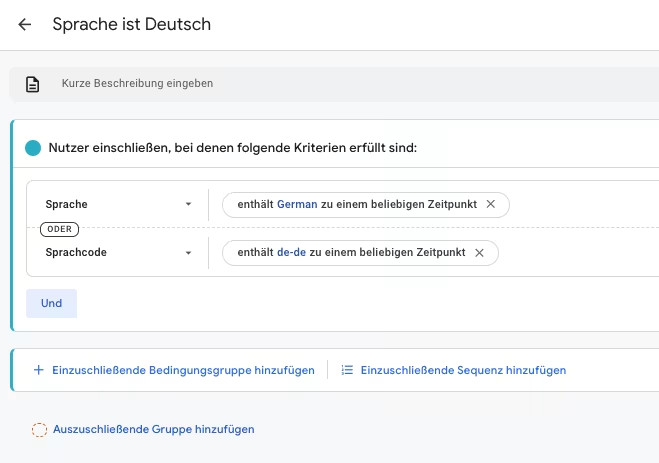
- Custom dimensions: Add custom dimensions like “language_company or websitename” to make specific language information, such as data captured via geolocation or the user account, visible in GA4 reports.
- Filters, segments, comparisons: Create filters, language-specific segments, or comparisons to analyze the behavior of different user groups in a targeted manner.
- Custom reports: Create individual (Explore) reports to continuously monitor the most important KPIs for each language.
Google Tag Manager (GTM): Flexible data collection and language selection
Google Tag Manager enables flexible recording and passing of language data via variables, ensuring that the correct language version of the website is loaded.
Basic functions:
- Flexible tag firing: Tags can be controlled specifically by language, so that, for example, different conversion tracking codes can be used for different language versions.
- Individual tracking solutions: Develop tailor-made tracking solutions that meet the requirements of a multilingual website.
- Language-specific variables in GTM: Define variables that capture the language of the current page and are used in triggers and tags to adjust tracking and enrich data.
Advanced functions:
- Browser language: Capture the preferred browser language of users and transmit it to GA4.
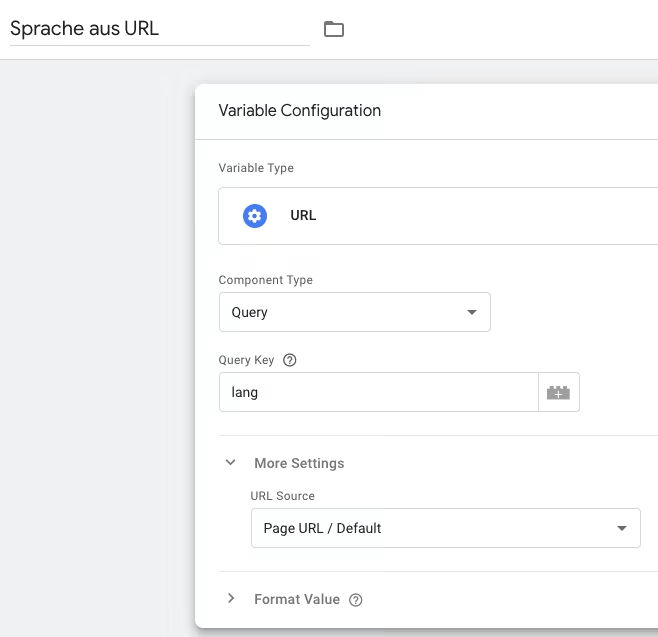
- URL parameters: Extract language codes directly from the URLs (e.g., /de/, ?lang=fr) using variables in GTM.
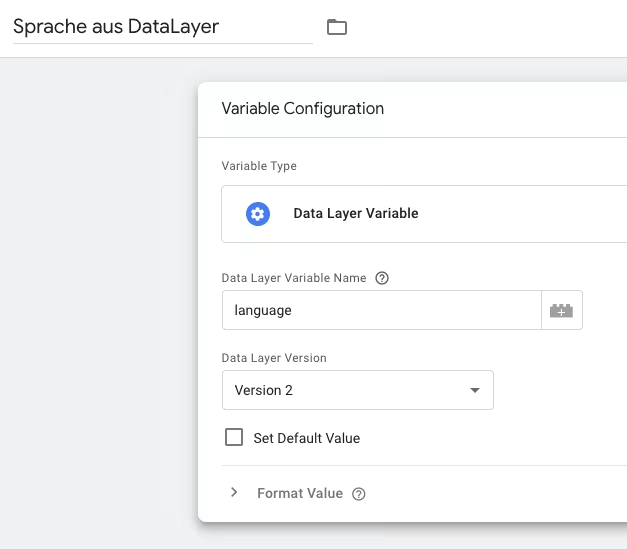
- Data Layer: Language information stored in the Content Management System (CMS) (e.g., language: ‘fr’) is best transmitted to GTM via the DataLayer.

BigQuery (BQ): Granular analysis for deeper insights
BigQuery enables an in-depth analysis of language data exported from GA4. This allows for detailed insights into user behavior in different language regions.
Basic functions:
- Detailed analyses: Export GA4 data to BigQuery to perform deeper analyses and answer complex questions.
- Data integration: Combine website data with other sources (e.g., CRM, marketing automation) to obtain a holistic view of customers.
- Machine learning: Utilize BigQuery’s machine learning capabilities to identify patterns in user behavior and make predictions.
Advanced functions:
- Regional language trends: Analyze how language usage differs in different regions of a country, e.g., between German and French speakers in Switzerland.
Simple example analysis:
SQL query to calculate the conversion rate (purchase_conversion_rate) as a ratio of purchases to all events for each language. Additional columns for the number of purchase events and the total number of all events for each language help in interpreting the result.
SELECT

  event_params.value.string_value AS language,

  COUNTIF(event_name = 'purchase') AS total_purchases,

  COUNT(*) AS total_events,

  SAFE_DIVIDE(COUNTIF(event_name = 'purchase'), COUNT(*)) AS purchase_conversion_rate

FROM

  `project.analytics_123456789.events_*`

WHERE

  event_params.key = 'language'

  AND event_params.value.string_value IS NOT NULL

  AND event_name IN ('purchase', 'other_relevant_events')

  -- Bei Bedarf Zeitraumbeschränkung,um Kosten zu sparen,wenn die Tabelle

     partitioniert ist,z.B.mit täglichen Daten

  -- AND _TABLE_SUFFIX BETWEEN '20240101' AND '20240131' -- Optional

 GROUP BY

  language

-- Bei Bedarf sortieren, um Kosten zu sparen

-- ORDER BY purchase_conversion_rate DESC -- Optional
Automated – Various methods for an optimized user experience
Geolocation-based language selection
How it works:
Geolocation technology can be used to analyze a user’s IP address to determine their geographic location and automatically display the appropriate language based on the country of origin.
Example:
A user from Zurich is automatically served the German version, while a user from Geneva is served the French version of the website.
🧰 Technical implementation:
Use APIs such as MaxMind GeoIP, ipstack, or the Google Maps Geolocation API to determine the location and adjust the language.
Advantage:
Ideal for countries with clear geographic assignment of languages.
Disadvantage:
In countries with multiple language regions (e.g., Switzerland, Belgium), geolocation may not always be precise enough, especially in border regions.
Language preferences from the user account
How it works:
For registered users, the preferred language can be stored in the user profile. Upon the next login, the preferred language version is automatically displayed.
🧰 Technical implementation:
The language field in the user account should be linked to the underlying database to automatically load the preferred language at each login.
Advantage:
Perfect for returning users and content personalization.
Disadvantage:
This method is only available for registered users.
Language selection based on operating system or app language
How it works:
For mobile devices or Progressive Web Apps (PWAs), the language setting of the device or operating system is automatically read and used.
Example:
An iPhone user with French language settings automatically receives the French version of the app or website.
🧰 Technical implementation:
Use the navigator.language property in JavaScript or the corresponding APIs for iOS/Android to determine the device language and display the correct version.
Advantage:
User-friendly and fast, as the device language is usually set correctly.
Disadvantage:
If multiple languages are activated on a device, the detection may not always correspond to the user’s actual preferences.
Machine learning for personalized language selection
How it works:
Utilize machine learning to analyze user behavior (e.g., interactions, location, preferred pages) and automatically suggest the preferred language.
Example:
A user who regularly visits the French version of the website will be redirected directly to the French version on subsequent visits.
🧰 Technical implementation:
Train a model with user data from tracking tools (e.g., GA4 or BigQuery) and implement it using tools like VertexAI or TensorFlow to enable personalized language selection and/or language-specific recommendations.
Advantage:
Very precise and flexible, as it relies on individual user behavior.
Disadvantage:
Requires initial setup effort and data protection measures during data collection.
The combination of GA4, GTM, and BigQuery enables precise recording and analysis of language data. With various methods for automating language selection—such as geolocation, machine learning, or the user account—it can be ensured that users are always shown the appropriate language version of the website.
Optimizing language selection: Best practices and additional tips
Best practices for effective language selection
A hybrid solution that combines different approaches usually offers the best user experience and provides valuable insights for continuous optimization.
- Standardized browser language: The language version based on the user’s browser language should be stored in a standardized way, for example via the “language” parameter in GA4.
- Save manual language selection: The language manually selected by the user on the website should be stored in a cookie. This facilitates future visits for the user (preferred language is automatically loaded) and provides further insights, e.g., if the browser language differs from the manually selected language.
- Language preference in the user account: For registered users, the preferred language should be stored in the account and automatically loaded upon login.
- Use geolocation data: If available, geolocation data should be used as a secondary factor to determine the correct language version.
Additional tips
-
01
Language & Hreflang tags
Used language and hreflang tags inform search engines about the different language versions of the website and help optimize the SEO strategy.
-
02
Uniform tracking concept
A well-thought-out, uniform tracking concept—adapting the naming of events and other tracking elements to the respective language, or to the main language, e.g., for centrally managed marketing—facilitates analysis and evaluation and is the foundation for data-based decisions in multilingual markets.
-
03
Observe data protection
Attention should be paid to data protection regulations in different countries or for different language groups to meet legal requirements.
Final conclusion
The precise recording and analysis of language data on multilingual websites is a central success factor for companies operating internationally or in multilingual countries. Through the targeted use of tools such as Google Analytics 4, Google Tag Manager, and BigQuery, user behavior can be efficiently recorded and evaluated. This enables continuous optimization of the user experience, the adjustment of marketing campaigns, and better localization of content. Especially for companies in multilingual regions like Switzerland, language-specific tracking represents a competitive advantage by helping to understand the needs of different language groups and offering tailored and more personalized solutions.