From Data Science To Cloud Engineering 8211 The Professional World Of Datadriven Advertising

Management Summary
Data science
Data science developed from thestatistical modeling and data analysisand is strongly rooted in disciplines such as mathematics, statistics, advanced analysis and machine learning. The interdisciplinary field uses scientifically based methods, processes, algorithms and systems to extract insights, patterns and conclusions from both structured and unstructured data.
Data Science is focused on extracting useful information from data sets!
The tasks of the data scientist
The data scientist translates economic questions into the language of computer science and mathematics. Useful information is extracted from composite data sets using machine learning and predictive analysis. The statements serve as insights or predictions and are a decision-making aid or basis for important business issues.
Core competencies of a data scientist
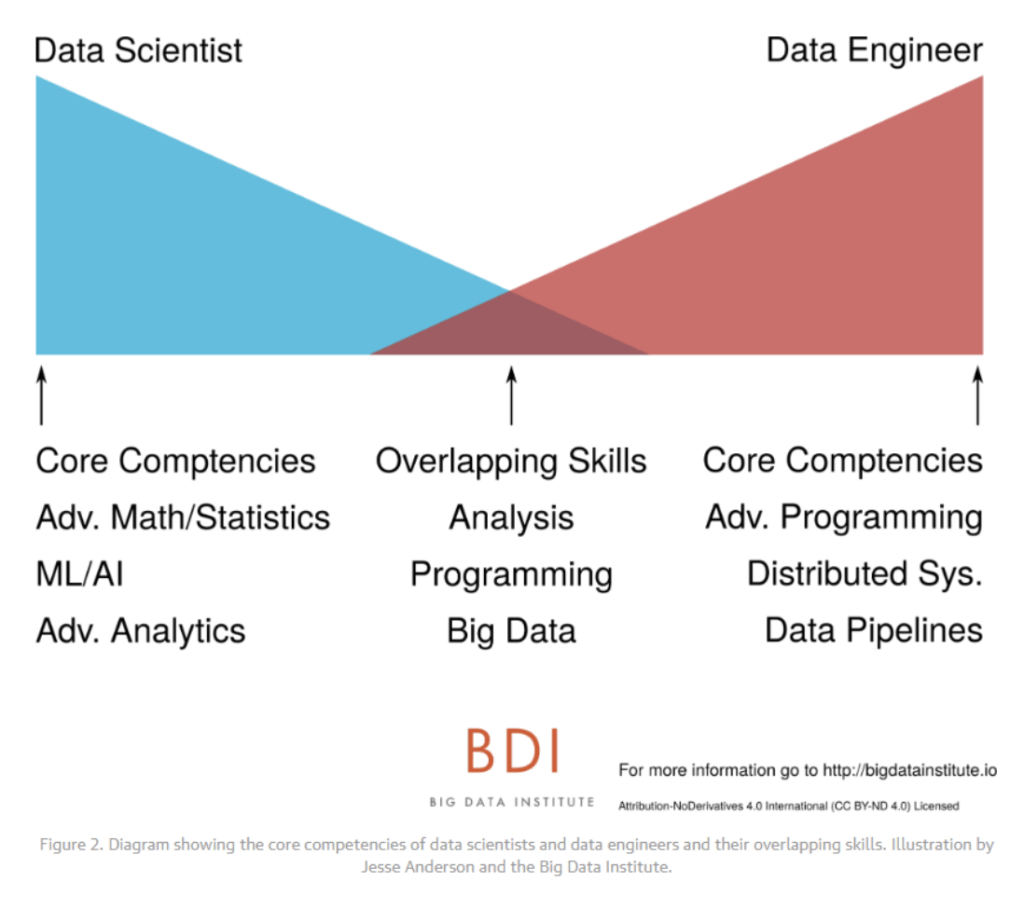
Data scientists are at home in the world of statistics, probability, mathematics and algorithms. Programming knowledge is necessary to train programs and create analyses. A common programming language in data science is “R”, which was developed for statistical calculations.
What makes a data scientist?
The characteristics of a data scientist are diverse. In any case, these include:
- Technical expertise:the best data scientists have deep expertise in a scientific discipline
- Curiosity:they have a drive to dive beneath the surface and get to the bottom of problems, then come up with a hypothesis that can be tested
- Storytelling:the ability to effectively communicate their results and use data for storytelling
- Cleverness:the ability to look at problems from a different, creative side
Data scientists don’t necessarily have to come from IT or computer science! Natural science disciplines such as chemistry, physics, marine biology, etc. are ideal because the research mindset can also be applied to data science.
Data engineering
Data engineering is considered a subfield of data science. The basic tasks of data engineering are collecting, processing and validating data.
The tasks of the data engineer
Data engineers are faced with the challenge of checking data from both structured and unstructured systems for missing fields, mismatched data types and other data-related problems and cleaning the data. Unlike data scientists, data engineers typically have a programming background, usually in Java, Scala or Python.
Core competencies of a data engineer
The programming skills are used to clean data and transfer it to a system. This data then enables the data scientist to create analyzes and hypotheses as well as apply data models.
Data engineers design, draft, and arrange data for further analysis.
Data Science vs. Data Engineering – a distinction
- The focus ofData Engineerslies on forming the infrastructure, architecture and data generation.
- The focus atData scientistsfocuses on advanced mathematical methods and statistical analysis
This means that data scientists are continuously involved with the data infrastructure, but are not responsible for setting up and maintaining this infrastructure – this responsibility falls within the remit of the data engineers. These form scalable, highly powerful infrastructures that enable business insights through raw data sources. You use this to implement complex analytical projects with the focus on ensuring that this data can subsequently be used by data scientists.
Data scientists deal with analysis techniques such as R, SPSS, Hadoop, and advanced statistical models. Data engineers, on the other hand, focus on products that enable the application of these techniques – e.g. SQL, MySQL, NoSQL, Cassandra, and other services for organizing data.
Both skillsets are necessary and thus form a data team that enables working with “big data”.
Machine Learning Engineer
In order to fill this gap (see picture above) between the academic mindset and the need to produce something tangible, a new type of engineer is currently developing. This is mostly found in the USA. The title of this profession is: Machine Learning Engineer.
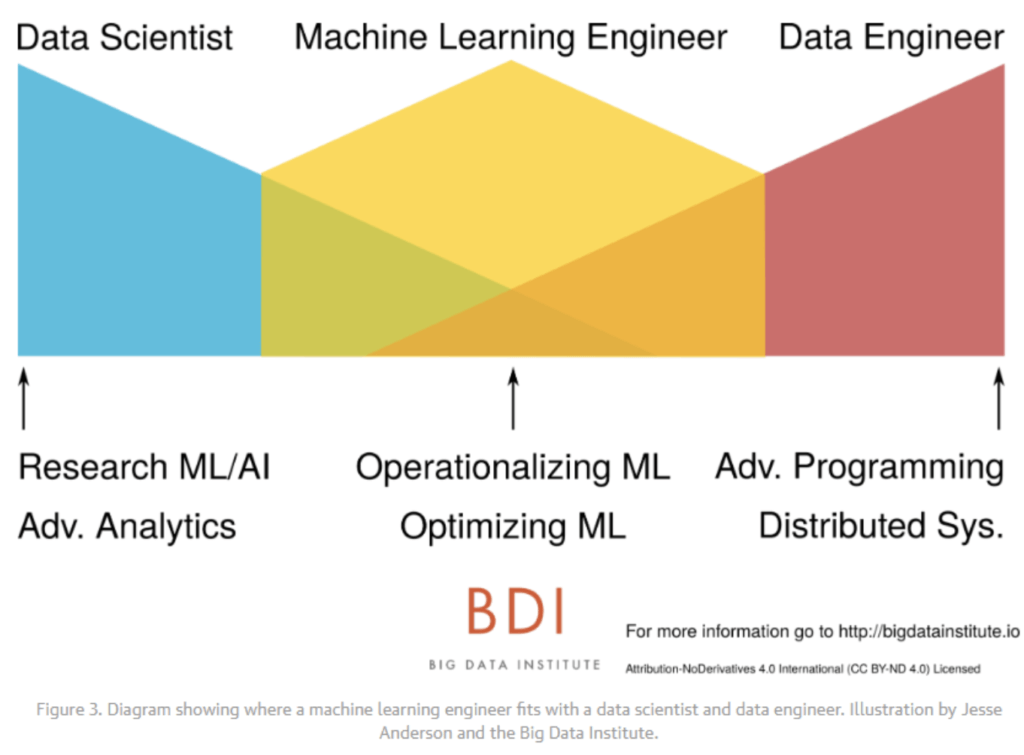
Machine learning engineers usually come from a data engineering background. You know both the world of data scientists and data engineers and can demonstrate knowledge of both areas. A machine learning engineer is the connecting position between data science and data engineering.
The tasks of the machine learning engineer
The job of machine learning engineers is to use the findings of data scientists and use them to implement or produce something tangible. A machine learning engineer has enough engineering knowledge to start here and realize the final step of the project.
Data engineers can become machine learning engineers, but this development takes time. They also need relevant mathematics and statistics knowledge and experience.
Data Architect
Data architects have the task of bringing order to the data chaos. To do this, data architects design a kind of “blueprint” for the data management of organizations and companies. Every data science team needs a data architect to visualize, design and prepare a data framework that can then be used by data scientists, engineers or data/web analysts.
The tasks of the data architect
Data engineers support data architects in building a framework for data search and data queries, which data scientists and analysts can then use in their work.
The biggest differences between data architects and data engineers are:
- Data architects design and visualize data frameworks; Data engineers create and manage these.
- Data architects lead and lead the data science team, while data engineers provide the supporting framework to make these tasks possible
- Data architects used to take over the work of data engineers, but today the job profile has changed and adapted to the circumstances.
- Although data architects and data engineers both have vast knowledge of database management, both roles use their knowledge in different ways.
Cloud engineering
The tasks of the cloud engineer
Cloud engineers are responsible for migrating business infrastructure and various functions to cloud-based systems. You create, manage and link cloud services and combine technical skills as well as business knowledge and experience with at least one major cloud provider, such as: Amazon Web Services, Microsoft Azure and Google Cloud Platform.
They assess existing infrastructures and look for solutions and implement different functions (such as database storage) in cloud-based systems. In addition to technical skills, they also need the ability to negotiate contractual terms with providers, ensure the security of data and implement new practices in a process.
Core competencies of a cloud engineer
- OpenStack, Linux, Amazon Web Services, Rackspace, Google compute engine, Microsoft Azure and Docker (at least one of these)
- Web Services, API, REST, RPC. Cloud architectures are based on APIs and web services
Virtualization, data storage and networking - In addition to technical skills, also business use case knowledge
- Programming languages such as Java, Python and Ruby. Many companies also look to cloud engineers for experience with APIs, orchestrations, automation, DevOps and databases such as NoSQL
Cloud Architect
A cloud architect is an IT professional who is responsible for the entire enterprise cloud computing strategy. This includes tasks such as cloud implementation, cloud application design, and cloud management and monitoring. They are also consultants and must stay up to date with the latest developments in their field.
Core competencies of a Cloud Architect
- Strong understanding of cloud computing technologies and infrastructures
- Experience designing and migrating applications to the cloud
- Consultant skills, as they also maintain customer relationships
- Experience with multiple programming languages such as: Java, Node.js, PHP, Python, Ruby on Rails
- Cloud architects can also be involved in the legal area of cloud computing and negotiate contracts
You would like to become part of our data team or are interested in the diverse application possibilities of data science & Machine learning in your company? Take a look at oursJobs page.