Ga4 Predictive Metrics Success By Looking Into The Future

Management Summary
GA4 Predictive Metrics: Machine learning purchase, churn and revenue forecasts, data-driven opportunity identification, risk mitigation, informed decisions and competitive advantages. Use forecasts, optionally with BigQuery ML, effectively!
GA4 Predictive Metrics
In an environment where customer needs are constantly changing, companies strive to use advanced analytics and forecasting to gain a competitive advantage. Google Analytics 4 (GA4) offers a range of powerful predictive metrics that provide insights into future trends and behavior based on existing (raw) data and machine learning. In this blog post, we will look at these predictive metrics, highlight their importance in business decisions, and see what to look for when using them in GA4.
Predictive metrics in analysis
Predictive metrics have the ability to predict future results based on historical data. While traditional analytics aim to understand the past, predictive metrics enable forward-looking analysis (predictive analytics). This method applies mathematical models to large data sets to predict future outcomes by identifying patterns in past behavior.
Predictive Metrics in Google Analytics 4
Also in GA4, predictive metrics reveal hidden patterns, identify opportunities and optimize marketing activities. By leveraging ML algorithms to analyze data, these metrics make it possible to look into the future, make data-driven decisions, remain agile and adapt to changing customer needs.
Three predictive metrics for success
- Purchase probability(probability of purchase)
The probability that a user who was active in the last 28 days will trigger a specific conversion within the next 7 days.
By analyzing factors such as purchase history, browsing behavior and demographic information, potential buyers with a high purchase propensity can be identified and specifically targeted. This allows customized marketing strategies and offers to be created. This key figure contributes to improved sales performance and increased sales.
- Forecasted sales/sales forecast(Predicted revenue) *
The expected revenue from all purchase conversions within the next 28 days from a user who was active in the last 28 days.
This metric predicts future revenue based on user behavior, conversion rates, and transaction values. The metric can be used to effectively allocate resources, identify revenue drivers, and focus on strategies that maximize profitability. This predictive metric enables data-driven decisions to be made about budget allocation, product development and marketing campaigns.
- Probability of churn(Churn probability) *
The probability that a user who was active on your app or website in the last 7 days will no longer be active in the next 7 days.
By analyzing behavioral patterns and historical data, GA4 calculates the likelihood that users will abandon interaction with a website or app, helping to identify potential churners. Based on this information, targeted retention strategies can be developed, personalized experiences can be promoted, and proactive measures can be taken to avoid premature churn and improve customer loyalty and sales
*For purchase probability and sales prediction, only purchase (recommended), ecommerce purchase and in_app_purchase are currently supported.
Prerequisites for Predictive Metrics in GA4
The forecast measurements are generated once a day for each available model and each active user. If the model quality in the property falls below the minimum value, the corresponding forecasts in Analytics will no longer be updated. In order for the forecast models to be trained successfully, certain criteria must be met:
1.A sufficient number of positive and negative examples for buyers and churned users: Within the last 28 days, at least 1,000 returning users should have fulfilled the condition (purchase or churned) on 7 days. Likewise, there should be at least 1,000 users within this period who have not met this condition.
2.TheModel qualitymust be maintained over a certain period of time.
3.The transmission of the “purchase” and/or “in_app_purchase” events is a prerequisite for returning data on purchase probability and forecast sales for a property. If “purchase” is captured, the “value” and “currency” parameters for the event must also be captured.More information
To verify whether a predictive model can be applied to the property, the suitability status can be checked in the audience lists of the suggested audience templates under the Predictable category. If none of the templates are suitable for use, you can try to take the measures mentioned below (#Best Practices – Predictive Metrics in GA4) to achieve the requirements.
Administration >> Target groups >> Create new target group >> Use reference >> Predictable
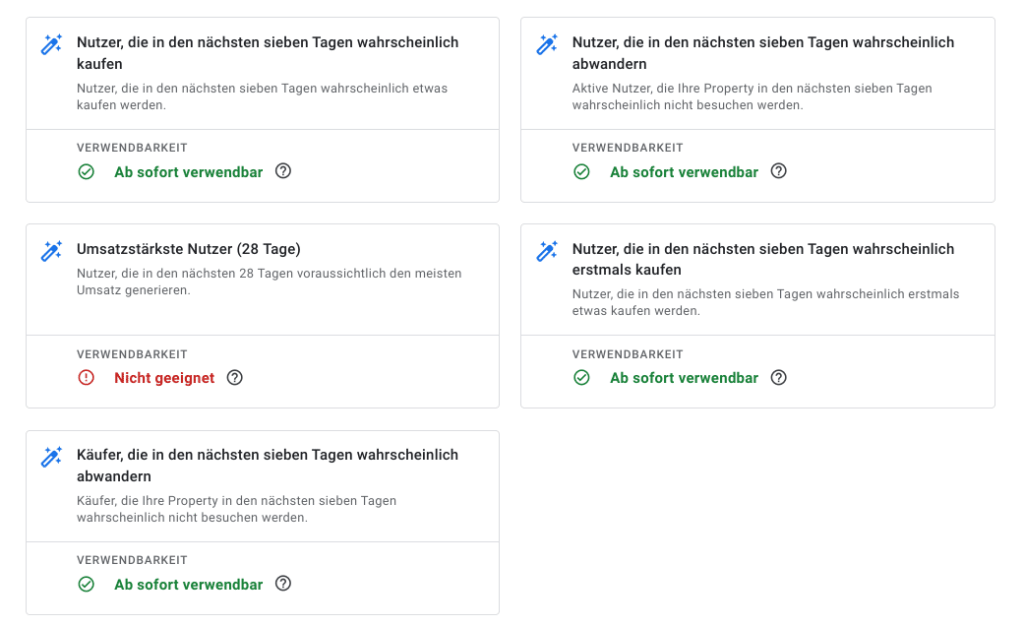
Suitability status for forecast models, source: e-dialog
Where are forecast values used in GA4?
Forecast measurements are in GA4 in theTarget groups(Audiences) and inexploratory analysis tool(Explore) available.
With the help of predictive metrics you canForecast target groups(Predictive Audiences) for churn, purchase and sales can be created.
Importing these audiences into Google Ads means tailored AI targeting that constantly updates itself.
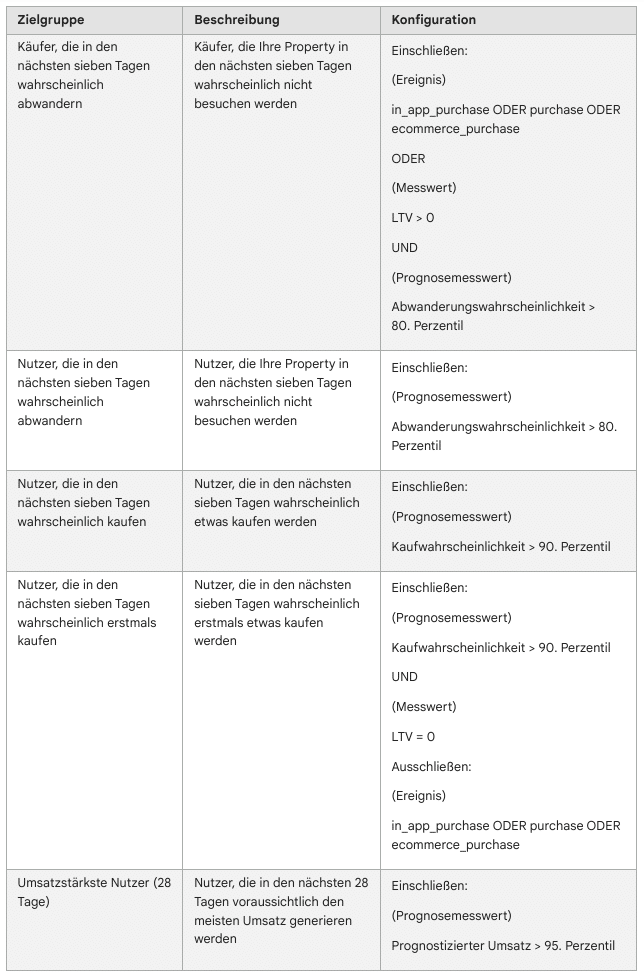
Where forecast values are used in GA4,source

Target group settings, source: e-dialog
In the Explore reports, purchase probability and churn probability and forecast sales are presented as metrics in percentages and averages within theUser lifetime explorationapplied.
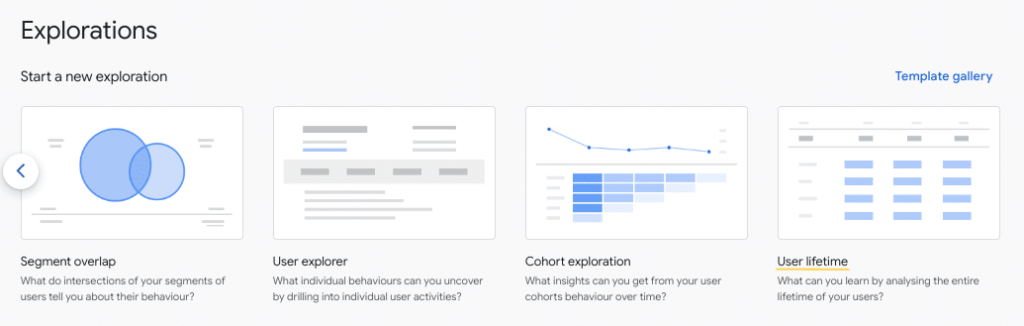
Explorations, source: e-dialog
A winning team:
GA4 Predictive Metrics & BigQuery Machine Learning (BQML)
BQML is a feature within BigQuery that enables building and running machine learning models on large structured or semi-structured datasets using Google SQL queries. The extensive data stored in Big Query can be used to apply individual machine learning (ML) models directly on the platform.
Examples of applications for this include customer segmentation, customer lifetime value (LTV) prediction, conversion or purchase prediction. Possible steps include data aggregation and transformation, building machine learning models, and displaying the model’s predictions on a dashboard.
Combining GA4 data with BQML can provide deeper insights and predictive capabilities, taking predictive analysis to a new level.
Best Practices – Predictive Metrics in GA4
To utilize the full power of Predictive Metrics in GA4, a series of implementation steps should be followed:
1.Optimally configure Google Analytics 4 Property:
Start by setting up Google Analytics 4 for your website or app. Make sure you have a properly configured GA4 property to accurately track relevant data.
2.Enhanced measurementactivate:
This feature allows GA4 to collect additional data points that are crucial for predictive analysis. Enhanced measurement should be seen as a useful addition to custom events.
3.Set up additional recommended events and conversions:
Define the events and conversions that match your business goals and target markets. These events serve as important indicators for predictive analysis and allow you to accurately measure desired user actions.
4.Collect enough data:
Collect a sufficient amount of historical data in GA4 to generate accurate predictions. The more data is available, the better the predictive models can analyze and generate insights.
5.Activate predictive metrics in GA4 and use reports:
Enable the predictive metrics that meet your business needs. This includes metrics such as forecast revenue, churn probability and purchase probability, but also engagement probability, average revenue per user (ARPU) forecast or lifetime value (LTV) forecast can be important.
6.BigQuery Machine Learning (BQML)-GA4 integration (optional):
This integration allows you to harness the power of advanced ML models and perform more complex predictive analysis on your GA4 data.
7.Customized machine learning models (optional):
If you choose to integrate with BQML, you can build custom ML models with SQL queries in BigQuery. These models can be tailored to your specific business needs and enable highly accurate predictions based on GA4 data.
8.Evaluate and interpret results:
Regularly monitor and evaluate the predictive metrics generated by GA4. Gain insights from these metrics to support your business decisions, identify trends and optimize your strategies accordingly.
9.Take action:
Use the insights gained from predictive metrics to make data-driven decisions and take proactive actions. Implement targeted marketing campaigns, optimize user experiences, personalize offers, and leverage data-driven strategies to drive customer loyalty and revenue growth.
Conclusion:
From forecasted revenue to churn probability, purchase probability and much more, using and evaluating predictive metrics in Google Analytics 4 offers a glimpse of what is to come. This allows companies to uncover future trends and behaviors, stay one step ahead, adapt to changing market dynamics and achieve sustainable success.
In order to achieve this, the operation should be well planned on many levels. Because of the optimal interaction between configuration, data aggregation and modeling, model quality, regular analysis, evaluation and development of data-driven measures, the insights gained into the future can be used extremely profitably.