Google Ads 8 Tips To Optimize Your Performance Max Campaign
Management Summary
Performance Max campaigns have revolutionized the way companies do digital marketing. Using Google’s AI, these campaigns optimize ad placement and bidding across channels including Search, Display, YouTube, Gmail and Discover. The aim of these campaigns is to achieve specific marketing goals, such as: B. generating leads, increasing sales or increasing brand awareness.
What is special about Performance Max campaigns?
Performance Max campaigns stand out for their automated approach, which leverages Google’s AI to analyze massive amounts of data and optimize ad placement and bidding in real-time. This data-driven approach ensures your ads reach the right audience at the right time and maximize the likelihood of conversions.
While Performance Max campaigns offer many benefits and can achieve truly outstanding results, they present some challenges for optimization due to their “black box” nature. So, compared to traditional search or shopping campaigns, we need to learn to rethink optimization in PMax.Performance Max delivers your advertisements on these formats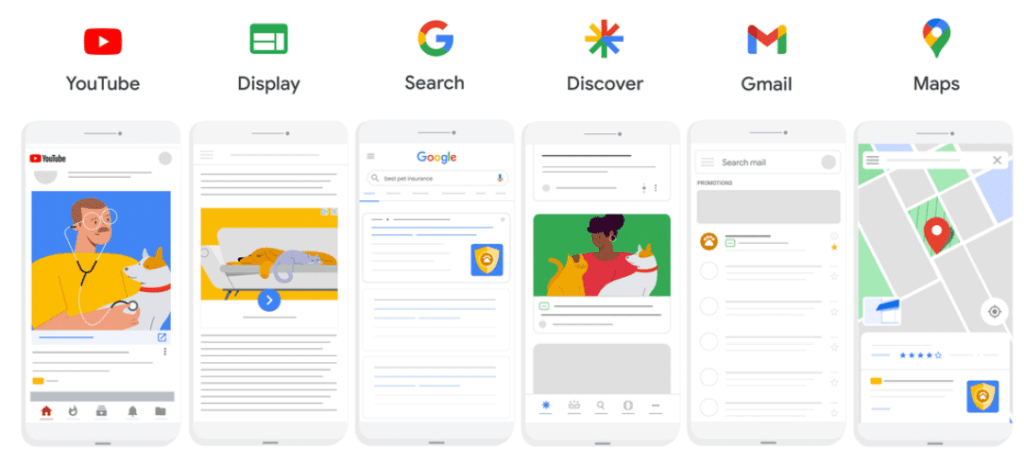 Source: Google
How do you optimize a Performance Max campaign?
Optimizing Performance Max campaigns requires a strategic approach that includes various elements. We’ll introduce you to some important optimization techniques that you should definitely consider.
1. Shopping feed management
A well-maintained shopping feed is the heart of a successful PMax campaign in e-commerce. Regularly check the feed for errors or outdated information and adjust relevant aspects. This could include updating product descriptions, prices or availability. A clean and up-to-date feed significantly improves the performance of your ads.
2. Edit search topics
Take advantage of the opportunity to target your PMax campaign to specific search topics and adjust them regularly. You have the option to store up to 25 individual search topics to support your PMax campaign. By adding or removing relevant search terms, you can ensure that your ads always appear for the most relevant and top-performing searches.
3. Audience targeting
Targeting specific audiences is another key to optimizing your PMax campaign. Adjust the target groups of the PMax Asset groups regularly to specifically address different users. This enables personalized targeting and improves the relevance of the ads for the end user.
4. Category based PMax setup
Do you only have a single PMax campaign in your campaign structure and it is not performing? Then it would make sense to set up several PMax campaigns and divide them into different categories. This makes it possible to evaluate which category performs well and which poorly and a budget distribution is then possible. For e-commerce providers, this could mean promoting different product categories separately. It could make sense for service providers to advertise various services in their own campaigns.
5. High-Performer vs. Low-Performer Setup
And if the category-based setup doesn’t fit into the account strategy, it would also be possible to create separate PMax campaigns for well and poorly performing products. This enables targeted optimization and budget allocation. High performers receive more budget to further maximize their good performance, while low performers can be individually optimized or paused if necessary.
6. Account-level negative placements
While it is not possible to exclude individual placements at the PMax campaign level, an account level exclusion can also be applied to PMax campaigns. This helps improve the quality of traffic and avoid unnecessary expenses.
7. PMax Brand Exclusions
A common phenomenon is that PMax campaigns bid very heavily on their own brand. To prevent this, it is possible to exclude brand names to ensure that ads are not shown for branded searches. This is how you achieve a generic display of your PMax campaigns.
8. Our extra tip for e-commerce: Switch PMax to Feed Only
Our top tip for all e-commerce campaign managers who don’t want to be featured on Search, Display, YouTube, Gmail, Discover and Maps. It is possible to align the PMax campaign with feed-only and thus really focus 100% of the power of PMax on the shopping area in Google search. Just give it a try while Google still allows this option of using PMax.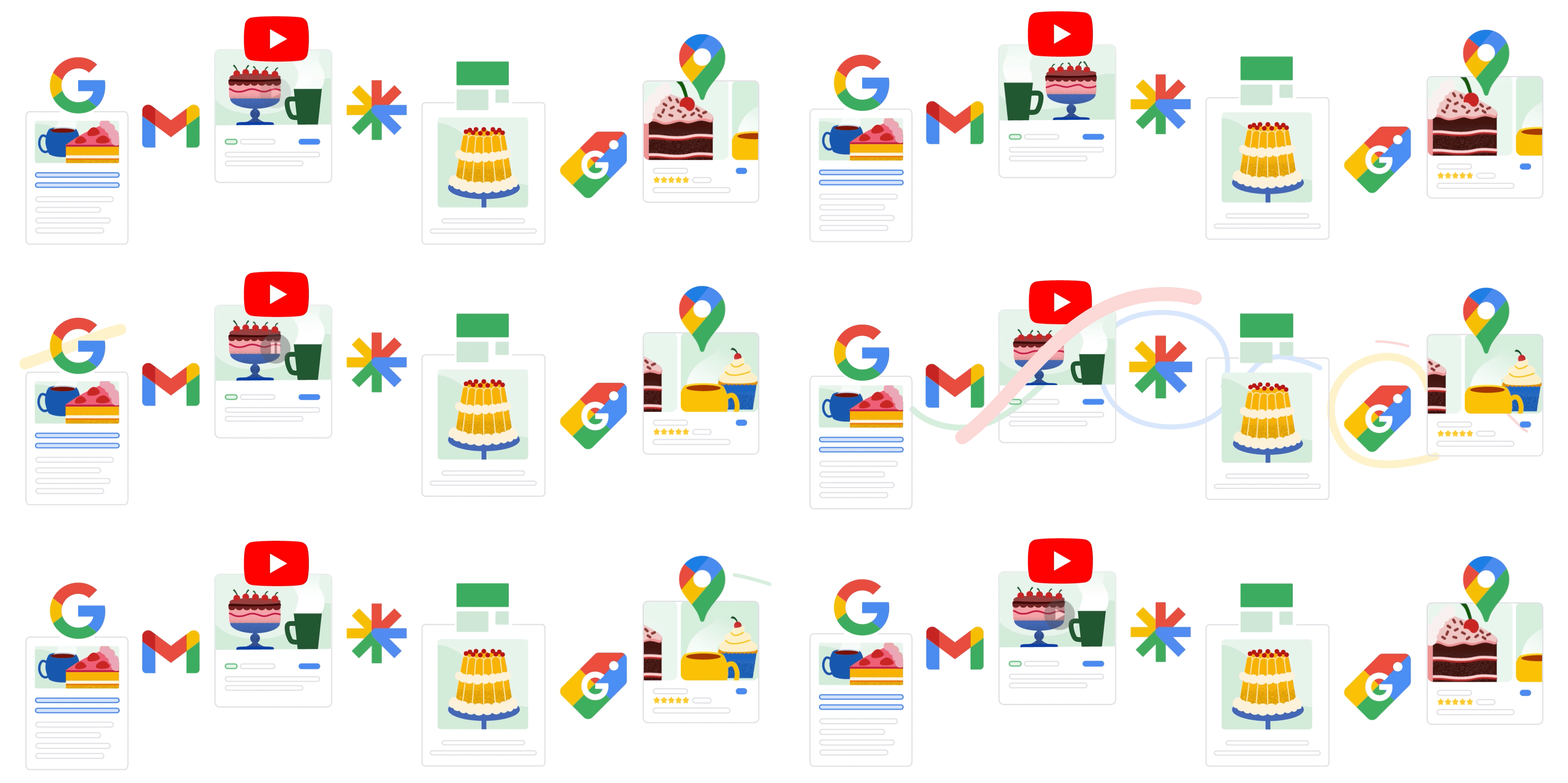 Source: Google
Conclusion:
Performance Max campaigns are a powerful tool for achieving individual marketing goals. By implementing the optimization strategies outlined in this blog post, you now have the opportunity to harness the power of AI-powered automation and data-driven insights to maximize campaign performance, increase conversions, and achieve your business goals. Of course, continuous optimization and experimentation is essential in order to exploit the full potential of Performance Max campaigns.