Google Consent Mode V2 Impact On Campaign Attribution 038 Why Utm Parameters Are Crucial Now

Management Summary
In recent months, Google has been evolving its systems to better support Consent Mode. This brought some changes in traffic attribution – particularly in campaign attributiongoogle / cpc (organic)as well as the integration of Google Ads and programmatic campaigns. Many partners noticed an increase in organic traffic directly attributable to these adjustments. But what exactly has changed and how does this affect campaign tracking and attribution? In order to continue to ensure correct allocation in Analytics, the use ofUTM parametersessential.
Attribution in consent mode – that has changed
It has been since March 2024Consent Mode V2causing obligation. The Google Analytics systems were then updated to support the changes to Consent Mode. These updates may have resulted in attribution changes, including an increase in organic traffic.
Depending on users’ consent to data processing by Google Ads and programmatic platforms such as DV360 (Display & Video 360), there are different effects on attribution logic. Especially if consent for ad_user_data is refused in consent mode or if the website visitor has not activated their Google Ads personalization settings and the link through Google Linked Services Remarketing in Google Search, Shopping, YouTube, Google Play and Gmail.
- If consent for the use of ad data is refused by the advertiser or Google:In this case, measurements and personalized advertising are disabled. This also includes the use of data based on user IDs or consented data provided by the user. These restrictions affect both Google Ads and programmatic campaigns. The ability to target ads to specific target groups is limited, which directly impacts campaign performance.
In addition, theutm_campaign parametersused to populate the campaign dimension in Google Analytics. This can cause the campaign dimension to be overwritten even if auto-tagging is enabled. This means that even if the auto-tagging function is activated, the campaign can be assigned manually using the utm_campaign parameter. - If ad_user_data is granted:In this case, the automatic tagging feature works as expected. The campaign dimension is populated by auto-tagging during theutm_campaign parametersused specifically for the manual source/medium dimension. This corresponds to how it works as documented in the Google Help Center.
Are you affected? How to check your campaigns:
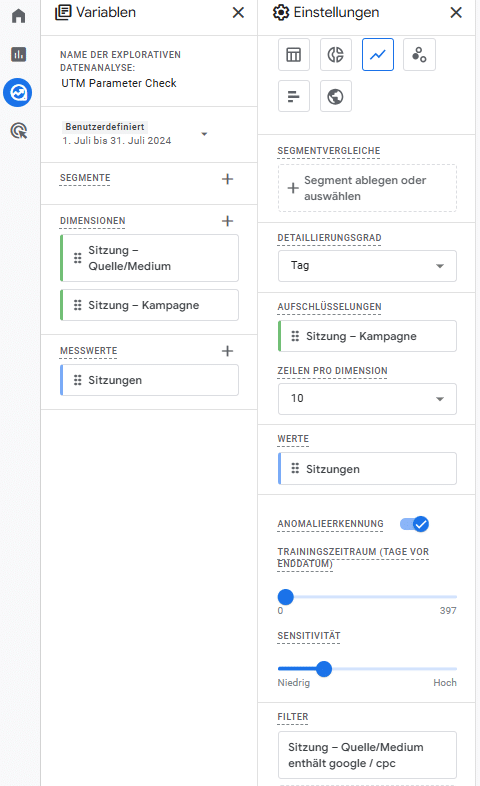
GA4 settings for exploratory data analysis, source: GA4 e-dialog
- Open GA4 and exploratory data analysis
- For the dimensions use the following:
a. Session – Source/Medium
b. Session – Campaign - Visualization of a line chart
- Breakdowns: Session – Campaign
- You can use sessions as a metric
- You use sessions as the value
- Important: Set filters for session source / medium and here, for example, filter Google / CPC
You can now check whether and how many sessions with the campaign names (organic) are available. As of June 26, 2024, assignment errors occurred.
If this is the case, you should add manual tagging to your campaigns in the future so that all traffic can be accurately assigned to your campaigns.
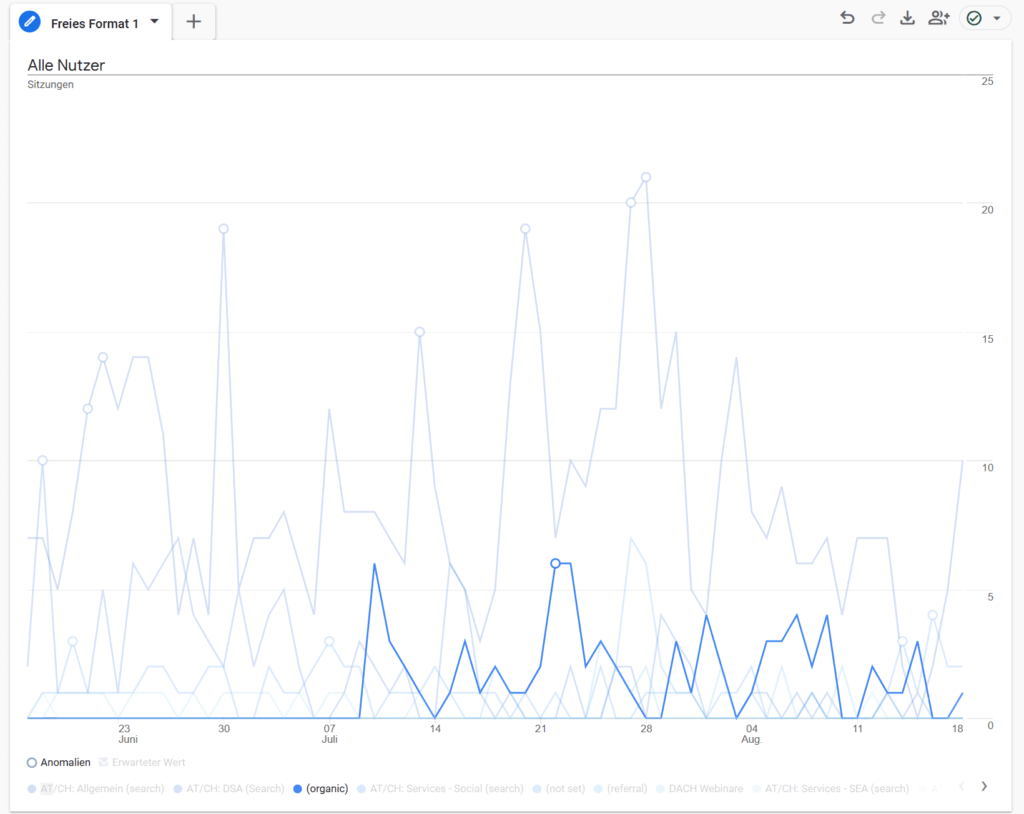
Impact of the update – (organic) traffic on google / cpc, source: GA4 e-dialog
Future adjustments and outlook
Even though Google strives to minimize the impact on attribution, not all data is fully traceable if consent to the use of user data is not given. This currently results in campaign labels such as “(organic)” or “(not set)” in Google Analytics 4 (GA4) when certain dimensions cannot be captured due to lack of consent. However, in the future, Google plans to better label affected traffic dimensions, for example as “unconsented traffic”.
There have been several Google Analytics updates since April 2025 and there will be more that are intended to significantly improve data completeness. Through automatic solutions, so-calledAggregate Identifiers, data gaps are closed. In particular, this will reduce issues with attributing Google paid campaigns to organic campaigns by mitigating the over-attribution of Google Paid channels to organic channels.
Additionally, there will be improvements to attribution data in behavioral reports (user/session reports) and ad module reports (event-level reports). Diagnostics are also introduced to detect when Aggregate Identifiers cannot be used andUTMs as a backup mechanismcan be used.
We therefore recommend entering manual UTM parameters, despite the introduction of aggregate identifiers, to ensure correct data assignment!
What does this mean for advertisers?
Advertisers should be aware of these changes and adapt their analysis methods. The combination of auto-tagging and manual tagging offers new opportunities to better control campaign data even with limited consent. At the same time, advertisers should keep a close eye on the impact of consent mode settings on their attribution in order to correctly interpret any traffic shifts and adapt their strategies accordingly. These innovations are a further step towards ensuring user data protection, while at the same time ensuring the most precise campaign allocation possible. Anyone who familiarizes themselves with the changes early on will be able to successfully optimize their campaigns and make data-based decisions in the future.