Higher Sales And Less Workload With Automated Campaigns

Management Summary
What are automated campaigns?
Automated campaigns are the right choice when it comes to processing large amounts of data and making the creatives appealing. The requirements for the feed are significantly more flexible than with Dynamic Campaigns. The only condition is that it contains sorted data as text or number. The number of fields and columns is not limited and – unlike Dynamic Campaigns – there are no mandatory fields. There are hardly any limits to the possible applications. Facebook itself does not offer this campaign format; it is displayed as a standard campaign in the advertising manager. Dynamic Ads are the method of choice for a product selection that is as tailored as possible to the user, as they take previous behavior more into account.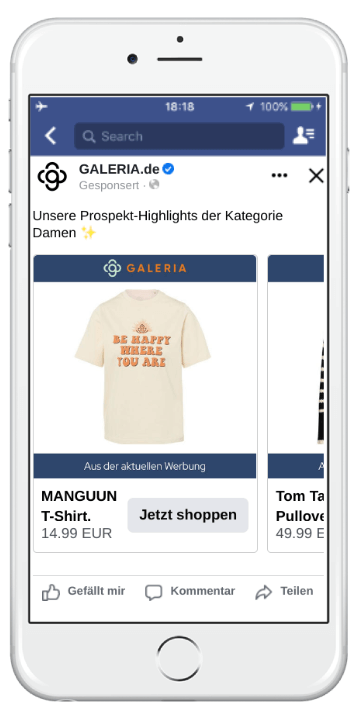 Advertising material example with image template
About Smartly.io – What can the tool do?
Smartly.io is a tool for automating the social advertising process. It enables data, media and creativity to be linked to create high-performance and personalized social campaigns across different channels. From ad creation with creative tools to campaign management and reporting, Smartly.io offers time-saving solutions. For us it has become indispensable, especially for customers in the e-commerce sector.
The data source – basis of automation
In our example, a department store’s weekly changing flyer is to be advertised with over 1,500 individual items recorded in a product feed. The data source can also contain real estate, travel, courses or completely different information, the principle is the same. What is also exciting is the possibility of filtering the current top sellers from the feed on a daily basis via a link to Google Analytics and using them for campaigns.
Our goal was to make the application process completely independent and to advertise the complete, reduced product set with minimal effort without having to actively intervene. If products are sold out, they will be removed from the feed and will be dropped from the application. If prices or other relevant information change, the ads are adjusted immediately. Week after week, the entire advertised product set is replaced and the new products are included in the application without any manual intervention. It is clear that maintaining the data source properly must have the highest priority.
Special features in the campaign setup
Segmentation by category can be carried out based on the underlying data feed. In principle, various feed columns – for example category, product type or price – can be used for segmentation, or they can be dispensed with completely. Furthermore, the data source can also be filtered and sorted according to different criteria in order to only use sub-areas of the overall range in the campaigns. In our case, in addition to targeting, the ads are also separated according to the product category being advertised. Through a homogeneous product selection according to categories within the ads, we ensure an optimal user experience.
Targeting for automated ads
In terms of targeting, there are no differences to classic campaigns. In addition to the well-known criteria for open targeting, all custom and lookalike audiences are also available. Each audience is presented in its own ad group. However, there is also the option of providing the targeting criteria in a feed, for example to separate between different user groups or to take regional circumstances into account.
The path to individual creatives
Advertising materials are becoming increasingly important for the success of a campaign. However, it requires a lot of resources to create suitable images or even videos for a broad product set. Image templates that are linked to the product catalog help here. Various information from the product feed as well as other elements such as logos, disruptors and the like are embedded in a template. This can be freely designed according to the advertiser’s corporate design. In addition, elements from the product feed can also be included in the ad copy or description.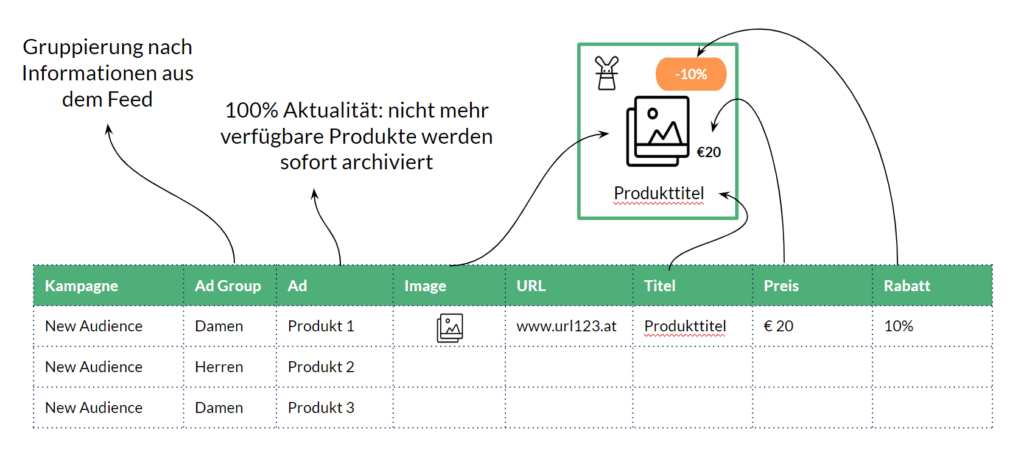 Possible elements in the image template
Videos can also be designed according to this principle, created directly in the tool and linked to the data source. The high costs of creating moving images are no longer an argument. Because it makes no difference whether the templates are used for 5 or 500 products. The automatic exchange of different videos can be controlled using various rules, so that on the one hand all of them are played out and on the other hand the most successful videos are retained.
What have we achieved with automation?
Compared to static link ads that tease the brochure, product carousels with image templates reduced the cost-sales ratio by 825%. The cost per purchase fell by about 700% while the size of the shopping cart increased. At the same time, there is no need to adjust text and image elements on a weekly basis because all information is processed automatically. The campaign has therefore become a sure-fire success, showing all currently reduced products in the advertising media with minimal effort and accounting for a considerable share of sales.