How Insourcing Adtech Solutions Strengthens Your Business

Management Summary
In this article you will learn about the reasons for insourcing marketing tools, how to make the decision and what advantages there are for your company.
Introduction: In-housing of AdTech solutions
In-housing adtech technologies is a strategic decision that offers companies numerous advantages such asData ownership, greater cost transparencyandlong-term cost savingscan offer. While analytics software has typically been procured directly by companies for years, in the media space, digital media buying and creative services are in many cases provided by agencies within their platforms’ accounts. Media buying is often fragmented and traditional, spread across multiple agencies or tools.
This fragmentation can be significantly reduced through integrated tools such as the Google Marketing Platform. Such platforms enable cross-buying of advertising placements, more efficient data collection, advanced analytics and informed decision making. This helps optimize campaigns and maximize return on investment (ROI).In-housing these platforms assumes control and ownership of your own digital media activities, associated data and intellectual property, whether these activities continue to be carried out by your agency partners or within your organization.However, the step to insourcing tools must be well planned, as there are some hurdles and pitfalls ahead. It is important to check which marketing resources are available in-house and which are handled via external partners and agencies. This decision requires a thorough analysis and evaluation of the arguments and perspectives.
A little digression: media bookings today
Media buying is often highly fragmented. Many bookings follow traditional patterns: classic online banners are played out programmatically, while special formats and fixed agreements continue to be booked in the traditional way. The various channels, including social media and Google Ads, are often viewed in isolation from one another and are not tracked together. Formats such as big screen, audio and out-of-home (OOH) are often neglected or, if taken into account at all, booked in cumbersome ways, such as via email. Many people are not aware that these processes can now be centralized and efficiently controlled via one or a few integrated platforms. This enables coherent planning, better data collection and optimized campaign control across all channels.
The Google Marketing Platform
As one of the leading platforms, the Google Marketing Platform (GMP) offers the possibility to plan, execute and analyze digital marketing strategies across multiple channels in an integrated and effective manner.
Thanks to the analysis functionality integrated into the product, the most important statistics are automatically displayed. This allows you to act quickly to achieve your goals. You can easily see which areas are working and make informed decisions to improve your advertising efforts. By accessing the data, you gain a precise insight into the behavior of your users and can therefore identify and address important target groups.
Information and statistics can also be made available to the entire company – appropriate user rights management helps to structure access according to roles.
The Google Marketing Platform tools
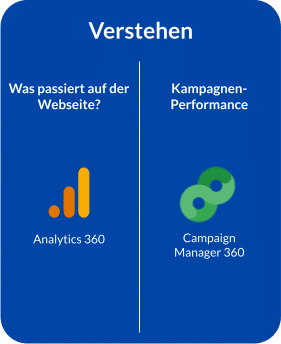
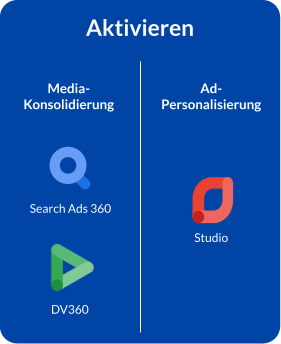
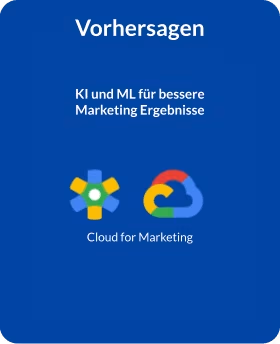 The tools of the Google Marketing Platform, source: e-dialog
TheGoogle Marketing Platform (GMP)is offered through certified Google partners, which also includes e-dialog. e-dialog was the first full-stack partner for GMP in the DACH region and a pioneer in the use of Google Cloud.
In-housing the Google Marketing Platform
Regardless of whether you implement your digital marketing activities in-house or they are controlled by an agency – by in-housing the necessary technologies, you retain control and ownership over these activities and the associated data.
What this means in concrete terms is the example of GMP
- Campaign Manager 360 (CM360) for ad serving (be it for programmatic campaigns or fixed bookings),
- Display & Video 360 (DV360) for programmatic buying,
- Search Ads 360 (SA360) for paid search (across different search engines) and e.g. for measuring social interaction data as well
- Google Analytics 4 360 (GA4 360) for analyzing website data
to have licensed within the company instead of having an agency run the campaigns within the Google Marketing Platform Suite.
In-housing the Google Marketing Platform
In-housing does not mean separating from the agency, but rather changing the model with your agencies by obtaining licenses for the Google Marketing Platform products.Carefully defining and planning a model for acquiring know-how and resources ensures that expectations are met, tasks are optimally distributed and the rollout can be implemented in a timely manner.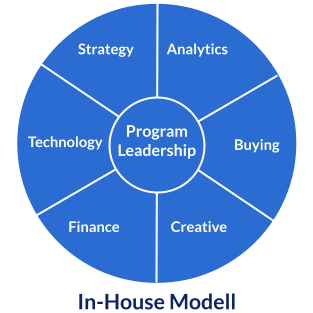 In-housing: With in-housing, the Google Marketing Platform is managed completely internally. The company hires its own employees who are responsible for implementing, supporting and optimizing the campaigns. This strategy allows full control over all processes and enables in-depth adaptation to company-specific requirements. However, it requires a significant investment in skilled workers and technology.
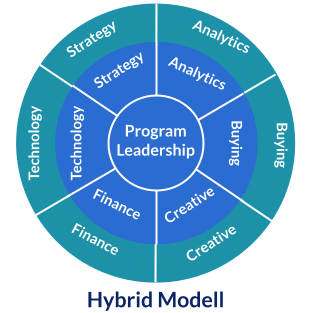 Hybrid: The hybrid model combines elements of outsourcing and inhousing. Some of the tasks are carried out internally by an in-house team, while specialized or resource-intensive aspects, such as technical integration or deeper analysis, are outsourced to external experts. This approach offers flexibility, enables the use of external expertise, ensures that a reliable partner is available when resources are scarce or, for example, during vacations, while maintaining internal control and know-how.
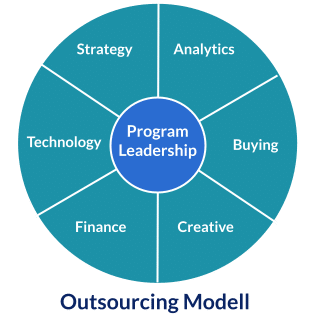 Outsourcing: When outsourcing, a company completely outsources the administration and operation of the Google Marketing Platform to an external service provider. This takes over the implementation, maintenance and optimization of the campaigns so that the company can concentrate on its core business. Outsourcing provides access to specialized expertise and can reduce costs, but carries the risk of dependencies and reduced influence on processes.
Source: Google, graphic created by e-dialog
The most important reasons for insourcing adtech software
Basically, insourcing is a strategic company decision that requires a careful assessment of the internal needs, the required capacities, the current and yet-to-be-developed skills of the employees and the investments in these.
In summary, the most common and important reasons why companies choose insourcing are as follows:
- Control over media investments and output
- Data Ownership
- transparency
- Long-term cost savings
Control over media investments and output
Would you like to know how your media budgets are distributed and where the individual budget pots go? Control is an important part of a planned, thoughtful approach and provides the opportunity to maximize results.
Own licenses of the Google Marketing Platform give you direct control over the granularity and frequency of reporting by giving you direct access to the platform. This provides greater transparency and the ability to make better data-driven decisions.
Display & Video 360 (DV360) provides this granularity for your digital media buying at the level of advertisers, campaigns, deals, creatives, etc., providing transparent information about where your spend is going. By leveraging insights during campaign execution, you can determine whether a campaign is successful or adjustments need to be made to achieve campaign goals – be it clicks, engagement, conversions, visibility, brand awareness measures and/or ROI.
Some examples of advanced media strategies and activations that you can now implement immediately include
- Integration of social media platforms via Search Ads 360 (SA360),
- Use dynamic or data-driven creatives via Studio
- as well as the extended analysis of campaign data using Data Transfer to transfer log files from, for example, Campaign Manager (CM) to BigQuery.
- Integrate or link with third-party tools such as Salesforce Marketing Cloud for additional control over marketing messages and audiences throughout the connected customer journey.
Data Ownership
Data ownership means having both legal legitimacy and full control over a data set or individual data. If you are reading this article, ask yourself: Do you have these?Or do you quickly add a pixel that the agency sends?A key advantage of using your own licenses is taking ownership of your data. This gives you the visibility needed to ensure control, accuracy and accountability in media spending. Target group data can also be used in a future-proof way because the data is collected in your tools – there is no dependency on third parties.For example, the collected data is not lost if you change agencies.By taking ownership of your own data, you also havemore controlabout who has access to your organization’s data and who has visibility into it, ensuring an additional layer of security and risk reduction.We have summarized more information on the topic of data ownership for you in this blog article.
transparency
An example of transparency in the Google Marketing Platform (GMP) is the change history report in the tools. The report provides a transparent record of changes made to an account, such as changes to bidding strategy. This enables stakeholders toefficiently and effectively track the context of an advertiser, campaign, ad group or keyword performance.
In addition, for examplecustom alertsfor selected issues by enabling email status and adding relevant stakeholders’ email addresses to receive daily alert emails.
Long-term cost savings
With direct access to the platform for company employees, there is full transparency into fees, conversions and budget spend, making building a business case much easier and typically the preferred option for this type of stakeholder.
Additionally, with the control that comes with data ownership through obtaining your own GMP licenses, it is typically easier to justify costs internally (rather than to an external partner) to procurement departments or senior stakeholders responsible for advertising technologies.
Hurdles in the insourcing process
Despite the advantages that insourcing marketing measures can have, this step must be carefully considered as there are some hurdles to overcome along the way.
These include:
- Finding the right people – Good creatives, data scientists and technology experts tend to work for companies with flat hierarchies and rigid corporate cultures often stand in the way of this.
- The change from a variable cost structure (media agency) to fixed costs (employee salaries or costs for consulting services from external companies) can create a high degree of uncertainty, especially at the beginning.
- Potential data loss or loss of learning when switching from media agencies to their own technology licenses.
Decisive reasons – a test
The following questions provide guidance for the insourcing decision. Rate the questions below on a scale of 1 to 5, with 1 being low priority and 5 being high priority.
Customer proximity and data ownership:
- Is your company the sole owner of customer data?
- Does your company have complete visibility into the customer journey?
- Do you have an impact on the customer experience?
- Can your company use the data for personalized marketing in real time?
- Is your company capable of managing and analyzing large amounts of data internally?
Reaction speed:
- Does your company respond quickly enough to customers (especially on social and digital channels)?
- Is your company able to process customer insights quickly?
- Is your company able to keep up with key trends internally or does it rely on agencies to do so?
Talent Management Skills:
- Does your company have enough budget to invest in technology, talent and training?
- Is marketing work sufficient and consistent throughout the year so that your company can justify creating skill pools?
- Can your company afford the time to build the required capabilities internally?
- Is your company able to recruit and retain talent, including experts?
- Can the company offer career opportunities to young talent?
If the answers show a lack of (data) control and responsiveness while at the same time being able to marshal appropriate resources, consider bringing activities in-house.
Conclusion
Insourcing offers companies numerous benefits, but requires careful planning to avoid potential challenges. e-dialog supports companies in managing their data themselves, building closer customer relationships and personalizing the customer journey. This includes both the display of relevant advertising material via various marketing channels and the personalization of the user experience on the website. Through insourcing, companies gain greater control, data sovereignty and transparency while leveraging the full potential of Google Marketing Platform and increasing their digital marketing maturity.