In Store Tracking How Customers Can Now Be Analyzed In Stores
Management Summary
Visitors and customers are recognized via smartphone
The most emerging opportunity for detection is detecting the smartphones people carry. This is done either by detecting the WiFi (WLAN) signal, which many cell phones always have switched on, or by detecting the Bluetooth signals. (Theoretically, it would also be possible to detect the presence of a processor by its clock frequency; but that doesn’t currently matter).
If you know how high smartphone penetration is, you can estimate how reliable this method is: Although we cannot record 100% – but the projections are highly valid.
Further technologies for in-store tracking or person recognition
Of course, there are also other ways to detect visitors: These start with simple light barriers and motion detection using thermal imaging cameras. Here we “only” get counts.
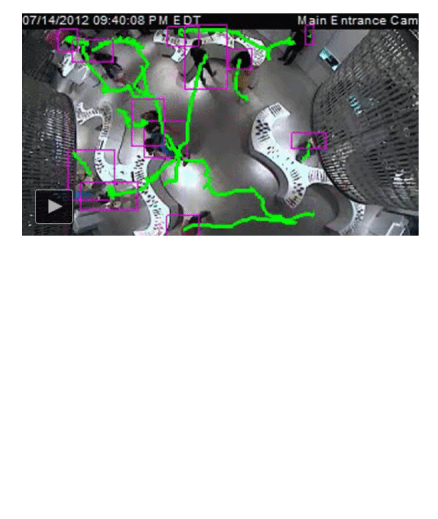
More interesting are image recognition methods that can identify and analyze people and their movements using video signals. The advantage is that 100% accuracy is actually guaranteed in the area (captured by the camera).
The most advanced solutions work with a combination of several measures such as video detection in combination with smartphone tracking. First-time visitors can then be distinguished anonymously from returning visitors.
Island solutions vs. integrated digital analytics
Offline measurement has been around for a long time in the form of light barriers and thermal imaging cameras; the more advanced methods only recently. Web analytics has been around for a few years now. Both have their place as an isolated or special solution – but the full power is only achieved through a link, as influences from online to offline and vice versa can then be examined:
- Do online campaigns and promotions bring more visitors to my branches?
- Did my TV campaign (recorded via TV tracking) increased my branch frequency?
- How many of my branch customers are also online visitors or buyers?
- And if this is resolved in the data protection agreement: What is the multichannel buyer behavior of my different customer segments?
Geographic tracking: macro and micro levels
Analyze customer flow at city level and regionally
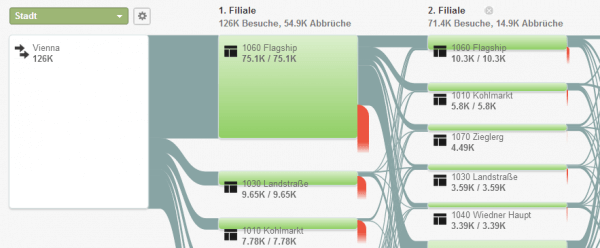
It is of course very exciting to analyze how customers use their own branches: Do they remain loyal to a branch? Do they move between locations? Does this have to do with proximity or distance? How large is the catchment area per branch – where are there outliers?
Of course, in addition to the flow analysis presented above, a map analysis or more in-depth analysis can be done at raw data level.
How do people move in my store – and outside of it?
The movements of people in the branches can be examined either through image recognition or by locating smartphone signals through triangulation. Which department has how much inflow? How many visitors from department A also go to department B? How long are the waiting times at the cash registers? (By the way, this could trigger alerts in real time so that more cash registers are opened…)
Frequency position used?
But it’s just as important to realize how many people DON’T come into my store, but simply walk past the outside. How many are standing in front of the shop window? Which shop window decoration encourages more people to actually come into the store? This can also be easily answered using smartphone tracking.
Cohort analyzes really make sense!
Cohorts represent a group of visitors with a unique common characteristic. Examples include:
- Buyers who met us in the new XY branch
- Customers who were there BEFORE the renovation and those who were here afterwards
- Customers activated by a TV campaign
Here, valuable conclusions from larger structural, strategic or communication measures can be analyzed in detail and conclusions can be drawn for future planning!
Data protection for user tracking
Of course, all legal regulations must be adhered to! In the case of WiFi or WLAN detection, technically only the MAC address of the smartphone can be recognized, which does not allow any conclusions to be drawn about individual people; In addition, this MAC address is usually irreversibly encrypted, so that users (smartphones) can be recognized, but the MAC address is not stored. If no further measures are taken, we can speak of anonymized data; If links are designed, pseudonymized data may also occur. This is important to consider when designing!
If Bluetooth beacons are used, the user must be informed, as a personal reference can be established very easily and is usually even the purpose.
In the case of image recognition processes, particular care must be taken to ensure that faces are made unrecognizable. These questions do not arise with pure thermal image detection or light barrier measurement.
Privacy and opt-out
In the USA, some providers have already joined forces and are also offering an opt-out platform under a “Code of Conduct”.www.smartstoreprivacy.orgwhere users can enter their WiFi and Bluetooth MAC addresses in a list so that they are no longer tracked by the participating technology providers.
Customer tracking at the POS with Google Analytics
Google Analytics offers an open interface via its “Measurement Protocol” to also collect external data. In this case, this would be the smartphone data from our tracking at the POS. As you can see in the screenshot above, we can wonderfully integrate offline tracking into Google Analytics and also link it to the online data. If you are interested, please contact us!
Retail tracking in branches with Webtrekk
As a proven e-commerce specialist, Webtrekk offers a ready-made module including a hardware solution for tracking offline behavior and linking it to online data. Both WiFi and Bluetooth (beacon) technologies are supported and thus section analyzes and movement patterns can be recognized. Store tracking with Webtrekk can also meet sophisticated requirements out of the box. The same applies here: Feel free to ask us about it!
Other offline and multichannel tracking systems
In addition, there is a growing number of providers and solutions, both specialists who only track the offline world (often to a more detailed level), as well as multichannel providers from a wide variety of areas. As always, it is important to choose the most suitable approach and ensure that the data can be integrated.
Conclusion on branch and in-store tracking
Now that multi- – excuse me – omnichannel commerce has been established, it is only a logical step to measure both worlds in a linked manner. The new technologies provide deep insights using affordable means. As always, you don’t have to do it – but if you do it, you gain a competitive advantage and can make better decisions.