Lead Nurturing 8211 7 Ways To Enrich Your Customer Data

Management Summary
Imagine coming across one onlinestudy, which states that 71% of consumers surveyed only interact with emails if they are addressed personally. You see this as a clear mission, yoursPersonalize emails. But you have a problem: you can’t address your email recipients personally because you have tonecessary data is missing.
Imagine you have the fantastic idea of sending your email recipients tailor-made offers that exactly match their purchasing interests. But again you have a problem: you have not collected such information for your email recipients.
These two examples are by no means just fantasy, but rather real situations that email marketers are confronted with every day in their work. In addition, with thisExtinction of 3rd party cookiestheStrengthening 1st party data(i.e. data that belongs to you) is becoming increasingly important. It is becoming increasingly important to enrich your customer data with additional information in order to continue to address your target groups effectively and in a personalized manner.
In this blog article we summarize 7 effective ways to improve your existingEnrich customer datacan.
1 Click behavior in email campaigns
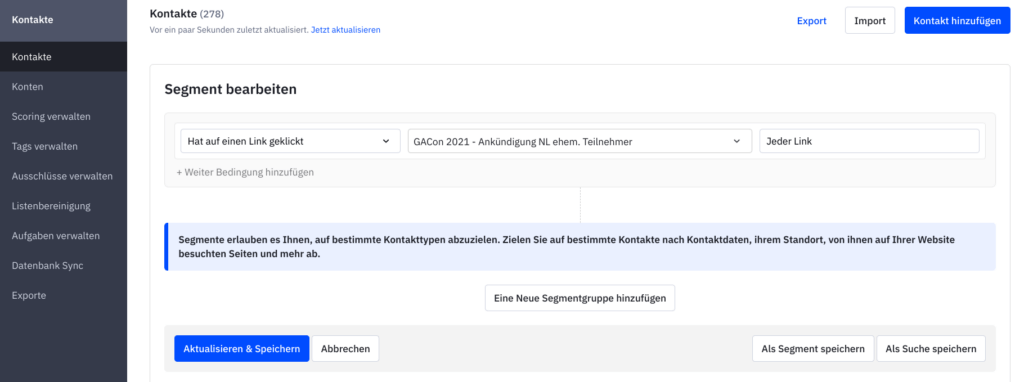
Through herClick behaviorshow your email recipients directlyintereston some content. Use this information! In most email marketing tools, interests and segments can be created based on the click behavior of the recipients. For example, if your newsletter recipient has clicked on the latest pants collection for the third time, then they are most likely interested in pants. Based on this knowledge, you can turn him backpersonalized offerssend.
If you send several different pieces of content as emails, theopeningsalso reveal something about the interest of your contacts. For example, some contacts don’t open generic newsletters at all but only specific offers, which also reveals what type of content is relevant for the recipients. Furthermore, the opening rate among recipients may indicate whichfrequencythey would like to receive emails.
2 Surfing behavior on the website
What can be analyzed within email campaigns can also be transferred to the website with the right email marketing tool. For example, you can understandwhich content, pages, categories or productsView your contacts on your website. Based on this, you can assign interests to the contacts and thempersonalized content and offersto send.
3 Preference Centers
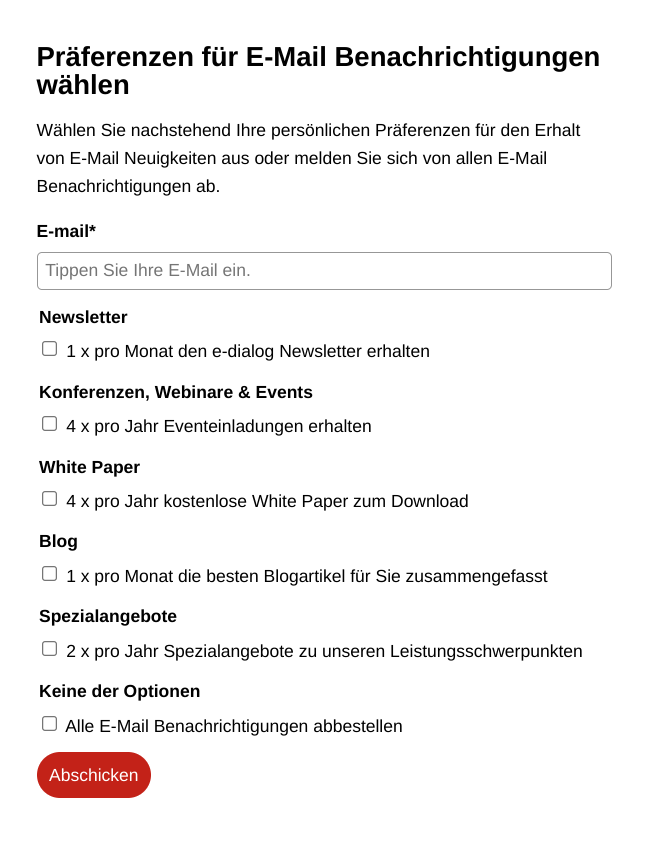
Perhaps the easiest way to conduct lead nurturing and personalize content for your contacts is to use a preference center. A preference center is nothing more than aForm, byUsers their preferencesfor content and, if necessary, the frequency of the mailingsindicate. So if you have different content or product categories, users can directly enter their own preferences. This is a win:win situation because users only receive content that is relevant to them and you once again know how to best address your contacts.
There are two ways to create a preference center:
(1) AtUnsubscribe link in the footer of your email campaign. This means that before your contacts unsubscribe from emails entirely, they can instead tailor the content to their interests. With the e-dialog newsletter, for example, unsubscriptions were reduced by 2%. Or
(2)when opting in to your newsletteror email marketing. This means that users indicate their content preferences in advance when registering.
4 Lead Nurturing in Forms
In general:the shortera form, the higher the completion rate. You should therefore exercise caution when requesting additional information in forms for the purpose of contact enrichment. It is not recommended to use additional form fields to discourage customers from purchasing during the checkout process in your eCommerce store. However, lead nurturing with forms can make sense if, for examplefree contentprovide and in return require interested users to do socertain information in a download formmake.
We have this type of lead nurturing, for example in the download form for oursWhite paper “Consent Management Platforms Comparison”operated by querying the current status of users in the Consent Management area in a mandatory field. This information gave us a better picture of where our prospects stand and made any follow-up easier for the sales team.

5 lead nurturing campaigns
Another option is to use a lead nurturing campaign to collect data from your recipients that you cannot collect in other ways. The response rates for lead nurturing campaigns are highest when you are open and open to usersexplain transparently, what you use the additional data for and how you use itbeneficial for the recipientscan be. An advantage for users could be that they receive relevant content. You can also specify additional dataIncentivein the form of a discount code or participation in a competition.
Let’s say you’ve used market research to identify personas of interest to you based on purchasing behavior, personal attitude, life cycle, and psychographic characteristics. You have also developed communication concepts with which you would like to address each of these personas individually. Now it’s time to do your email marketingDivide recipients into these persona groups. Based on 2-3precisely designed questionsYou could be able to make this classification based on your purchasing behavior, your attitude towards certain aspects or your life situation.
6 transactional emails / thank you page
Another way to enrich customer data is in so-called Transactional emails (such as the welcome email in a newsletter) or the thank you page in an ordering process. On average, transactional emails have an opening rate of around52%. Through theparticularly high visibilityFor such mailings, it is worth asking the recipients for additional customer data using a form.
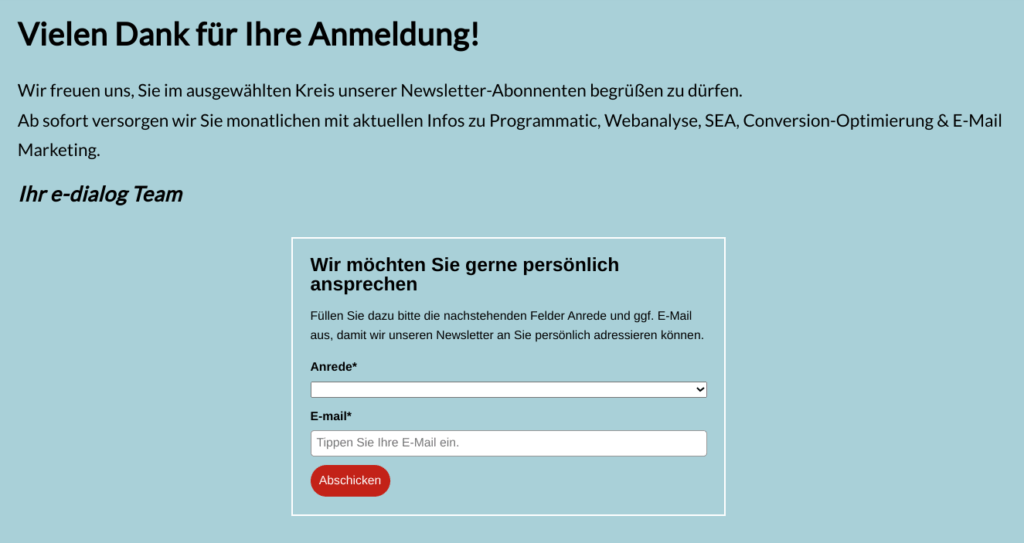
For example, we at e-dialog have placed a lead nurturing form on the thank you page of our newsletter with a very high ratingResponse rate of 75%. >> Read Success Story
7 Link to CRM data
Which users who previously exposed you to online advertising came to your brick-and-mortar store and made a purchase? Which of your website visitors are already loyal customers, and which of their characteristics resemble particularly loyal customers? Which of your newsletter recipients have already inquired about your products by telephone? These questions pose real challenges for online marketers. However, if you can answer some of the questions with your own data, this opens up new opportunities for targeting existing and potential customers.
Typically they are locatedInformation about calls to service centers or stationary purchases in your CRM system. HerEmail databaseis in yourse-mailMarketing tooland yoursWebsite datain yoursAnalytics tool. Normally, these data silos do not communicate with each other, which prevents you from combining the data and holistically understanding the user journey. OneCustomer Data Platform(CDP for short) allows you to link the individual systems together and so oncomprehensive picture of your customer journeyalong all touchpoints. With this understanding, you can target users specifically and the content along all touchpointspersonalize.