Marketing Mix Modeling Vs Attribution Modeling 8211 A Relationship In A Roundabout Way

Management Summary
A dream idea: your target group converts into a lead after just a single click or view of an ad. In practice, however, it turns out that this requires several points of contact over a longer period of time. Thanks to modern tracking methods, marketers and advertisers can gain a very detailed insight into the world ofCustomer journeysobtain. This allows thatTargeted optimization of the marketing budgetand its distribution to the most relevant channels. You get particularly granular and meaningful insights using attribution. But the more classic marketing mix modeling is also used to use marketing budgets efficiently and, above all, to measure the efficiency of offline marketing channels. In this blog post you will find out what distinguishes the two methods, how they work and how you can use them in the best possible way.
What is Marketing Mix Modeling (MMM)?
Marketing mix modeling is used to model the increased sales volume that is due to the increase in advertising on a particular channel to a certain extent. The main goal of MMM is to find out how different marketing activities (marketing mix) determine sales and thereby predict the success of planned activities. This is particularly helpful in predicting the return on investment (ROI) of respective marketing efforts. Statistical models are used here that look at the long-term relationships between business developments and marketing expenses. The data to be collected must be recorded and evaluated using a regression analysis.
Benefits of Marketing Mix Modeling
In contrast to attribution modeling, which can only be used to calculate the efficiency of online channels, MMM allows the collection and evaluation of data from offline channels. This means that numbers from classic print, TV or out-of-home (OOH) campaigns are also included in this survey model.
Disadvantages of Marketing Mix Modeling
Data can only be collected roughly using this process (TV spending/day, estimated reach of print, sales achieved/day, etc.). Furthermore, no direct cause-effect relationships are recorded: it is not known for sure whether a TV commercial followed by a print advertisement triggered a specific purchase. Only rough statistical correlations can be estimated from this.
What is Attribution Modeling?
Attribution modeling helps us to determine which touchpoints or marketing channels are taken into account for a conversion: concrete profit shares can be derived from granular customer journey raw datafor every individual user, every advertising contact and every journeyattribute.
Attribution modeling explained using a football field
Let’s assume our customers are soccer players who just scored a goal (made a purchase). Using attribution modeling, you will be able to track every single contact right up to the shot on goal and thus gain a holistic insight into the entire course of the game (individual customer journey touchpoints).
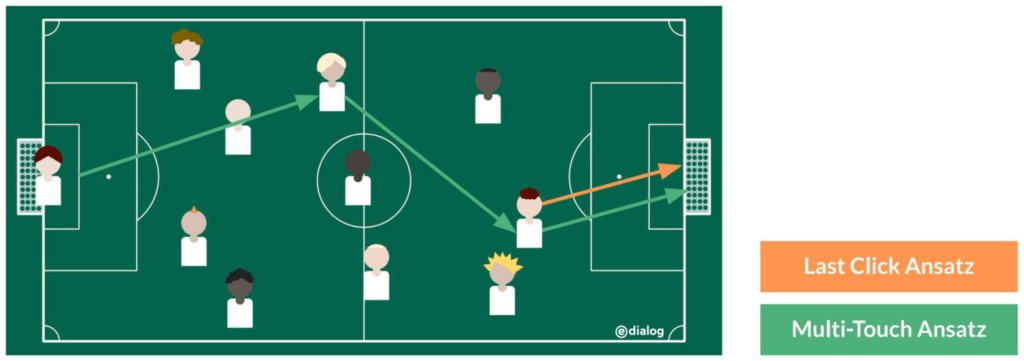
In typical reporting, the information about who contributed what part to success would be lost. Because not only the striker alone, but also the midfielder and the goalkeeper are crucial for a successful end to the game. A valid statement cannot therefore be made from aggregated data. They are merely projections that do not, for example, recognize the value of the midfielder. What is interesting here is not correlations, but causalities that can be proven using attribution and recognize the existing connections up to the goal shot.
Based on the available raw data, we can understand customer journeys based on individual “moves”. If we now transfer the attribution to an online campaign, it can be applied not only to click analysis, but also to views and all KPIs to be recorded by the user are calculated in this model.
What attribution models are there?
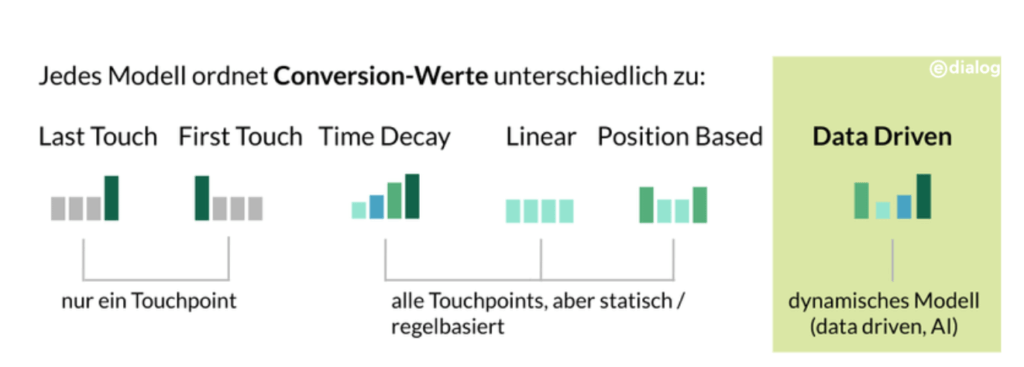
In attribution there issimple models, which only take into account one touchpoint, which are very basic, but are only listed here for the sake of completeness. There is also advancedrule-based models, which statically record all touchpoints. However, they are of greatest interestdata-driven models, which enable deeper insights into the ROI for each marketing channel. Unsuccessful journeys that did not sell a product are also taken into account here, as a valuable learning effect can also be gained from these, namely what does not work. Models based on machine learning, which are regularly recalculated individually depending on the channel or product, are now state-of-the-art and recognize (automatically) which measures contribute to the desired goal. In addition, not only channels, but also campaigns and advertising materials can be evaluated in detail. This gives you the opportunity to combine, relate and understand the insights gained across different channels. The advertiser is also able to easily analyze the quality of incoming traffic and make decisions about the use of channels in the future.
Benefits of attribution modeling
Segmentability – since the attribution models are based on raw data from all individual journeys, the results can also be segmented (filtered, analyzed) according to all attributes. For example, by customer group, products purchased, campaign specifics, precise geography and much more. This enables very detailed insights for further channel and campaign optimization.
Disadvantages of attribution modeling
As can be seen from the points above, attribution models are useful approaches to generate analysis and insights from the customer journey. However, this method reaches its limits when you want to analyze offline channels, as attribution modeling is only applicable to digital channels from which measurable data can be taken (no print or OOH).
Why does a combination of both make sense?
This blog article is not intended to present you with one or the other as the non-plus-ultra analysis model, but rather to highlight the respective strengths and weaknesses. Consequently, a comparison of attribution and marketing mix modeling:
| Attribution (data driven model) |
Marketing Mix Modeling | |
|---|---|---|
| Mission | for daily insights and optimization | for long-term budget decisions |
| Channels | only digital channels | all channels |
| segmentation | detailed information on user groups and product details | Product segments (rough) |
| relationships | possible between individual channels | only viewing per channel |
| analysis | statistical modeling of measured user journeys | Regression analysis |
| activation | programmatic, detailed | long-term planning, rough |
| focus | Optimizations in daily business as well as in the long term | Long-term planning of the marketing budget |
| Database | granular raw data (every single view & click is included) | aggregated data (only totals per channel and time unit) |
Conclusion
Basically, it can be said that a combination of both measures, i.e. MMM and attribution modeling, can represent great added value for your company’s holistic media strategy: the models complement each other! But where attribution is possible, more precise data can be generated, which can make a significant contribution to the efficient planning and management of media budgets.