Moving Image Usage 8211 Where Do The Tv Users Go

Management Summary
In this blog post we look at the development of video usage over time and analyze the behavior of video users by age group. We also place particular focus on the video platform YouTube. We look at what influence new trends in the use of moving images have on marketing strategies.
User behavior has changed
The moving image study by RTR Medien and the Teletest working group has been examining the use of moving images in Austria since 2016. The study analyzes various video channels from linear television to TV media libraries to video-on-demand offers and social media. The 2022 study shows that video consumption is still at a high level. However, it is also clear that user behavior has changed significantly. The daily reach of current TV is currently around 68%, compared to 81% at the beginning of the recordings. The changes are particularly drastic among younger target groups. The reach of current TV among 14-29 year olds has fallen by almost half since 2016 and is now only 39%. At the same time, you notice a jump in the daily reach of “Total Video”. “Total video” is defined in this study as live streams, video-on-demand and downloads via platforms such as YouTube, Netflix, Amazon Prime, social media, etc. This type of video usage is particularly popular among younger people under the age of 30.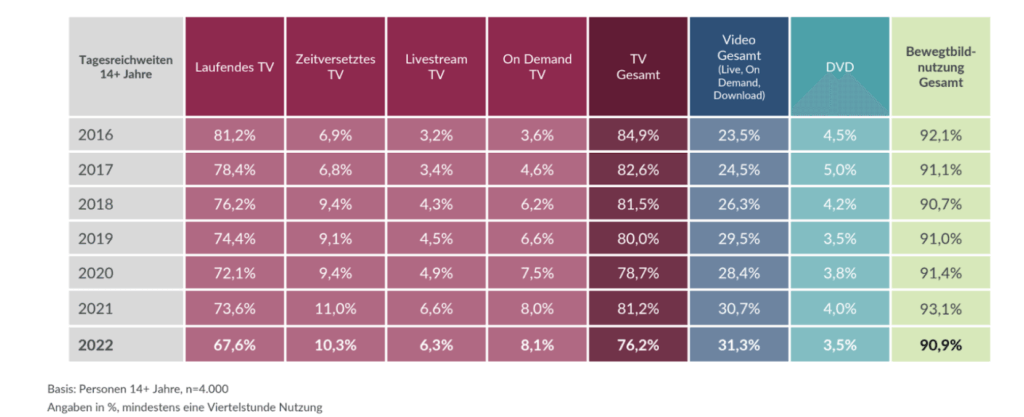 Source: Moving Image Study 2022
A forecast study by the University of Salzburg confirms that current developments will remain relevant in the future. The usage time of moving images will increase in 2024 and 2030, but the increase will be driven by non-linear moving images. Another study also predicts a reduction in the number of minutes of use of linear television in all age groups.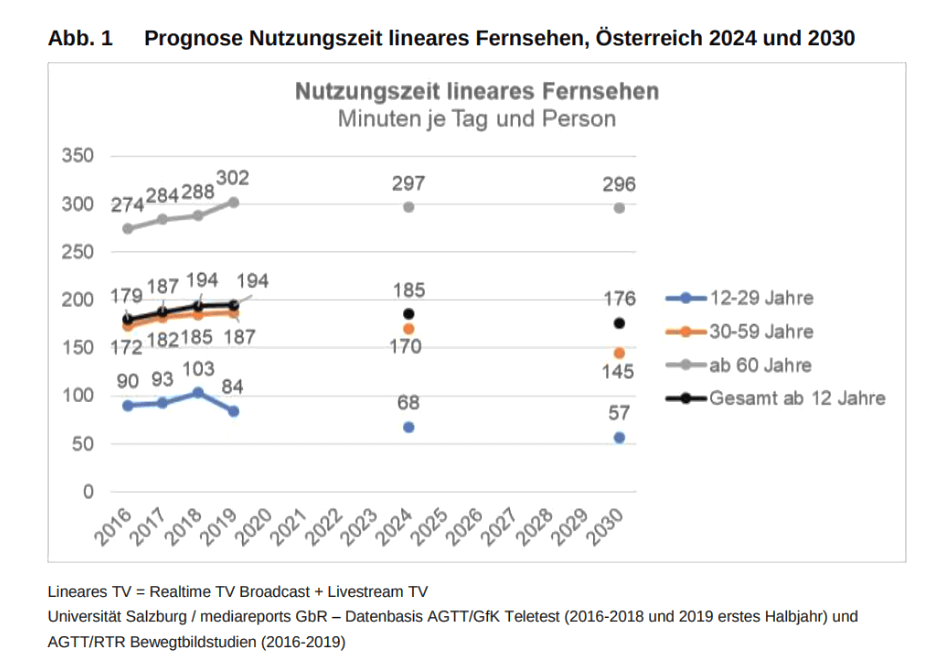 Source: Linear television 2030 in Austria
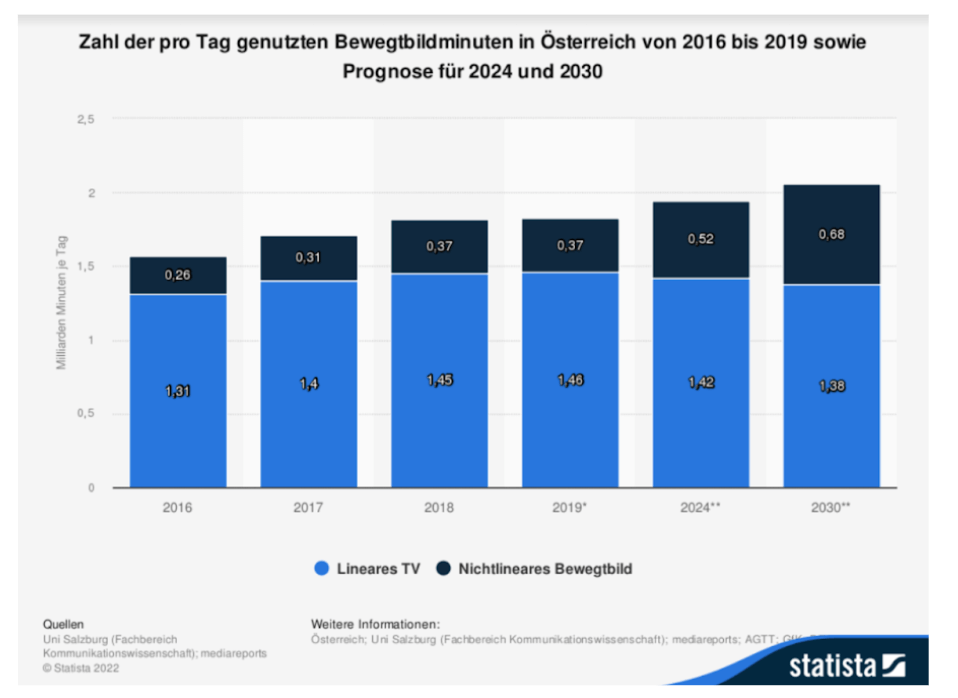 Source: Minute volume of moving image offers in Austria
Distribution of video usage by age group
The trends in usage habits show that classic television cannot be seen as the only moving image medium. Although television still accounts for a large proportion of usage, other video platforms should not be neglected. This becomes clear, among other things, when one analyzes the distribution of the average length of use of the various population groups.
Linear TV is particularly popular with people over 50 years old. According to the moving image study, they spend the majority of their viewing time watching classic television and the reach in this age group is therefore very high. However, the gap between video and TV is larger the younger the respondents are. In the advertising-relevant target group (14-49 years), almost 59% of viewing time can be attributed to television. In addition to linear TV, this also includes time-shifted TV, live stream TV and on demand TV. However, other video platforms such as Netflix, Amazon Prime Video and Instagram already have a significant share of video usage of 38%. YouTube particularly stands out with a percentage share of 9.1% and is the second most used moving image offering after current TV! For younger people under 30, the proportion is even higher and amounts to 13.4%. This target group spends almost half of their usage time consuming various video offerings, while only a third can be assigned to linear television.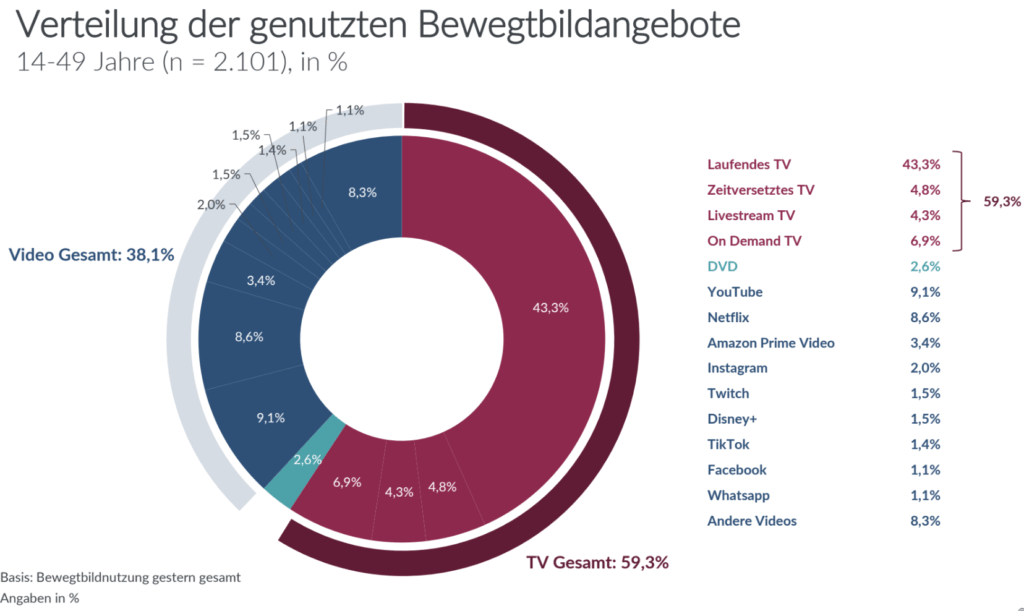 Source: Moving Image Study 2022
The YouTube potential
According to the moving image study, YouTube is the most widely used platform among video offerings. The number of YouTube users has increased by 65% since 2017 and amounted to around 5.5 million in 2021. According to forecasts, the growing trend will continue in the next few years and YouTube is expected to have around 6.8 million users in 2025.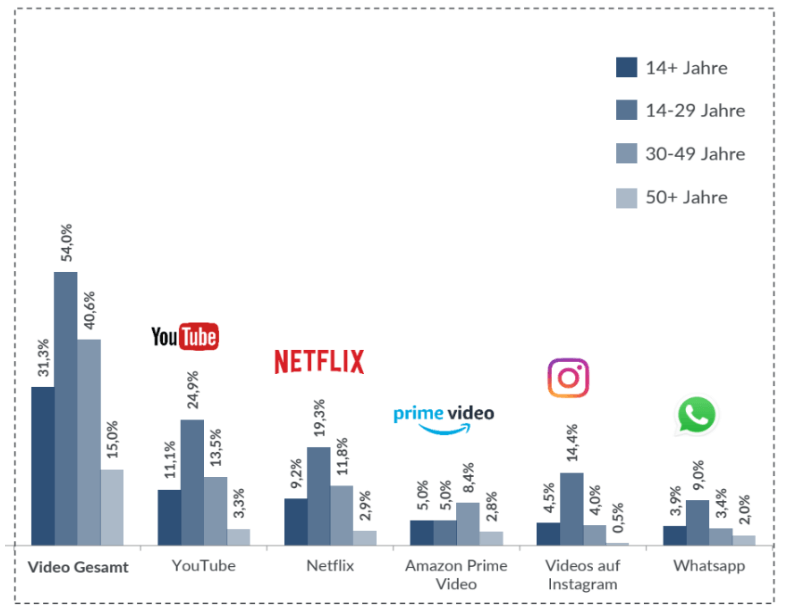 Source: Moving Image Study 2022
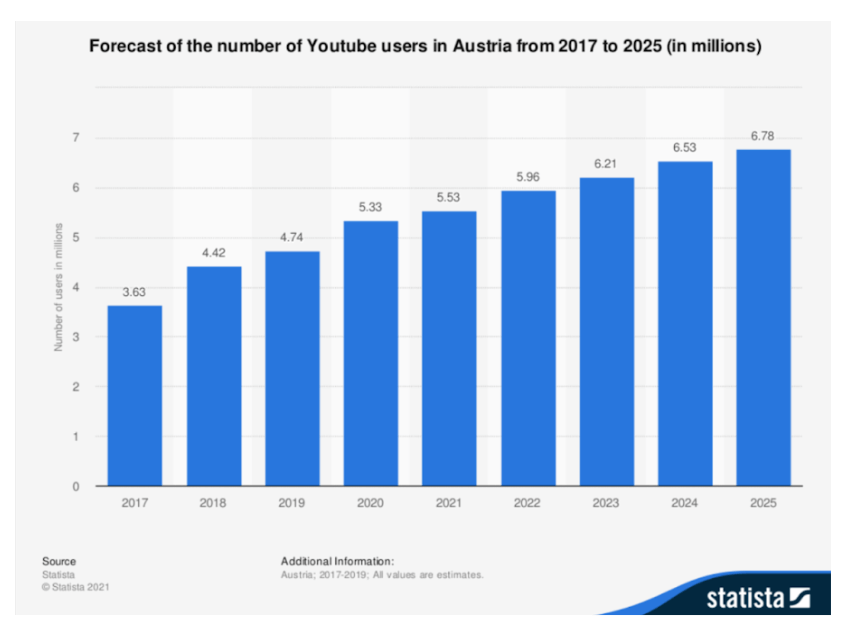 Source: YouTube users in Austria 2017-2025
The question now arises as to what influence these developments in the use of moving images have on marketing strategies and how should marketing managers react to new trends?
In a meta-analysis, Nielsen observed 144 MMMs (marketing mix models) from the consumer goods industry in Germany and researched the effectiveness and efficiency of moving image channels. This independent study by Nielsen showed that ads on YouTube achieved both higher advertising impact and higher revenue than TV advertising. Although the majority of the budget was invested in TV, YouTube achieved an average of 3.9 times higher sales. This results in an ROI that is almost twice as high (1.7 times) for YouTube spots compared to TV spots. The Nielsen meta-analysis discovered great potential in video marketing. Advertisers can achieve maximum ROI in the moving image sector by increasing the average weekly YouTube budget by 77%.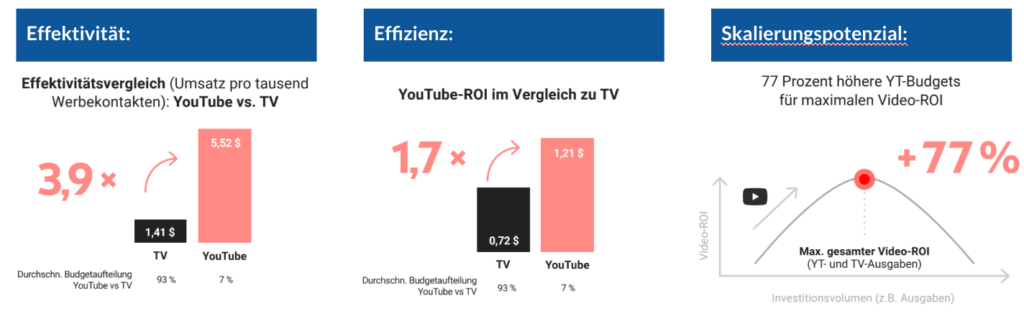 Source: New Nielsen study on the optimal moving image mix: Why marketing managers should act now
Conclusion:
Although linear TV is still the most used moving image medium, its reach is decreasing across all target groups. Meanwhile, non-linear video usage has increased dramatically in recent years and is forecast to continue to grow. Above all, YouTube is proving to be a frequently used platform with a high reach and great investment potential.
Do you have anymore questions? We are happy to help you! Contact us viakontakt@e-dialog.group
Sources:
- Moving Image Study 2022; RTR Medien and Teletest working group; 2022
- Linear television 2030 in Austria; University of Salzburg Department of Communication Studies; 2019
- Minute volume of moving image offerings in Austria until 2030; Statista 2022; 2022
- YouTube users in Austria 2017-2025; Statista 2022; 2021
- New Nielsen study on the optimal moving image mix: Why marketing managers should act now; Ludwig Brütting, Nils Hartje; 2022