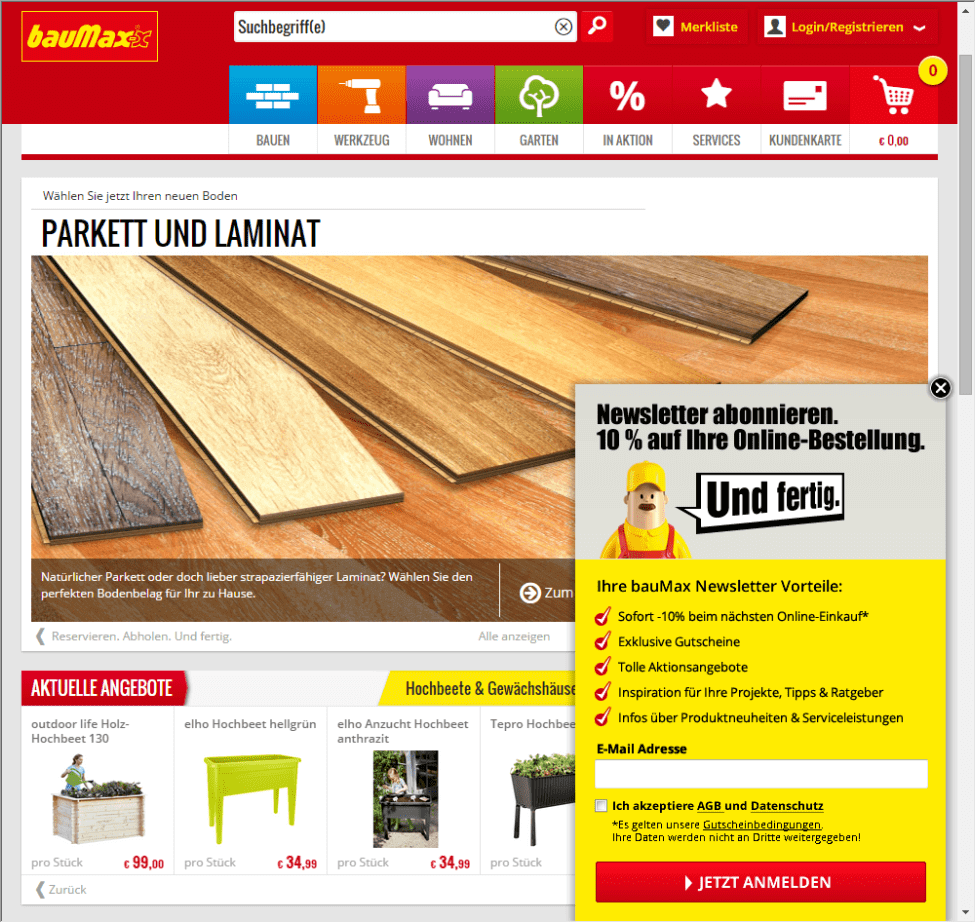
Optin Layer %e2%89%a0 Optin Layer
Management Summary
Efficient increase in newsletter subscribers
What sounds simple hides a well thought-out concept in the background. In addition to the layer’s specification of size, shape, content, etc., there must be a concept for the following measures:
- Regulation mechanism: to control the display of the opt-in layer (when, how often, where).
- Interface issue: it must be clarified where the user’s data flows in what form after it has been entered in the opt-in layer.
- Tracking: to to make it understandable what was actually achieved with the layer.
“E-mail marketing works and every newsletter subscriber gained is therefore worth its weight in gold,” confirms Siegfried Stepke, managing director of e-dialog.
1. Top priority: the right control mechanism using data from web analysis
Showing the layer to every user on the homepage every time they visit the website is definitely the wrong approach. The layer must be played out according to a specific control mechanism that is based on the customer-specific data from web analysis. The top criterion for the control mechanism is that buyers should never feel disturbed and those who return should never feel annoyed.
The analysis data results in an individual pattern of values for each website. There is no uniform control mechanism that can be applied to all websites. The users of each website visit the site differently often, with different lengths of stay and view different numbers of sub-pages per visit. For example, the layer could only be played every second session and the third page visited.
2. Interfaces reduce manual effort
What happens after a user signs up for the newsletter via the opt-in layer? You should definitely ask yourself this question. Everything that has to be done manually is prone to errors and takes time.
We recommend: an interface to your newsletter tool must definitely be present. This means that all data flows immediately to the right place and the new recipients can be sent to each newsletter easily and without prior import.
3. Tracking makes the results verifiable
Online activities without tracking? We can’t think of any reason why this statement would make sense. That’s why an opt-in layer also needs to be tracked. This is the only way to determine exactly how many conversions are triggered and how high the engagement is in the web analysis tool. Tracking the individual pages is particularly important for opt-in layers with multiple frames in order to analyze the success of the frames and derive optimization measures.
Case: Layer helps bauMax achieve a 138% opt-in increase in 3 months
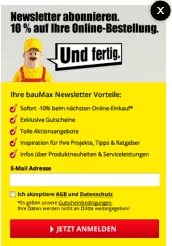
Using bauMax as an example, we show how high the increase in newsletter registrations can actually be. The increase in the total number of all registrations for the bauMax newsletter was measured – with clear results. With the OptIn Layer, 138% more newsletter registrations were generated in Q2 2015 compared to the previous quarter. That’s 138% more potential buyers who can be contacted regularly because they have given their consent in the opt-in layer.