Performance Max Campaigns 8211 The Eierlegende Jack Of All Trades

Management Summary
Since mid-2021, there have been three words that have caused quite a bit of anticipation, excitement and discussion in the Google Ads world – thePerformance Max campaign. With this new campaign format, Google promises even more automation, a simplified setup and still the ability to optimize specifically for the most important conversions.
But what exactly is a Performance Max campaign?
PMax is essentially a Google Ads all-in-one solution that allows users to use all Google channels with just one campaign. During setup, keywords, display ads, videos, ad assets, the product feed and more are put into the campaign, which then uses these assets to optimize towards the desired goals and maximize performance. Performance Max campaigns combine all Google channels
In contrast to standard search, display or shopping campaigns, campaigns are no longer divided into ad groups, but rather into so-called asset groups. The product groups are now also called listing groups.
assets
Google generally recommends storing as many assets as possible so that all placements can be used. But that is not a must. For example, only one product feed can be stored without keywords or creatives, then only shopping will be used (correct, like in a Smart Shopping campaign).
bidding
PMax campaigns, as the name suggests, focus on performance. You won’t find the option to maximize clicks or impression share in the settings. You can choose between two bidding strategies:
- Maximize conversions (optionally also with target CPA)
- Maximize conversion value (optionally also with target ROAS)
Targeting
As with the well-known Smart Shopping and Display campaigns, it is not possible to target individual target groups with the Performance Max campaigns. However, you can make your customer lists available to the system and then exclude them from targeting. The respective Google contact can also block brand keywords in the campaign.
Audience Signals
Since it is not possible to target specific target groups, it is even more important to provide the algorithm with the right audience signals. By storing the most important target groups, machine learning can optimize better and faster for the desired users.
Reporting
Similar to the well-known smart campaigns, Performance Max is also a black box in some places when it comes to reporting. However, Google promises to provide more options for insights in the near future.
Who should use Performance Max?
But who are these Performance Max campaigns intended for? Large Google Ads accounts with several thousand euros in media spend per month that employ several employees to optimize their shopping, search and display campaigns? Or small businesses that want to put as little time and effort into their campaigns as possible and get the most out of the budget they have? According to Google, Performance Max is intended for everyone, both large and small accounts. Below we have taken a closer look at two very different accounts that use PMax campaigns:
e-Commerce: Performance Max vs. Smart Shopping
Using the example of a large e-commerce retailer that has so far relied primarily on Smart Shopping campaigns, we tested whether Performance Max campaigns are suitable for this type of account.
At the end of Q2, Google began enabling certain accounts for the 1-Click tool, which enabled an easy switch from Smart Shopping to Performance Max. With just one click, the old Smart Shopping campaign is deleted and re-set up and started as a PMax campaign with all existing settings. Anyone who is afraid of a long learning phase or a drop in performance can rest assured: The switch from Smart Shopping to Performance Max campaigns for e-commerce companies
In the case of the e-commerce retailer, the PMax campaign, which was converted using the one-click tool, started without any problems after just one day and was able to generate a conversion value uplift after just one week. So if you have a large amount of data in your account and have so far relied on Smart Shopping campaigns, you should definitely think about a PMax test. The new campaign is not called Smart Shopping 2.0 for nothing.
Education: Performance Max vs. Standard campaigns
Using the example of a smaller educational institution, we tested how a Performance Max campaign compares to the classic search, display and discovery campaign. The PMax campaign was filled with text, image and video assets and played out parallel to the other campaigns. Due to the small amount of data in the account, the test ran for several weeks.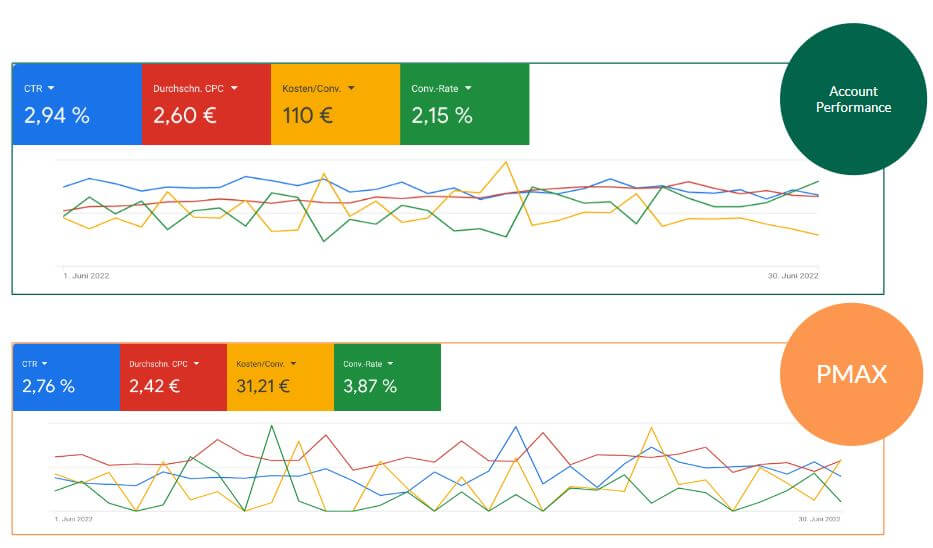 In comparison: Performance Max campaign vs. Standard campaign
The results of the PMAX campaign show an almost 70% lower CPA compared to overall account performance and a consistently lower CPC. Based on these results, it was decided to continue using the campaign. Obviously, despite the small amount of data available to it, the Performance Max campaign is performant and can optimize well towards the goals.
Conclusion:
No matter whether it’s a large account with a lot of data or small campaigns with little budget – Performance Max campaigns should definitely be tested! However, before setting up the PMax campaign, it is important to think carefully about the purpose for which I want to use it. For example, should it only replace Smart Shopping and only be used for shopping and retargeting or perhaps even use all Google placements? Google promises to provide even more insights and reporting options for Performance Max in the future, so that hopefully more light can soon be shed on the performance black box.