Personalize Or Perish Why Ads Need Personalization
Management Summary
Learn how tailored advertising is changing the game in the marketing world – and why your brand can’t be left behind.
Personalization, the key to success?
We’ve all been there: You’re surfing the internet or scrolling through social media and you’re bombarded by ads. Many of them are no longer consciously noticed – they are uninteresting. Others strike you negatively because they simply ignore your own interests and preferred purchasing behavior. Only a few make it into our memory and even fewer entice us to click or buy directly.
So if you still believe that a banner ad is just a piece of the digital landscape, then you probably haven’t discovered the power of personalization yet. This is by no means a new topic –dynamic digital advertising mediahave long been a popular “secret weapon” in online advertising.
Dynamic and personalized – an unbeatable combination
Dynamic advertising media are like the chameleons of the advertising world: they adapt in real time to present relevant and engaging content for each user. Unlike their rigid cousins, traditional banners, which appeal to everyone while playing the same old song on a loop but never really reach anyone, dynamic advertising uses data and algorithms to ensure that what you see is what interests you. So it’s no wonder that71% of consumers want ads that are tailored to their shopping habits and interests (Study by Adlucent).
The psychology behind it is very simple: we humans are all different. We have different interests and preferences. While one person may enjoy humorous advertising, someone else may want straight facts and information. Personalized advertising makes us feel like we’re not just another number in the big database, but that there are shops and companies out there that really understand us.
Individual approach and its effect
Individualizing how you address customers is a tried-and-tested strategy to increase advertising effectiveness. Personalized advertising speaks directly to users and creates a deeper emotional connection to the brand. This targeted approach not only promotes engagement, but also increases the likelihood of a conversion – from initial interest to purchase.Over 80% of consumers would be more likely to make a purchase if the product’s marketing and advertising were personalized to them (Study of Epsilon).
Studies in the field of digital marketing repeatedly show that personalized ads are more effective than non-personalized ads (see e.g.Forbes statistics collection). It is reported that a targeted personalization strategy can significantly increase conversion rates, increase ROI, and reduce customer acquisition costs. At the same time, companies that pursue personalized approaches to marketing and advertising see a significant improvement in customer loyalty.
We have also seen the success of personalized advertising campaigns several times – across companies and industries.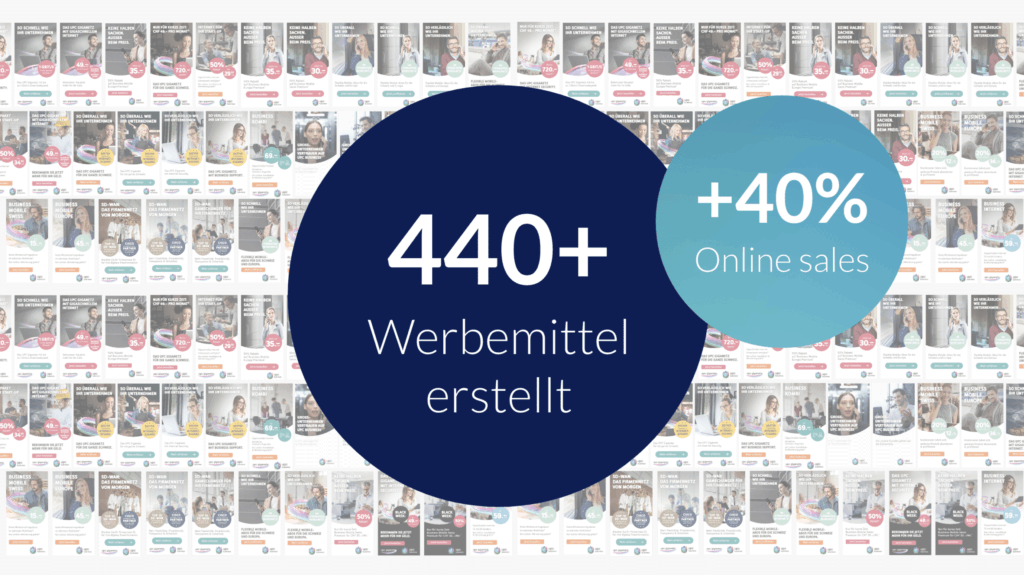 Always-on campaign with full-funnel approach for Sunrise Business, with dynamic and personalized ads, source: e-dialog
The most effective marketing speaks to people not just as buyers, but as individuals. And that’s exactly what makes personalized advertising so powerful – it recognizes the people behind the data points.
No personalization without a creative concept
In the world of digital advertising, creativity is key. But creativity alone is not enough if it is not tailored to the needs and interests of the target group. This is where personalization comes into play: it allows advertisers to develop creative concepts that not only stand out but also resonate personally.
Extraordinary creativity is based on irrefutable strategy
Developing a creative concept that includes personalization is an art in itself. It starts with a deep knowledge of the target group – their wants, needs and behaviors. Building on this, messages are created that are individually tailored and still clearly communicate the brand identity.It’s about creating a narrative that appeals both universally and individually.
Examples of successful personalization
Take, for example, a marketing campaign for a travel platform that presents potential customers with individually tailored travel destinations based on their previous searches and bookings. This data can also be combined with other individual information – for example interest-based Google Audiences.
But the advertising media doesn’t just use this data. It is also crucial that they flow into an appealing storyline – perhaps that of an action-loving adventurer who always finds the perfect travel destination by chance, or that of a tired businessman who suddenly wakes up in his dream destination. It is such creative, personalized concepts that turn simple, dynamic campaigns into successful and award-winning success stories.
This is how we were able to do so in our projectsXXXLutzandSPORT 2000Leverage the benefits of personalization to achieve outstanding results for our customers.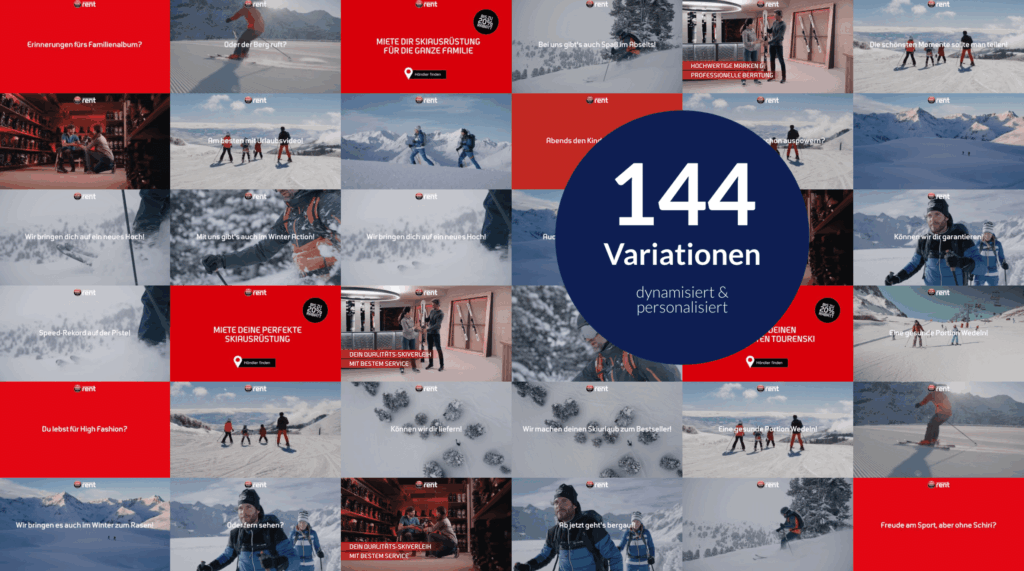 By using ACS Dynamic Templates we were able to do so with little effort144 dynamic and personalized video ad variantsbe implemented, source: e-dialog
Challenges and limitations of personalization
Personalization in digital advertising sounds like the ultimate marketing coup, but of course it also comes with its own challenges. Data protection regulations are becoming increasingly strict and users are becoming more aware of their online privacy. This requires a sensitive balance between personalized approach and maintaining privacy. Over-targeting, which makes users feel like they are being followed all the time, everywhere, is understandably off-putting and has the exact opposite effect of what was intended.
And even though it may sometimes sound like it, personalization is not a silver bullet that works equally well for every target group. There are limits to what is considered comfortable – and these limits are subjective and culturally different. The challenge for marketers is to recognize these limits and design marketing measures in such a way that users perceive them as added value.
The golden mean
So it’s important to find a healthy middle ground: personalized enough to be relevant, but not so specific that it seems scary. Successful campaigns often use A/B testing and constant feedback to find the right level of personalization.
Future outlook and innovation in personalized advertising
The future of personalized digital advertising lies in the intelligent integration of technology and creativity. Artificial intelligence (AI) and machine learning will enable increasingly precise personalization without being intrusive. The use of big data and predictive analytics can help to better understand and predict user behavior.
The combination of augmented reality (AR) and virtual reality (VR) with personalized advertising messages could also create completely new worlds of experience for customers.
A future in which people are the focus
In a world where products and services are becoming increasingly interchangeable, personalized advertising can help brands stand out and build a deeper emotional connection with consumers.
Nevertheless, it will be crucial to keep an eye on developments and adapt strategies. Because as quickly as technology advances, your customers’ expectations change just as quickly. After all, they are the ones that make or break every advertising campaign.
Conclusion:
In summary, personalization in digital advertising is neither a short-term nor a new trend, but an essential part of an effective marketing strategy. It offers a unique opportunity to directly address users personally, improve the online experience and ultimately increase success numbers. But with great personalization comes great responsibility. Advertisers must find the right balance to reach their target groups effectively and appropriately.
The journey into the future of personalized advertising promises to be exciting, full of technological advances and innovative applications. It is still crucial that companies do not lose sight of the people behind their target group data and user behavior.