Play It Safe 8211 Brand Safety In Dv360

Management Summary
Brand safety has become massively more important in recent years – at least since the issue surrounding Breitbart, there is no getting around the topic. But don’t panic – DV360 offers numerous options to ensure a secure brand environment.
But is it that easy to distinguish between “good” and “bad” inventory? The answer is no – there are a few categories in which very few advertisers are happy to appear. Other topics depend heavily on the product – you probably wouldn’t want to appear on an online wine guide for baby accessories, but you would probably want to appear in an advertisement for a gourmet restaurant. In this article we want to show the possibilities of DV360 with which you can guarantee brand-safe playout.
Option #1
The first optionTo ensure brand safety, targeting is based on digital content labels. These describe the different classifications of apps and websites. This is how every page is ranked and assigned by Google. The basis is the diverse aspects of a website in terms of keywords, quality, user experience, content and structure. These are updated monthly.
The following categories exist:
- DL-G: suitable for all users
- DL-PG: content suitable for most target groups; the presence of an adult is recommended.
- DL-T: Content suitable for young and older viewers
- DL-MA: content suitable for adults only
- Not yet labeled: not yet assigned a label (for very new websites or non-transparent inventory)
Option #2
The second optionis to filter inventory based on sensitive categories. Google also uses its technology to filter pages.
The following sensitive categories can be excluded:
- Adult: Adult content
- Derogatory: Content that can be interpreted as biased and derogatory based on criteria such as ethnicity, religion, disability, gender, age, sexual orientation, gender identity or political orientation.
- Downloads & sharing: Content related to downloads or file sharing
- Weapons: Content that deals with firearms or other weapons
- Gambling: Betting and gambling (also such as online casinos)
- Suggestive: suggestive content that is not explicitly pornographic (site label DL-MA)
- Violence: Content that can be classified as violent or shocking. These include videos of fights and explicit descriptions of violent crimes
- Profanity: swear words or sexual expressions
- Drugs: legal and illegal drugs, their cultivation and production
- Alcohol: Content about alcoholic drinks, as well as recipes
- Tobacco: Smoking products of all kinds
- Politics: political content, discussions (note – news sites can also be affected here)
- Religion: religious themes or beliefs
- Tragedy: Content related to death, disasters, war or similar
- Transportation accidents: car accidents, plane crashes or similarly serious accidents
- Sensitive social issues: polarizing and controversial topics where there are strongly differentiated views. Examples here could be immigration issues or abortion (these issues can vary by country and market)
If the control of Google itself is not enough for you, you can3rd party providerfall back. Integral Ad Science, DoubleVerify and Adloox are integrated into DV360 and can easily be added to the campaign with a click – costs are limited to a small CPM surcharge.
Other providers such as Meetrics, Batch, CHEQ.AI or many others can also be easily connected. In this way, brand safety can also be ensured with the preferred partner.
There are also other ways to maintain brand safety in programmatic control. A classic variant here is the use ofBlack and white lists.Absolute no-gos for URLs can be easily ruled out here.
- Whitelists: List of websites on which content can only be played
- Blacklists: List of websites that are not allowed to be played on under any circumstances
Furthermore, inventory can also be easily taken with younegative category targetingrestrict. If the general exclusion of “Politics” is too imprecise, you can differentiate further by specifically excluding the category “Right-Wing Politics” or “Left-Wing Politics”.
Also negativeKeyword targetingcan be used as a filter. For example, tour operators can ensure that you are featured on news sites, but not in the context of “plane crash” or “terrorist attack”.
Some advertisers also like to work harderprivate deals– here the play of the surroundings can be clearly defined in advance.
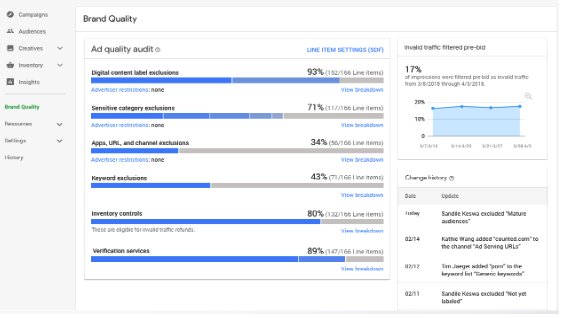
Maintaining an overview of all brand safety settings can be a challenge, especially with complex campaign structures. An ideal overview and control function of all measures can be found inBrand Quality Dashboardfind. With this DV360 feature, direct monitoring can be carried out and further optimization potential can be quickly discovered.
Conclusion
In summary, it should be noted that brand safety settings have gained a high priority in the quality assurance of online ads.