Possible Impact Of Consent Changes On Programmatic Campaigns

Management Summary
Privacy on the Internet is becoming increasingly important and private individuals are also becoming more and more conscious about their data. They are often skeptical about personalized marketing, but at the same time have little knowledge about it. According to statistics, the opt-in rate (the rate of users giving their consent to cookies) for most websites is around 40-50%. This development has a clear impact on programmatic campaigns. But are we already aware of this?
What does that mean in detail?
The current Privacy & Tracking topics have a significant impact on programmatic campaigns. The following effects are already noticeable:
- 3rd party cookie loss: In some browsers such as Safari or iOS 14, 3rd party tracking is no longer possible; Google has also announced its use without 3rd party cookies for Chrome in 2023.
- Abbreviation of Conversion Lookback Window: The measurement of conversions has already been limited to 24 hours, e.g. in Safari, by shortening the conversion tracking.
- Limited App & Web Tracking: Apple’s changes also have a (negative) impact on the link between app and web tracking in iOS 14.
- Increased privacy regulations: Current data protection laws mean that advertisers have to work with smaller data pools; e.g. GDPR (General Data Protection Regulation), CPRA (California Privacy Rights Act), and LGPD (Brazil Lei Geral de Proteção de Dados)
- Increased use of ad blockers: Currently, around 37% of internet users worldwide use ad blockers. Not only do ad blockers prevent ads from appearing, they can also make tracking conversions more difficult.
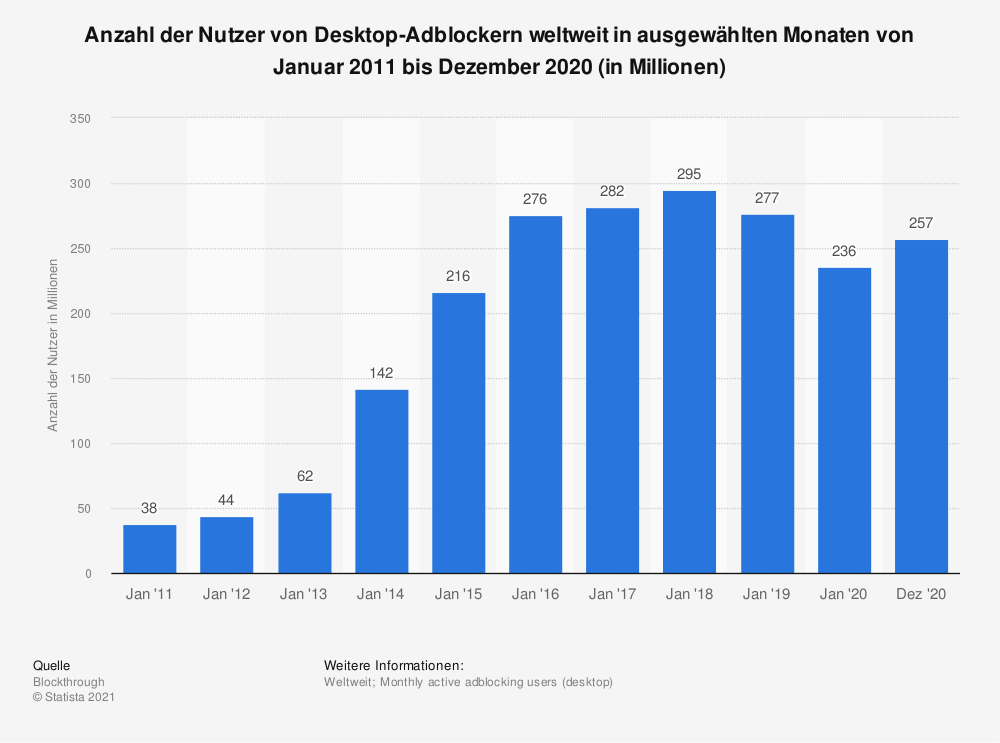 Source:statista.com
What do these changes mean for programmatic campaigns?
These current topics influence our online campaigns. We can already notice some effects in reporting, for example, while others only become apparent when analyzing performance. Below we have summarized the most important points that affect not only reporting, but also the control and optimization of programmatic campaigns.
3rd party targeting is no longer possible
The first and obvious impact of the above points for online campaigns is the restriction of 3rd party data. From 2023 at the latest, 3rd party targeting will no longer be possible.
1st party audience targeting becomes more difficult
Due to the limited tracking, significantly less information regarding user behavior on the website can be used for online campaigns. If we can track fewer users, we also collect less 1st party data, which leads to a shrinking of the audiences collected. An influence on campaign performance can already be observed, especially in remarketing, as only fewer users can be retargeted. The narrower the audiences become, the more the purchase price in the open inventory can increase.
Creating Similar Audiences is compromised
The gradually decreasing number of users in the 1st party audience lists also influences the creation of similar audiences (users with similar interests to a specific 1st party audience list) for the online campaigns. If the shrinking of the audiences means that a smaller data pool is available for the algorithm, the similar audiences can no longer be formed as precisely.
Conversion reporting is restricted
Just like the collection of audience lists, the measurement of website conversions is also limited. This also means we have fewer website conversions available for online campaigns. The conversions generated are not measured at all or cannot be assigned to the campaign (e.g. view-through conversions or conversions that take longer than 24 hours). In the second case, the conversions may appear under direct traffic (see screenshot) in Google Analytics and therefore the influence of a campaign on the conversion can no longer be analyzed precisely.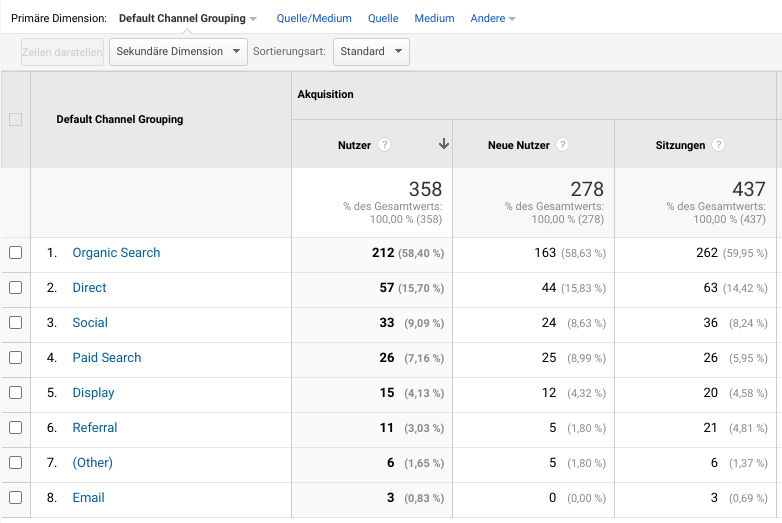 Source: e-dialogue
Conversion optimization is slowed down
Due to the limited measurement of conversions, we can not only report the performance of a campaign unclearly, but also control it more unclearly. Optimization strategies that rely on conversion generation have less basis due to the smaller data pools and become imprecise.
How do I deal with this?
Of course, there are also some approaches that will help us with campaign control and reporting in the future.
Reporting will be more complex and probably less detailed in the future. We currently recommend reporting the performance of several tools and comparing them to fill in any gaps. Various attribution models such as a data-driven attribution model or marketing mix modeling (MMM) can also help to reinterpret the performance of a campaign or channel. (→ Read ourBlog articleon this topic) There should also be increased use of a comparison with the real sales figures in order to assess the overall performance of the measures.
Google already has several solutions for the post-cookie era. An intelligent solution to the decline in measurable conversions is conversion modeling. This already enables advertisers to close the resulting gaps with statistical predictions using machine learning. (→ Read ourBlog articleon this topic)
A planned component of Google’s Privacy Sandbox, which is currently still in development, is the Attribution Reporting API, which is intended to offer a data protection-compliant alternative for conversion measurement and reporting. You can find more information about thishere.
For targeting, it is currently very important to build 1st party data. This can ensure that the formation of similar audiences and remarketing continues to function smoothly for as long as possible.
To boost the collection of 1st party data, the adjustments to the consent banner help enormously. User consent can be influenced by the design of the cookie banner. The opt-in rate can be increased simply through small adjustments (e.g. colors, text, etc.). (The legal requirements must of course be adhered to.) We therefore recommend carrying out A/B tests in order to determine the optimal cookie banners. (→ Read ourBlog articleon the topic of consent optimization)
In addition, Customer Match is a good alternative to making 1st party data available for campaigns. With Customer Match, also known as customer matching, targeting can be expanded with customer data such as name, email address, device ID, etc. Of course, the data protection requirements must be taken into account.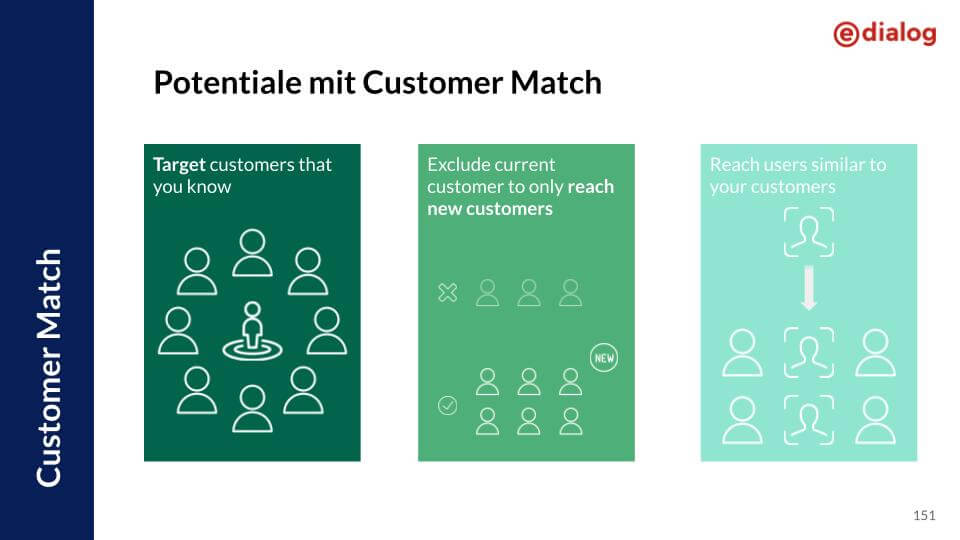 Source: e-dialogue
When it comes to campaign management, it is currently important to be open to new possibilities and test, test, test. In addition to conversion modeling, we can also use custom bidding to give the algorithm more signals for optimization. With the Goal Builder in DV360, even simple custom bidding scenarios such as conversion weighting can be quickly mapped. (→ Read ourBlog articleon the topic “Custom Bidding made easy”)
This could become an essential lever in optimization.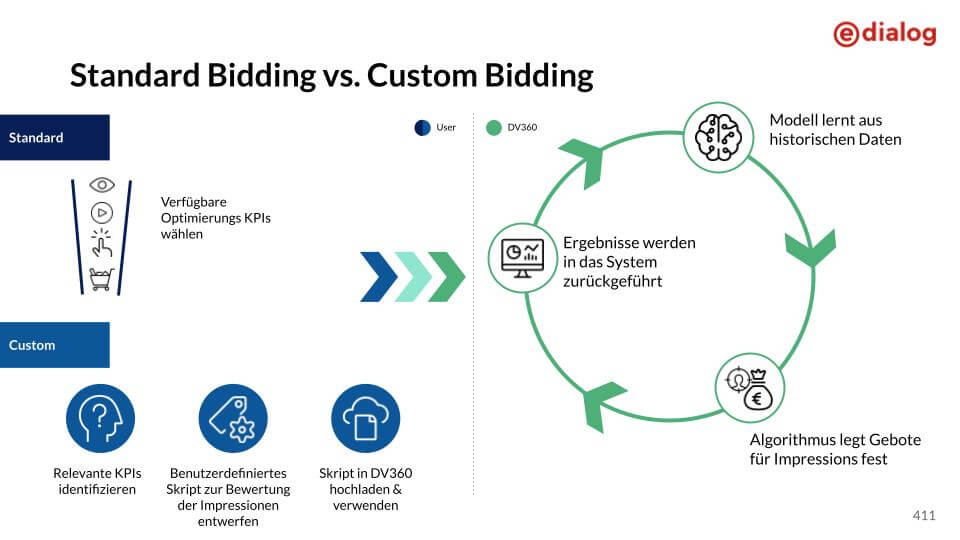 Source: e-dialogue
These few points alone make it clear how complex the topic and extensive the effects of consent changes are. It is therefore essential not only to change your way of thinking in terms of data interpretation, but also to expand existing approaches in the setup and control of campaigns and to test new methods.
Conclusion
Many changes in the data protection and consent management environment are already having an enormous impact on our programmatic campaigns. A lot will change not only in the area of reporting, but also in terms of campaign management. It is important to inform ourselves in advance if possible and to research the influencing factors and their possible effects. By remaining open to new perspectives and methods, we can not only protect user privacy, but also ensure the success of our own campaigns.