Remarketing Lists For Search Ads Rlsa A Must Have For Every Business
Management Summary
Why is remarketing so important?
Have you ever wondered how many people who visit a website add products to their shopping cart and then leave the website without completing an order?
Based on an analysis of 37 studies from 2006-2016, according toBaymard Institutea global shopping cart abandonment rate of 69.23%. And the abandonment rate continues to rise. According to Statista.com, the shopping cart abandonment rate in Q2 2017 was: 77.3%.
OurGoalas an advertiser it is,Find a way to retarget these users and convince them to complete the transaction!And that’s exactly what you use remarketing lists for.
Display remarketing versus search remarketing
“Remarketing” is generally associated with display campaigns: people who have visited a website are addressed again in the Google Display Network (GDN) using a banner without having actively searched for a product from this website at the time.
In comparison to display remarketing, search remarketing only shows ads when visitors who have already been to the website perform a new search query.
Remarketing Lists for Search Ads – How and When to Use Them?
Search Ads Remarketing Lists allow us to add custom audiences in search campaigns without creating a separate campaign or using a separate budget. In order to store a remarketing list in a search campaign, the list must contain at least 1000 users.
The following example shows you how easy it is to create remarketing lists for search ads:
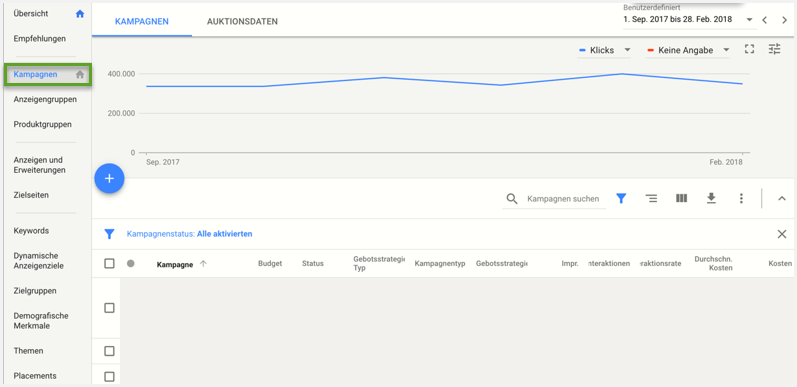
1. Select the desired campaign to which you would like to add the remarketing lists:
2. In the next step, click on “Target groups”, select the desired remarketing lists and press “Save”.
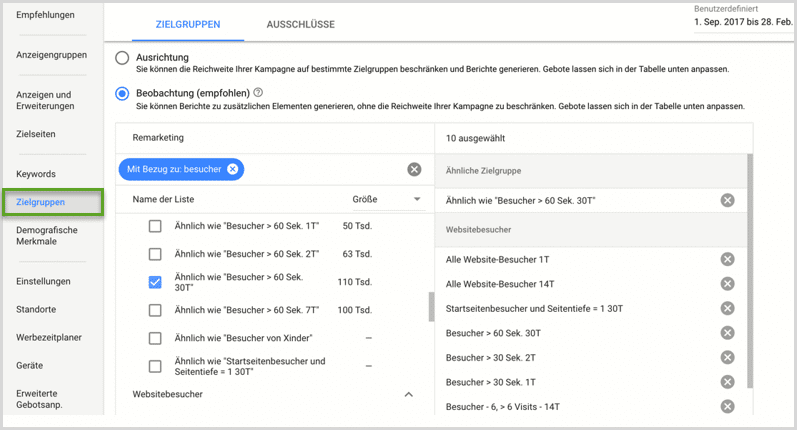
When using remarketing lists, you can choose from two setting options:
- Alignment
Formerly called “Alignment and Commandment.” Using this option limits the range; The ads will only be shown to users who are in the added remarketing lists.
- observation
In the previous Google Ads interface, this option was called “bid”. This means that the reach is not limited and the ad is played every time a search query is made for one of the booked keywords, regardless of whether it concerns new or previous users.
3. Next, you can adjust the bid for each individual remarketing list.
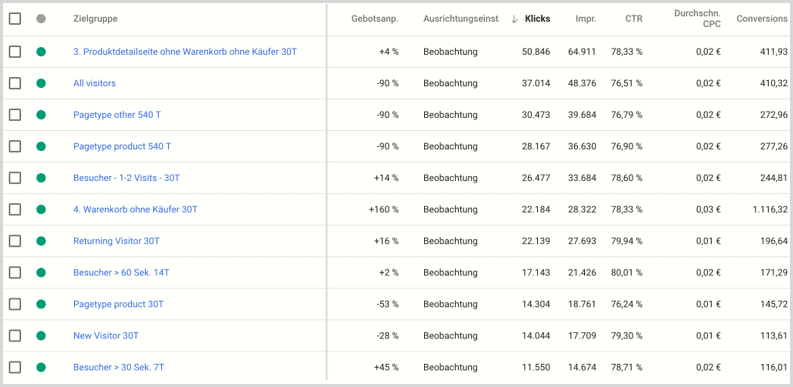
At the beginning you can also start with a lower bid adjustment, e.g. +2% and adjust the bids again over time, depending on the development of user performance.
Winning Strategies – How to best use RLSA?
When used correctly, remarketing lists for search ads can achieve higher click-through rates, lower CPAs, and more transactions!
To achieve optimal results, we recommend you consider the following strategies when using remarketing lists for search ads:
Tip 1: Segmentation of website visitors
Given that customers exhibit very different behaviors, our opinion is that segmenting website visitors is the main key to a successful search campaign.
For example, users who have added a product to their shopping cart are “more valuable” than users who have just viewed the website without showing any purchase intent.
For a rough but absolutely necessary target group segmentation, we would recommend that every account manager define the following target groups:
- All website visitors
- Visitors to specific product categories
- All shopping cart abandonments
- All buyers
- Returning users
If customer behavior is analyzed even more thoroughly, you will notice that some users visit the website several times before deciding on a product and ultimately making a purchase. Users who spend longer on the website are also more valuable than users who left the website immediately because they took the time to learn more about the product or service in question.
For better optimization, we recommend that you create additional target groups, e.g.:
- Visitors without purchase (1-2 visits without purchase, 2-4 visits without purchase, >5 visits without purchase)
- Visit duration (> 30 seconds, > 60 seconds, > 120 seconds)
- Returning users to purchase (1-2 visits to purchase, 2-4 visits to purchase, >5 visits to purchase)
- Visitors to specific product categories (last 30 days, 60 days, 90 days, 180 days, 540 days)
- Organic users, paid users
- Conversion value
Especially when creating remarketing lists, where we have the option to adjust the bid separately for each target group, you should strategically differentiate between valuable and less valuable customers.
Tip 2: Bid adjustments for RLSA
Based on the stored RLSA and the customer value, you can decide for which target groups you are willing to offer more so that your ads are better positioned – and for which target groups less.
If you manage an eCommerce store, you can set a higher bid adjustment for users who added products to their cart without finalizing the purchase. We assume that when a new search occurs, users will consider your business. Why? Because the brand name sounds familiar to them and because they have already had initial contact with your product. The probability that these users will complete the purchase is quite high!
If you are running a campaign in which you have used an automated bidding strategy, the algorithm will also optimize the bids for the RLSA. It is no longer necessary to set the adjustments manually. In any case, you should constantly keep an eye on campaign development. Depending on the bidding strategy used, certain values must be reached so that the algorithm can optimize correctly.
For example, a target CPA bid strategy requires you to have achieved at least 15 conversions per campaign in the last 30 days.
Tip 3: Tailor ads to customer needs and demands
Depending on the performance of your visitors, you can address visitors with individual ad texts.
For example, you can create a separate ad group for users who have added products to their cart but have not completed a transaction and target them with a customized offer: “Buy now & save 10%”.
For visitors who are no longer in the information phase but in the deeper part of the conversion funnel (Desire and Action), we recommend increasing the bids.
You can start with +20% or +30% and watch the development over time.
For users who are in the upper conversion funnel or for users with generic search queries, we recommend a smaller bid to start with, between +2% and +5%. For visitors with a high bounce rate, we would suggest reducing bidding slightly.
Tip 4: Use the “Alignment” option for smaller or limited budgets
If you run a business that has a low budget and still prefers to be visible for generic keywords as often as possible, we recommend that you choose the “Targeting” option when using RLSA.
In order to avoid high costs and make optimal use of the budget provided, we would proceed with the following solution in such specific cases: simply create a separate ad group for generic keywords and add the “All website visitors” remarketing list with the “Targeting” option. This way, the ads are only visible to those users who have already visited your website.
What’s the point? Case: Use of remarketing lists for search ads
Of course, in theory it all sounds simple and great!
You are probably wondering to what extent the RLSA has a positive impact on the performance of the overall campaign.
In the following example we have theDevelopment of a generic campaign over a period of six monthslooked at. We separately analyzed the performance of the campaign and the remarketing lists used and came to the following results:
- Increasing the click rate
- Lower cost per conversion
- Better conversion rate
- Better position
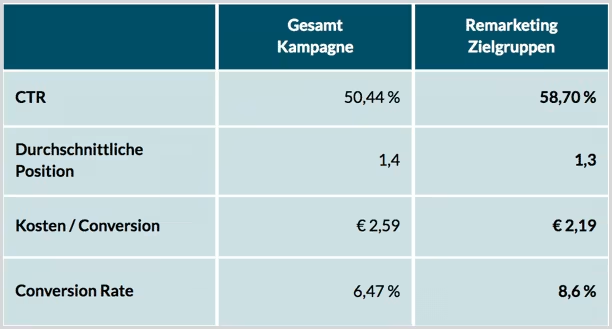
You can clearly see that the users who have already visited our customer’s website and were contacted again using remarketing lists showed better performance.
We personally are enthusiastic about the remarketing lists in search and would recommend every account manager to optimize the search campaigns in this way. We hope we were able to convince you that remarketing lists in search are not just a trend, but also a sustainable way to achieve cheaper conversions and significantly increase traffic.
If you haven’t created any remarketing lists yet, now is the time to do so: 1-2-3 and go!