The Online Targeting Compendium For Rtb
Management Summary

Disclaimer: feasibility ≠ sensibleness
What is very important at this point is that not everything that is possible with online targeting automatically makes sense. At first, many people tend to aim too euphorically, which then leads to a shot backwards. A lot of expertise and, above all, ongoing control and optimization bring the best results.
But the biggest mistake is not targeting at all!
Geographic targeting
GEO targeting / location targeting
Depending on the system, the IP addresses of users are resolved from country, state to city level. Some also offer pin-surround regions or self-definable polygons. With mobile devices, this can be done even more precisely depending on the user’s approval via GPS.
Tip:Although this seems to be the basis, many campaigns forget to at least set the target country – really! Check your campaigns – only the publisher’s selection often books unnecessary cross-border traffic…
Business chain targeting
Depending on the selected radius (0.5km – 2km), different companies and their branches can be targeted. For example, it is possible to display the company’s current offers in the vicinity of all Desigual stores – or to draw attention to yourself as a competitor. Available companies include H&M, Hofer, Nordsee, Shell, McDonald’s and many more. …
Hyperlocal targeting
Hyperlocal targeting refers to particularly precise geographical online targeting, which usually works on mobile devices with the help of GPS and mobile phone positioning.
Proximity targeting
The first DSPs (Demand Side Platforms) offer particularly precise geographical targeting options using proximity targeting. For example, you can choose from a list of department store chains or upload address lists or latitude/longitude coordinates. This is particularly helpful for making people in the vicinity of locations to be advertised aware of, or in combination withMarketing momentfor example at events.
Technical targeting
Operating system targeting
From Android to Windows to Macintosh, users can be shown the appropriate advertising. Classic example: I don’t need to offer my iOS app to Windows or Android devices. Extended: Sometimes the operating system also anticipates the purchasing power of the owners…
Browser
The following example illustrates how effective and targeted the option of browser targeting can be: A user visits a website with Firefox and is offered the latest Chrome extensions… this could be avoided.
 Device
The device itself can be recognized and targeted, from PC to Apple and of course all manufacturers and models of mobile phones and tablets.
Device class: Mobile, Tablet, Desktop, Smart TV, …
Here the previously mentioned devices are grouped into categories. This allows you to specifically use mobile campaigns and landing pages differently than desktop environments.
Internet providers, IP networks, companies – carriers, ISP
Every user surfs the Internet with an IP address that is assigned to an organization. On the one hand, this can be the Internet provider through which you are online – this mainly applies to private users and mobile Internet access. Here we see Telekom, Vodafone, UPC and many others.
On the other hand, employees of medium-sized and larger companies often surf from the company’s own network and can therefore be identified: Siemens employees, for example, can be targeted in the same way as officials from ministries and authorities.
Connection Speed - Connection Speed
For static banners, animated GIFs and animated banners with small sizes, an excellent internet connection is not absolutely necessary. However, if you want to reach the user with advertising using video messages, there should be a good connection. This targeting option can be selected in a number of gradations, from less than 56 kbps to greater than 2mbps. If the user needs to perform a specific action on the website that requires good connectivity, this option is ideal to ensure sufficient speed.
Day and time
Often overlooked because it seems too banal – but it matters at what time on what day which message works and how! A tip is to switch through at the beginning of the campaign and find out the best times of day in the analysis and then adjust the settings afterwards.
Content targeting
Placement / Channel / URLs / Apps
In classic (old) media planning, publisher websites or networks were mainly chosen and booked; sometimes channels. Example DiePresse/Economy. The hope was that (outdated) analyzes would reach the right users there, including women in women’s magazines. While the last example may be obvious, as we increasingly recognize, it is importantto reach the woman at the right moment, not on a women’s website. After all, not all women are on such sites all the time or at all…
 Such online targeting makes sense in two scenarios, among others:
Blacklisting: For certain reasons you consciously don’t want to advertise on certain platforms/environments.
Whitelisting: You want to consciously include a few placements or offer a higher or lower CPM for certain environments in a second line item (booking line with its own parameters).
Multiple placements and URLs can become so-calledChannelsbe summarized.
Contextual targeting / keyword targeting
Depending on which DSP (Demandside Platform – booking tool) you use, it also offers the option to include or exclude individual items based on the existing keywords.
For example, advertising could be placed specifically on all pages that deal with the topic of “vacation”, but please not if it also deals with the threat of terrorism or environmental pollution.
Thematic environments/categories
Online targeting is somewhat broader based on content categories, such as
- /Hobbies & Leisure/Water Activities/Surf & Swim
- /Shopping/Green & Eco friendly shopping
- /Travel/Specialty Travel/Ecotourism
The categorizations summarize topic areas.
Semantic targeting
With semantic targeting, algorithms not only examine the occurrence of individual keywords or the meaning of titles, but also attempt to interpret and correctly classify the entire text using linguistic methods – also in terms of mood and context. Here instead of the simple term recognition “vacation” & “Egypt” can also be recognized whether it is a positive mention or travel warnings in connection with attacks. One provider of this methodology available to us is, for example, Semasio.
Brand safety
Especially when it comes to automatically placed advertising bookings, people are often very skeptical about whether their own brand is created in a dubious environment. If the following options are used, this is now better guaranteed than is often the case with static bookings! (Just google itDisplay Ad Fail)
 Digital Content Labels
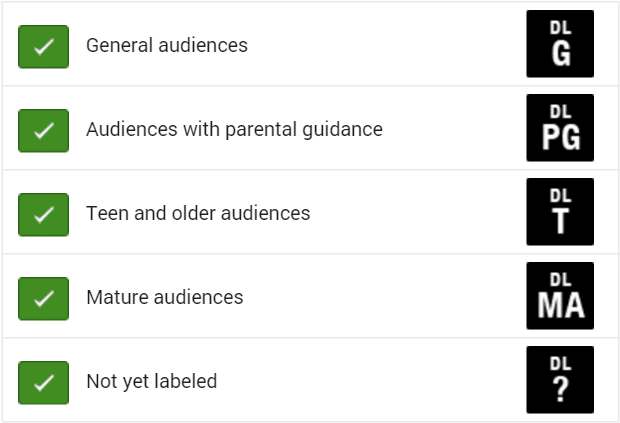
There is a general classification of content according to the digital content labels shown, which can be used to decide in which environments the campaign should run.
Since not all content is classified, deselecting “Not yet labeled” will result in little or no inventory available to some publishers or networks.
 Sensitive Categories
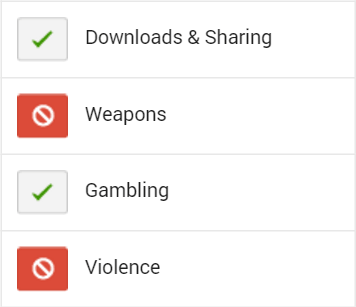
In addition, the specific content can be selected or deselected. In the example on the right, the campaign should run in the areas of “Downloads & Sharing” and “Gambling”, but not in the areas of “Weapons” and “Violence”. Our DSP offers us 16 specific classifications to choose from.
Further verification services
A variety of other so-called verification services are optionally available for security purposes, which can be filtered for “Hate Speech”, “Offensive Language” or “Suspicious Activity”, among other things.
In summary, it is clear that there are enough security measures for safe advertising placement via RTB – if you use them…
Viewability – visibility
An absolute reason for the superiority of programmatic bookings over classic reservation buying is that you can only bid in advance on impressions that meet the quality criteria in terms of viewability of the advertising medium.
Depending on the system, different metrics are used – we work with themActive view(following the IAB standard), according to which an impression is counted if the advertising material was at least 50% visible to the user on the screen for at least one second. A viewability of 75% then means that out of 100 displays, 75 met this criterion.
Online targeting “above-the-fold” or “beyond-the-fold” is still possible, but is becoming less important.
Moment Marketing – Event Based Targeting
The “Real time” in RTA and RTB today enables us to discover new, fascinating and excellent data-driven possibilities for online targeting almost every day. Since they relate to the moment, we also speak of “Moment targeting“.
 TV sync, TV targeting
Linear television still has a considerable reach and therefore impact. However, the television no longer enjoys the viewers’ undivided attention – the second screen in the form of a cell phone, tablet or laptop is always available. If a message on TV (whether an advertisement or a program) triggers the viewer’s interest, research is carried out online immediately. Anyone who uses this attention in online targeting gets all the advertising pressure for themselves.What effect does TV advertising have on online traffic?, we have already explained elsewhere in this blog.
TV Boost
Advertisers who place TV advertising themselves should, if possible, get 100% of the attention they build up with (expensive) money. Extending the campaign in both display and search(!) is a must. Nothing wastes more advertising money than when users only find advertisements from competitors because of advertising.
Please do not use the outdated method of storing the TV media plans for the timing: These are usually not adhered to precisely enough, the effort is high and it is much easier to do it automatically. It also works like this:
TV Competitor Sync
If a friendly competitor builds up a topic well with a lot of TV budget, but forgets about online targeting, you can easily target their spots. In the same way, you can easily target all spots in an industry and, for example, whenever a food discounter advertises, you can place advertising yourself.
TV show / TV program / environment
You can also book programs, series, formats and topics, such as all cooking shows or whenever Tatort is on or Titanic for the 10th time.
Commercial break
We know that during commercial breaks attention to the TV screen drops dramatically, but people increasingly turn to their cell phones. This means, for example, that bidding could take place exactly in the prime-time advertising window of Pro7, RTL & Co can be increased.
TV Live event
Online targeting can now be defined for specific events, e.g. if Leonardo DiCaprio actually wins the Oscar…
Radio sync
What is possible with TV can of course also be done with radio advertising, namely display and search advertising.
Weather targeting
As we demonstrated years ago with our weather data study (together with Ottoversand), the weather has a major influence on the (online) (purchasing) behavior of users.

Weather situation
The local weather situations shown above can be selected based on both the current weather situation and the forecast. Classic example: When the first snow falls, boost advertising for your ski holiday. We also know in which weather people invest more in online shopping and when online targeting pays off…
temperature
Of course, the temperature can also be selected as a trigger. Both the absolute temperature and temperature fluctuations, for example a drop in temperature.
Environmental situation: pollen pollution, CO2 pollution, smog
Environmental signals such as pollen levels or the smog situation can now also trigger campaigns.
General events via API
In general, company-owned or open data can be used with little effort via API to trigger online targeting campaigns. The following examples are already available:
Sports events
Using football as an example: Bundesliga games when a certain team plays, or wins (or not) or Messi scores a goal. This also applies to other sports.
Financials & Stock market prices
Obviously, stock market and foreign exchange prices can be selected based on absolute or relative thresholds.
Practical example: Flight cancellations
The American motel chain “Red Roof” ran a highly regarded programmatic campaign that was played locally at airports whenever an evening flight was canceled – and the stranded passengers absolutely needed a room for the night. Once set up, this campaign has been extremely successful to this day, while at the same time saving the overall budget (which had high wastage).
User-centric targeting
All of the following online targeting methods are based on the evaluation of profile data, usually anonymized. This means that no direct personal connection can be established. Providers of these targeting methods usually set cross-domain cookies and draw conclusions about user characteristics from surfing behavior. Because the user’s behavior is used to determine their characteristics, this is calledBehavioral online targeting; when additional data sources such as surveys and surveys are linked, this is calledPredictive behavioral targeting.
Demographic targeting by age and gender
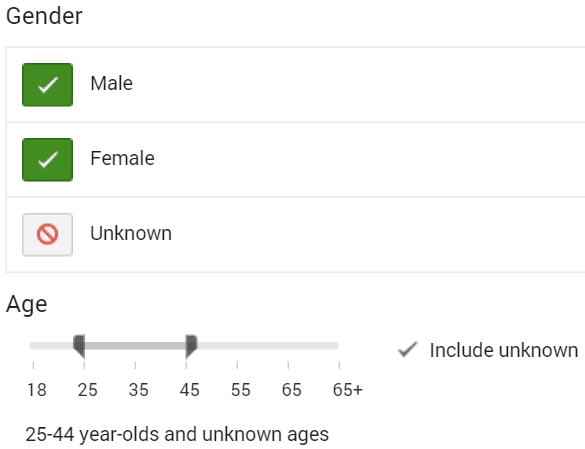 It is obvious and particularly valuable to be able to target users according to age and gender.
As with all data-based methods, a big caution here: Users (at certain publishers) are often not identifiable according to the desired criteria, i.e. “unknown”; Excluding this “Unknown” group can dramatically reduce the reach. Good DSPs show how much the target group is narrowed when unknown is omitted.
Audience lists
Audience lists are lists of users with certain characteristics. They are either collected ourselves, in which case it is 1st party data, or collected and purchased by third parties, in which case it is 3rd party data.
Third Party Data
Service providers who collect user profiles and make them available as targeting lists want to earn something. Often your own offersDMPalready offers a large number of lists free of charge; Third-party providers such as eXelate, Eyeota, Lotame, Bluekai and many others have specialized in their own data collection and algorithms. There are an incredible number of such lists – the trick is finding the right ones with the right quality.
A few examples:
- Mercedes Benz owners and fans
- Intent > Travel > Weekend Travellers
- interest > Animals > Pets > Dogs
- Real Estate > Mortgage Amount > 60-120,000
- Family Position > Grandpa
- Affinity Categories > Music Lovers > Blues fans
- In-Market Categories > Sporting Goods > Winter sports
Before the boldest online targeting fantasies with the sharpest target groups arise, be warned: Many of the lists are well-stocked with data, especially in the USA, but are rather thin in this country. The trick is knowing the right ones.
First party data
First party data is always collected from our own users. As a rule, these lists are of the highest quality, but of course they only target their own target group. Excellent foradvanced retargetingstrategies, but alone they are not suitable for acquiring new customers.
At this point I would like to take a stand forprofessional remarketingbreak: Retargeting done right brings huge results and doesn’t bother users either. The trick is to collect very granular data early on, i.e. not just to capture visitors vs customers, but also to capture even more specific segments: customer status and attributes as well as lifecycle information.
Good systems allow you to target for up to 1 minute (in minute increments) when an attribute occurs. This shows again how precisely the messages can be coordinated and that a remarketing campaign/advertising medium for everything is far from the highest art.
First party data from web analytics
An excellent source of high-quality audience segments is your own web analytics system (as long as it is well designed and implemented). For example, offersGoogle Analytics 360a very simple way to create complex user segments for theDBM (DoubleClick Bid Manager)to provide. The same thing works in other digital marketing suites.
Offline data
If there is a well-founded concept for first-party data, this can easily be expanded with additional data from the company: CRM and BI usually offer extremely valuable classification attributes that can be joined with the online data for targeting purposes.
Second Party Data
In addition to your own first-party data and third-party data provided in aggregate by third parties, a market for second-party data is developing. For example, non-competing companies provide each other with targeting lists. For example, an automobile company could make its customer lists available to a tire dealer for a winter tire campaign in the fall.
Data collected by publishers about their users and provided to advertisers is often referred to as second party data.
Similar Audiences – Audience Extension – Statistical Twins
A huge advantage of the existing data, algorithms and computing power is the ability to extrapolate from existing information and create predictions. One of these methods uses so-called statistical twins to find similar ones from a known group of users in the big wide world.
This means you can use the feature to select “top customers” from the groupSimilar audienceFind and address similar users. Depending on the tool and the quality of the first party list, this works mediocre to excellent.
Personal targeting
Here we are talking for the first time and explicitly about online targeting, which means an individual, identifiable person. All previous methods were anonymized, aggregated & clustered. From this stage onwards, we ourselves (!) and the technical service providers have a completely different legal responsibility – unfortunately we are not always aware of this… and it is still far from completely clarified.
Synchronize and target your own user lists
What has long been possible on Facebook is now also offered by Google: your own user lists can be uploaded to the provider using the “email address” key. These audiences can then be specifically addressed, excluded or similar audiences can be searched for in the provider’s inventory.
Note: With Google the list can be encrypted in advance.
Use personal attributes directly for online targeting
Be hereSecond party dataused by the partner. The best known (and most infamous) is Facebook, where you can choose your relationship status, sexual preference, interests and 3000 more attributes. These targeting can also be linked to external inventory when booking directly or via Facebook’s Atlas.
Extra Disclaimer: I see a huge difference between using anonymized, aggregated data and directly personal data. If this happens via third parties, it is largely unclear…
Cross-device targeting
We know that the typical user unfortunately doesn’t always stay on the same device in his customer journey, but often switches from mobile to desktop and tablet (and more commonly to the offline world). So there is relatively little point in retargeting a user who liked our product via a mobile campaign on the way to work in the same channel all day long. I have to reach it again on all (or the right) devices.
Since the cookies are not only device-specific but even browser-specific, this tool is not enough for us; We need systems and algorithms that can recognize and link all (as many) different devices of the same user.
On the one hand, this can be done through our own survey (e.g. from regular customers) – then we would have high-quality first-party data again. Or we rely on data suppliers who do exactly this for us and make it available to us.
Targeting strategy
As explained at the beginning: methods and data alone do not make for good targeting. It takes a clear strategy, know-how, the right tools and (working) time to get the most out of the enormous possibilities.
Ours will be published shortlyOn-lineTargeting Guide – Sign up for the newsletter now, so you don’t miss it!
Costs and ROI of online targeting
In practice we see how efficient targeting is and what impact the methods shown above have – in the right combination! – can bring.
Third-party audience lists in particular often have a price list, with a CPM surcharge of between €0.05 and up to €2, depending on the complexity and quality of the data. Whether the additional costs are worthwhile can be determined very easily using an A/B test: We fire the campaign for a short time in parallel with and without the purchased targeting and determine the ROI of both campaigns: If the campaign with targeting brings a higher ROI despite additional costs, the additional purchase is justified.
You benefit most from oneownData and tracking strategy: This not only makes it possible to collect high-quality first-party data, but also allows all targeting experiments to be easily checked for success.
Let’s not forget here that we are not solely concerned with last-click or simple post-view, but rather the influence of our actions throughoutCustomer journeyby means ofAttribution modelingwant to analyze.
You will find a wealth of information and know-how about all of this in our blog.Ask usif you want to build up or professionalize this area for yourself!
PS: Did we miss an opportunity? Please comment or email.
Otherwise, we would be happy if you share the article!