Topics 038 Fledge 8211 How Are They Supposed To Work

Management Summary
After the overview of the Privacy Sandbox in the lastArticleToday we’ll take another look at how Topics and Fledge work.
TOPICS
Based on the browser history and the linking of host names (e.g. Spiegel News) to topics, a maximum of five so-called topics are stored in the user’s browser.
Topics Internal can also be used to query which topics are assigned to a host name: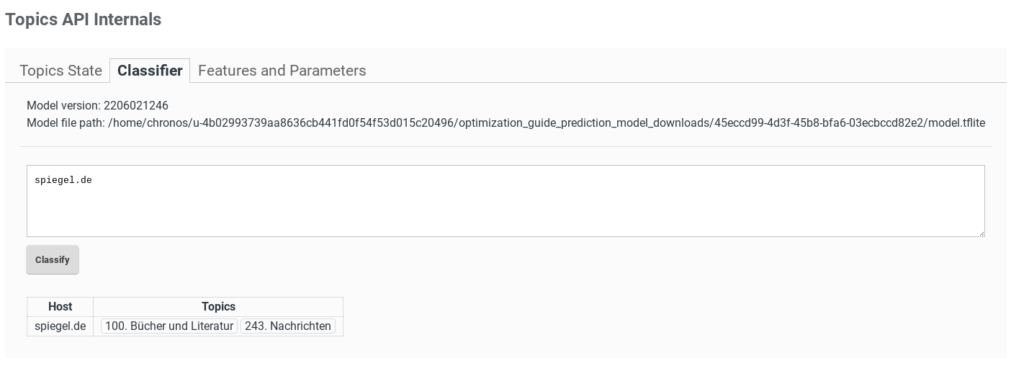 chrome://topics-internals/
You can see which topics there are here:https://github.com/patcg-individual-drafts/topics/blob/main/taxonomy_v1.mdFor certain topics, this value is always saved for the last three weeks. However, which value is then stored in the browser is determined by algorithms.
Below is the exact process:
- The user browses a page that participates in the Topics API and an interest from 349 categories is stored based on the hostname. But this list is not final.
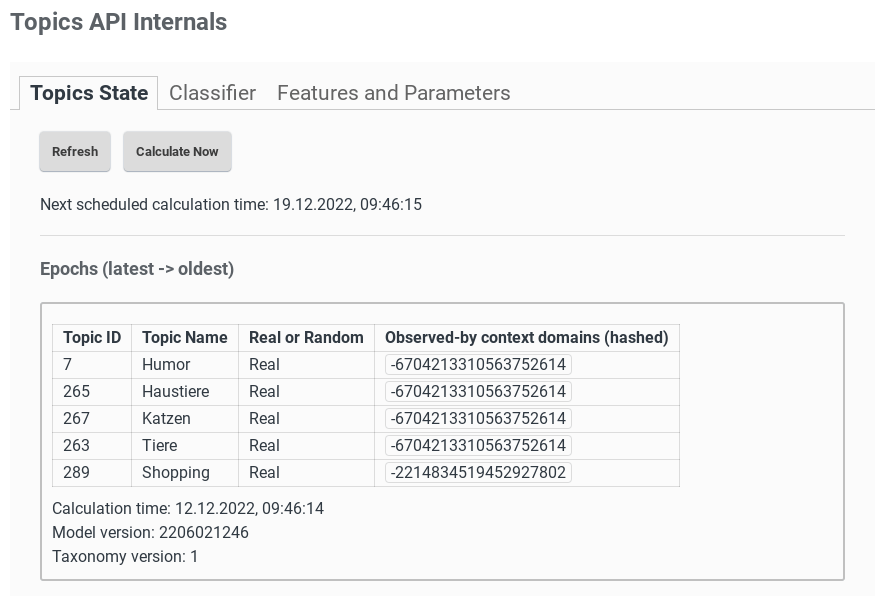
- After one week (epoch), the topics that are most relevant are calculated from all topics. These are stored in the browser for up to three weeks, but the assignment changes constantly. Here is an example of what that could look like:
 It may also be the case that the user is assigned random values at the beginning or if there is insufficient data:
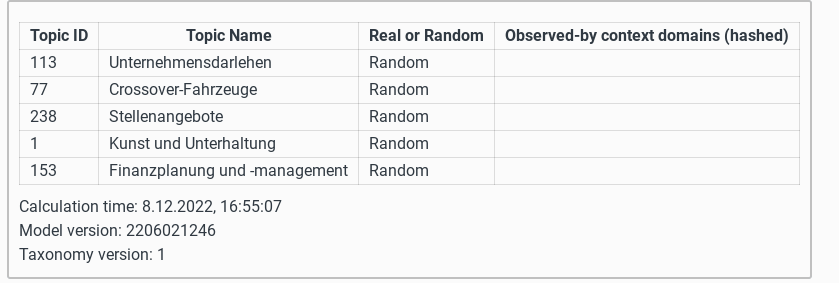 These values can be overchrome://topics-internals/can be viewed.
- The user visits a page with possible advertising materials.
- Here the adtech partner requests the Topics API (browsingTopics()) and sees up to three topics that are assigned to the user.
- The adtech partner uses this topic to decide whether to bid on it.
- If the auction is successful, an ad will be displayed.
Current challenges:At the moment Topics is limited to 349 different topics, which on the one hand limits the selection significantly, but on the other hand is good for data protection. Likewise, the three weeks of storage are perhaps either too long or too short depending on the industry. A travel provider that is looking for users who are interested in traveling at short notice will have problems here because the window is too long.
In the same way, the recognition is linked to the user’s browser behavior and only the most important topics are returned by the API, but this can lead to a lot of users being marked with very generic topics, which poses the challenge that relatively few users are available for certain topics.
All of this is still the basis for discussion between developers and market participants and is likely to change significantly.
If you would like to try out what Topics collects now, you can do so here:https://topics-demo.glitch.me/
FLEDGE
The principle of Fledge is slightly different than that of Topics and is intended to serve as a long-term replacement for user recognition for remarketing.
The process currently looks very simplified like this:
- The user comes to an advertiser’s page.
- The advertiser categorizes the user into an audience and marks him with an audience name, with the creative that he would later like to show to the user and with his domain.
This can be viewed on this page in the developer settings:

- This data is stored locally in the user’s browser.
- If this user comes to a website with ad slots, the advertiser receives the information that this user is in this audience. The advertiser can then decide normally whether to bid on the user and, if suitable, submits a bid.
- Then, after the publisher decides whether to place the adslot in a Fledge auction, the auction takes place on the user’s device.
- Otherwise the rest of the process goes as usual.
Current challenges:At the moment, Fledge is being tested extensively, but this is sometimes much more difficult than with other topics, as significantly more parties are involved with their technologies and the processes largely run on the users’ devices.
This point in particular is still somewhat open today; What happens if thousands of people bid on the device? How quickly does the auction run? What will the general latencies of the auction be?
Anyone who would like to test this can do so locally here:https://fledge-demo.glitch.me/
Conclusion
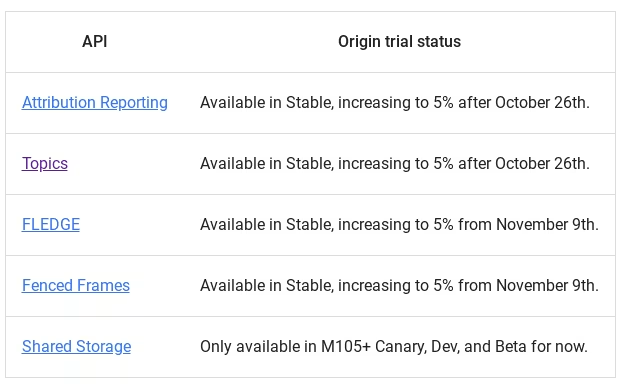
Both technologies are on the way to finding their way into the feature set of the Chromium browser. All features should be available to all Chrome users in the second half of 2023 (Source:Chrome) and there are already 5% of all Chromium users (source:Chrome).
 There is very little to do for advertisers at the moment, as testing is currently only possible for adtech providers, but you should accept offers to test these features as early as possible when they become available in order to adapt your own marketing strategy as quickly as possible.