Use Conversion Optimization As A Competitive Advantage
Management Summary
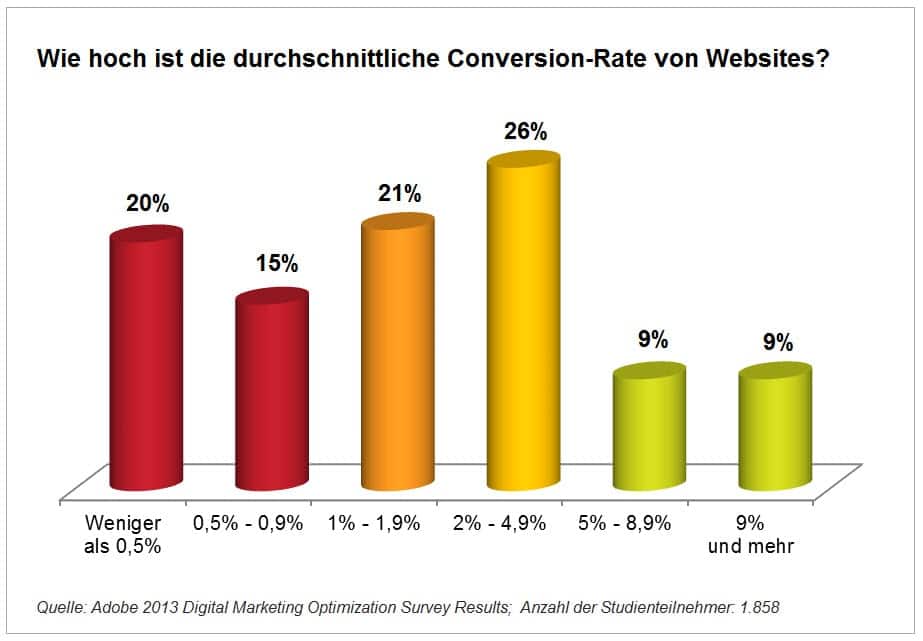
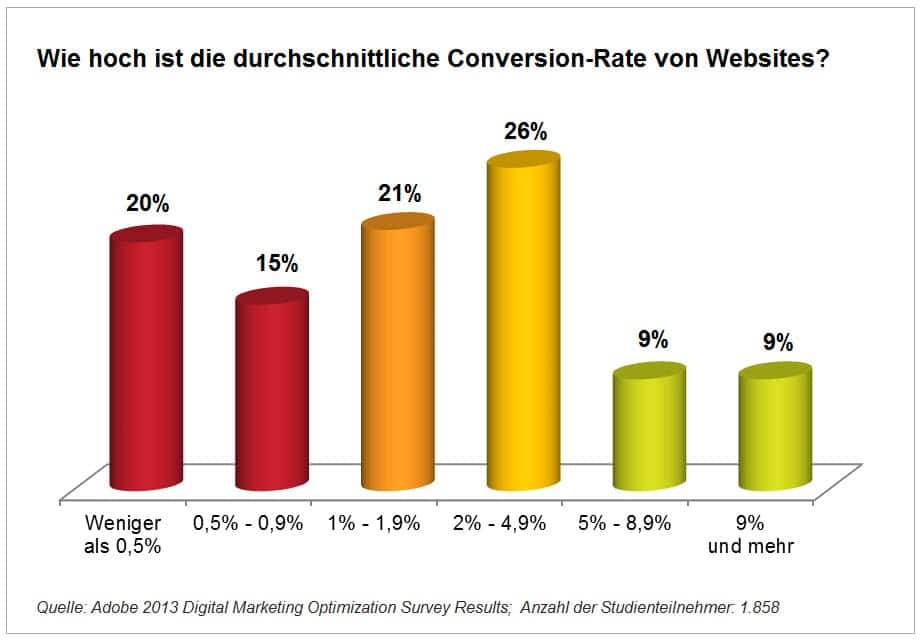
35% of participants in an Adobe study on the topicConversion optimizationWith more than 1,800 marketers from North America, Europe and Asia, focusing particularly on B2C and B2B commerce, the website conversion rate is less than 1%, followed by a conversion rate between 1% – 1.9% on 21% of websites. I.e. on over half of the websites98% of users don’t buy!
In addition, we find onesaturated marketbefore: Internet usage has already reached its maximum in most target groups. The offer on the Internet is increasing and with it the competition. The user’s attention span is short due to the large number of offers and the existing sensory overload.
Some competitors are still sleeping, others are already securing a competitive advantage with testing procedures
Half of the Adobe study participants are already implementing tests as a decision-making tool in their company or in various departments. With the results achieved therebyOptimization measures give you a market advantage over the competition.
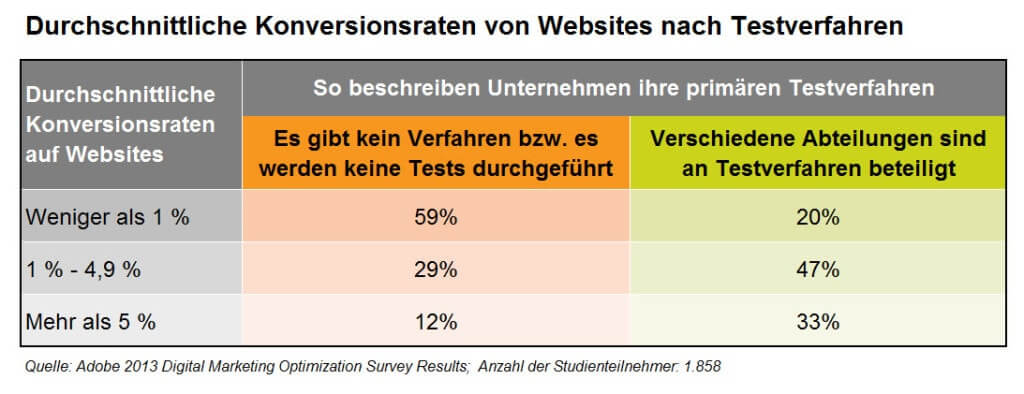
The other half of those surveyed do not see testing as an optimization process as a priority in their company. The study by Adobe Systems shows that for the 59% of companies that do not carry out any optimization procedures or tests, the conversion rate is less than 1%. If you compare those companies that have a conversion rate of over 5%, it can be seen that 33% of the companies have various departments involved in testing procedures, in contrast to the 12% that do not do any optimization. This makes it clear that especially thoseCompanies that do conversion optimization, a significant onehigher conversion ratehave. This is also clear in the following graphic:
What does testing actually mean as an optimization process?
We should first be aware that the success of a website is not determined by the marketing or sales department – nor by the graphic designer’s beautiful subject material and, to the disappointment of all superiors, not by the HIPPO (highest paid person’s opinion). It issolely the user, who with his purchase or his action about itdecides whether a website is successfulor not. The purpose of conversion optimization is to convince undecided visitors of the offer from the traffic that has already been generatedto encourage more visitors to take the desired action and thus convert them into customers. So why don’t we just ask the user how they can be guided to the desired action? It’s probably not that easy.
An online user survey provides information, but do I receive all the necessary information and can I rely on it? A direct questioning of the user brings with it unwanted disruptive factors. On the one hand, the user is largely unaware of which factors influence them and to what extent. On the other hand, a direct questioning of the user always has the disruptive factor of so-called social desirability, i.e. users do not give the answer that corresponds to their attitude but rather adapt their answers to the expectations of the tester or the environment.
In order to find out influences on the conversion rate and to exclude disruptive factors, so-calledTesting procedure, in which the behavior of theUser in his real situation environmentis tested. Individual elements or variants are tested against each other at the same(!) time (to exclude time-related disruptive factors) and insights are gained about their effect on conversion. The test variants are usually evenly distributed among the existing traffic. This means that in an A/B test, the first user receives variant A, the second user receives variant B, the third user receives variant A again, etc. The following testing case study is intended to better illustrate the testing methodology.
Palmer’s Testing Case Study
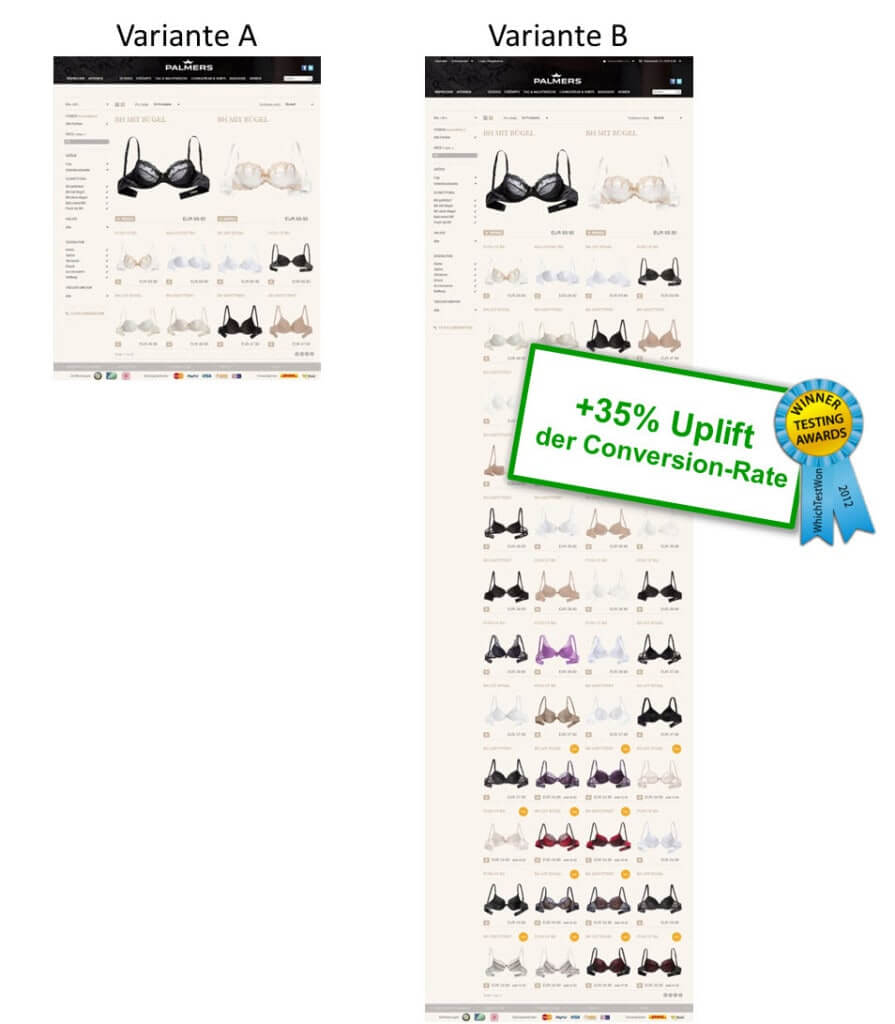
In the Palmers online shop, the category page displayed 10 product items per page by default. The question was whether a higher number of product items per page leads to a higher order rate. This was based on the assumption that users could use scrolling to “browse” the product range more quickly and thus experience a better shopping experience. Therefore, the control variant or variant A (10 product items per page) was tested against the alternative variant B of 50 products per page as the default value. This hypothesis could be solved with one35% higher order ratebe confirmed. With this test, e-dialog was able to win the awardGold at the Online Testing Award 2012from WhichTestWon in the “E-Commerce Category Page Test” category.
Testing requires more than just a tool
Testing is an ongoing processand requires a well-thought-out and structured approach. A test without analysis, concept, goal and correct interpretation can quickly lead to the wrong conclusion. This requires relevant know-how, namelyKnowledge of usability principles, psychological and neuroscientific aspects, persuasive copywriting, web analysis and statistics, etc. That does90% of successout of. The right testing tool and how to use it is only 10% of the rent.
Conversion optimization is mainly used in the following areas:
- Sales funnel optimization (category and detail pages, check-out, …)
- Layout and usability optimization
- Lead generation
- Landing page optimization
- and much more
How much should ideally be invested in conversion optimization?
As already mentioned, conversion optimization is about getting more conversions from existing traffic. This means that in order to carry out optimization measures on the website, we need it on the one handtrafficand on the other hand the use ofConversion optimization process. But how can the two resources be used most efficiently?
Let’s imagine we have 12 resource units available for generating traffic (= media budget) and for conversion optimization. If we now invest 11 units in media budget and 1 unit in conversion optimization, we get a maximum of 11 units(Invoice: 11 units of media budget x 1 unit of conversion optimization).
However, if we invest 10 units in traffic generation and 2 units in conversion optimization, we get a total resource maximum of 20 units(Invoice: 10 units of media budget x 2 units of conversion optimization). This calculation can continue until you reach oneequal distributionof resources, namely 6 units for generationof traffic andalso 6 units forConversion optimization investmentsreached there with 36 unitsoptimal use of its resourcesfinds.