What Is A Dmp Data Management Platform
Management Summary
What is stored in a DMP?
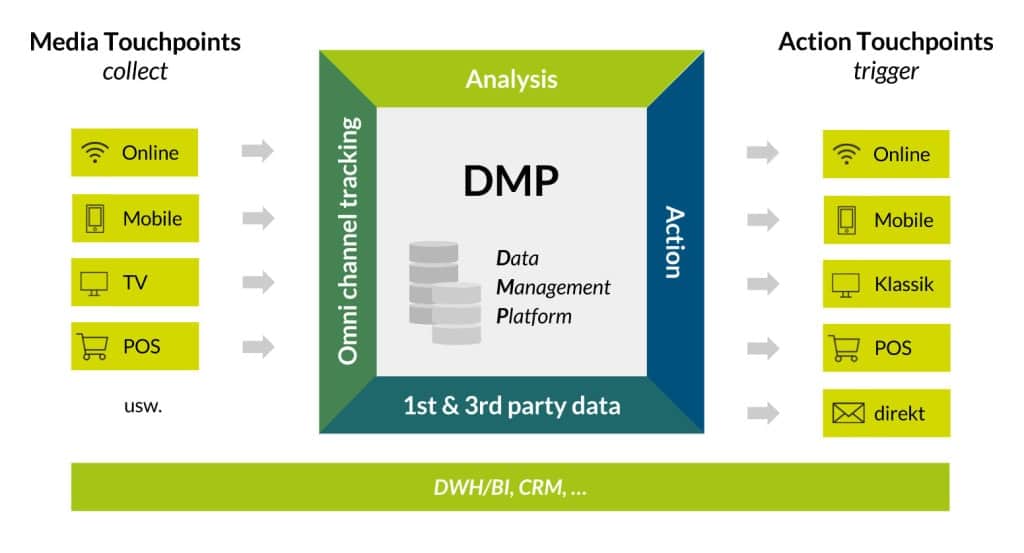
Essentially, cookie IDs are recorded by a wide variety of systems and linked together for target group targeting (audience lists). The data management platform often forms the bridge between 3rd-party data, such as from publisher ad servers or data suppliers, and 1st-party data from your own website or from internal company systems (CRM, DWH, BI, …).
Why do I need a data management platform?
In addition to collecting and evaluating campaign data at user level(!) to measure success, promising “audience segments” (target groups based on users) are calculated and these users are then addressed via DSPs (Demandside Platforms) for advertising purposes. This means that advertising materials (banners) are shown to exactly the right people. (See: What is programmatic marketing?)
What is the difference between DMP and DSP?
The boundaries are becoming increasingly blurred: Many DMPs also offer the booking of advertising space via their own DSPs. Conversely, systems such as the DoubleClick Suite in combination with Google Analytics 360 meet all of the above requirements for a DMP – and much more…
What does it mean if my media agency/marketer has a DMP?
First of all, they collect more data with each campaign. Ideally, you use these for better Online Targeting. Campaigns become more targeted and therefore more successful.
The downside: the CPMs increase and you don’t expand your own database, but instead feed the agency’s DMPs with each of your campaigns, which sells this data to you again at a premium for the next campaign.
Is there a list of DMPs?
A few of the well-known DMPs are: Turn, Krux, Lotame, Semasio, Aggregate Knowledge, BlueKai, CoreAudience, Knotice, nPario, The Adex etc. But the Google DoubleClick/Analytics Stack also represents many of the use cases.
[Update March 18, 2016] Since the official announcement 3 days ago, we can now also report on Google’s DMP, the Audience Center 360, which is not only directly connected to all Google services (logical), but also integrates data from third-party systems right from the start and can also trigger external channels.
What should I pay attention to?
Dubious offers! A customer received an email from his media agency: “Just install the pixel. It’s all 1st-party data and completely secure. This will increase your data ROI immediately!”. Inexperienced customers also install this – the agency recommends it. And you often violate legal principles, give away valuable data and have no access to it yourself. In general, it is recommended that anyone entering this league needs a strategy, a concept and professional support that also ensures that they generate as much 1st-party data as possible.
Criticism of DMPs
As a rule, DMPs are virtual cloud services, i.e. the data is owned by the provider. However, these systems are so huge that not only your data, but also that of other customers in the same market is there – and (depending on the contract!) can of course be linked. In a more or less disguised manner, some providers offer the data obtained in this way for targeting. Not every publisher or advertiser likes this (understandably) and opts for solutions that work cleaner in this regard.
Do I need a DMP now?
Make sure, step by step, to generate more and more 1st-party data and to be less and less dependent on 3rd-party data, or on systems for which you are not (contractually!) guaranteed data sovereignty (ownership). Data governance will be an important topic in the future. Sooner or later you will end up with a form of DMP. We would be happy to help you on this path!