Why Programmatic Marketing Only Works If You Understand It
Management Summary
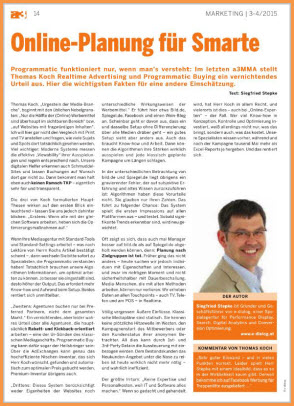
Koch begins with the usual smokescreen: “only half of the (online) advertising materials are in the visible area” or “on websites with questionable content”. I don’t even want to make a comparison with print and TV and ask how many subjects and spots are actually seen there. Much more important: modern systems measure the effective “viewability” of their displays and adjust accordingly. Our digital helpers also recognize dirty sites and do not allow bookings there if requested. Then you don’t get a junk CPM – actually very fair and transparent.
This means that programmatic doesn’t lead anywhere
Koch formulated three main theses against programmatic marketing in his article. At first glance, these may seem obvious – but let’s look behind them:
“Firstly: If everyone works with the same ‘software’, the optimization measures cancel each other out.”
If your media agency works with standard tools and standard settings – which seems to be confirmed after reading Mr. Koch’s article – then please switch immediately to specialists who understand programmatic! In fact, our algorithms need information to work optimally. The better they are adjusted, the higher the output. This requires more know-how and effort during setup. Both pay off immediately!
“Secondly: Agencies only book with ‘preferred partners’, not the entire market.”
A devastating but unfortunately true judgment on all agencies that primarily work with discounts and kickbacks in mind. One of the original sins of the classic media business. Programmatic buying can even be the savior: via AdExchanges, exactly the highly efficient niche inventory that Mr. Koch wants can be found and automatically booked at the optimal price. By the way, premium inventory too.
“Third: This system does not take into account the peculiarities of the websites or the different effects of the advertising materials.”
Here he lists Bild.de, Spiegel, Facebook and a wine blog. Apparently he assumes that the same setup can be used across all media without differentiation – but a good setup looks different! This also requires know-how and work. Then the algorithms can really show off their strengths and beat any traditionally planned campaign by far.
Automation with brains
By the way, there is a serious error in the different considerations between bild.de and Spiegelsubjective experience and ancient knowledgecan be attributed to: Algorithms do not have these prejudices. They only believe their numbers. This leads to the following opportunity: The system plays out the first impressions on all platforms – and tests them. As soon as significant trends are identified, the weighting is rebalanced. It often turns out that managers can be found better on bild.de than Spiegel because:
Planning based on target groups is dead.It used to be no different. Today, however, we are looking for individuals with characteristics and interests, at the right moment and not with constant exposure to be on the safe side. Media people who work with old methods can only lose; We collect data at all touchpoints – including TV, telephone and at the POS – in real time.
Completely forgotten: external influences.Classic media plans are static. They don’t know about a sudden heat wave in the West, when a competitor’s campaign is starting, or about the customer status of their anonymous viewers. All of this can be included in the control using 1st and 3rd party data. Rubbing the new customer offer under the nose of existing customers is really no longer necessary today – and truly inefficient.
Programmatic marketing needs specialists
The biggest mistake:“No expertise and personnel costs because IT and software do everything.” If people think and act like that, Mr. Koch is right in everything, and in many places this is the case – including with “online experts”. Anyone who invests a lot of know-how in conception, control and optimization not only knows what it brings, but also what it costs. Our specialists know a thousand times more before, during and after the campaign than Excel reports ever provide. And it pays off.