Your survival guide through the Meta conversion jungle

Management Summary
Measure & interpret Meta conversions correctly: Learn how to gain a better understanding of your campaign results and make informed decisions.
Why is it important to measure and interpret campaign data?
Measuring conversions in Meta Ads Manager is crucial for evaluating the success of social media campaigns and identifying which actions are effective.
However, not every conversion automatically means success. Meta Ads Manager offers numerous methods for measuring conversions—and ways these results can be (mis)interpreted. Therefore, it is important to distinguish between different measurement methods and attribution settings in order to assess campaigns correctly.
The difference between events & conversions
First, it is important to distinguish between the different setups of events & conversions:
-
01
Standard events
These are predefined by Meta (e.g., purchase, lead, contact, etc.). When using the event, Meta understands which action is meant.
-
02
Custom events
These events fall outside the predefined events and are set up according to the advertiser’s individual needs (e.g., 30s goal, scroll depth, etc.).
-
03
Custom conversion
These enable more detailed analysis and campaign optimization. They are based on standard or custom events and follow specific rules (e.g., standard event: purchase and custom conversion: product category).
Attribution settings and their impact
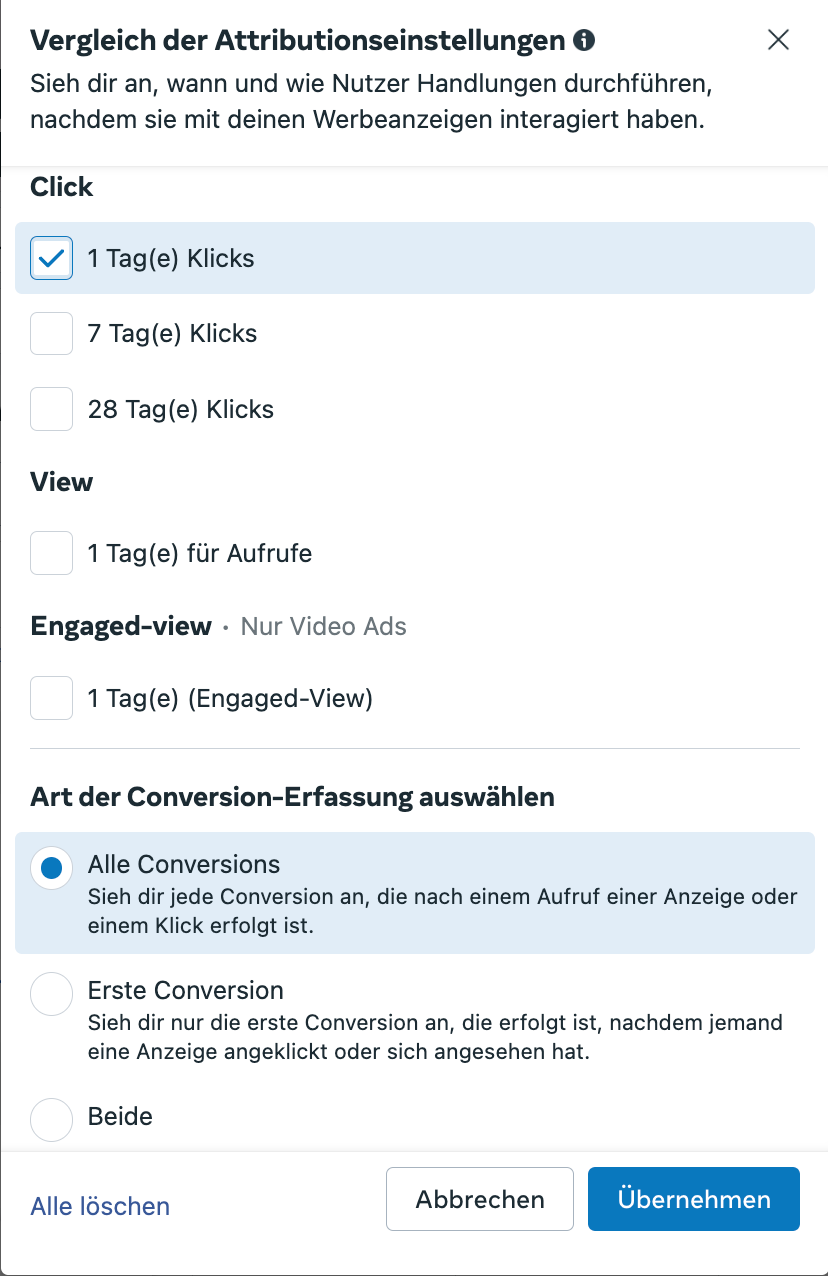
Choosing and comparing attribution settings has a major impact on how results are presented. Meta fundamentally distinguishes between the following options:
-
01
Click-based attribution
A conversion is attributed if it occurs within a selected time window (1, 7, or 28 days after the click).
-
02
View-based attribution
This conversion is attributed if an ad was viewed (but not clicked) and the conversion occurs within one day.
-
03
Engagement-based attribution
This attribution is available exclusively for video ads and is attributed when users watch the video for at least 10 seconds (or 97% of its length for shorter videos).
The attribution window can be selected when creating the campaign. This affects not only how conversions are recorded, but also how Meta optimizes ad delivery. For example, if the campaign is optimized for 1-day click, Meta will preferentially look for people who complete a conversion within one day.
To view the results of the campaigns in the right context, it is important to compare the different attribution windows with each other. By default, results are shown in the attribution window selected when the campaign was created. Comparing them allows results to be broken down and also attributes conversions that occurred outside the selected attribution. If the comparison shows that most conversions come from view attribution, this indicates that the ads have no direct impact on completing the conversion. Conversions outside the selected attribution may indicate that customer journeys are longer than expected, for example for higher-priced or more complex products.
What should you pay particular attention to here?
With click-based attribution, every click on the ad counts, even if it does not lead directly to a website. The conversion can also be attributed after an interaction with the ad (e.g., clicking on the video).
With view-based attribution, Meta assumes the ad was noticed and contributed to the conversion—without a click on the ad. This assumption is plausible, but not always verifiable. Therefore, the value of view-based conversions should be assessed lower than click-based ones.
A useful new feature in the attribution settings is the option to use “First conversion”. Comparing it with “All conversions” is particularly useful when optimization is not for purchases but for specific actions (e.g., whitepaper downloads). This way, only the first completion is counted, not multiple downloads by the same person.
Distortion of results due to targeting & incrementality
A still widely used method for achieving good and cost-effective results is retargeting. As a rule, these deliver comparatively better conversion values than broad targeting options. However, it is also important here to take a closer look and put the numbers into context. Retargeting audiences are also addressed in broad targeting (unless they are explicitly excluded)—mainly because the algorithm looks for users who are most likely to convert, and these are usually people who have already purchased or interacted with the brand.
Why do remarketing campaigns in Ads Manager often show excellent results?
If you take a closer look at the results in Ads Manager and compare the attribution windows, it is often noticeable that a large share of conversions comes from view-based attribution. Ads are specifically targeted at people who have already been on the website, for example, and were planning to convert anyway. Therefore, especially in retargeting, the topic of incrementality must not be overlooked. The share of incremental conversions is often much lower here than in broad targeting. To derive robust arguments, lift studies are suitable, as they can measure the incrementality of campaigns.
Gaps in attribution and measurement
No attribution and no measurement method is 100% correct and error-free. Especially due to the iOS 14 update and cookie blocking, conversions are often modeled and not directly traceable. View-based attribution also has gaps, as it is only visible in the respective Ads Manager and does not directly match reality.
Another challenge is deduplicating conversions. Different Ads Managers, attribution windows, and numerous touchpoints in users’ customer journeys make it difficult to comprehensively attribute conversions. Therefore, it is important not to interpret results only in your own Ads Manager, but also to cross-check them in other tools such as GA4.
Click attribution also has gaps, as the click does not necessarily have to be on the URL, but can also be attributed through interaction with the ad. As a result, UTM parameters lose importance and explanatory power in this case. To deal with these challenges, it is important to be aware of them and try to put the numbers into context.
Conclusion: There is no single, correct way to look at it!
There is no universal solution for conversion measurement in Meta Ads Manager—each method has its strengths and weaknesses. Click and view attribution provide only partial aspects of the truth and should not be considered in isolation. What matters is a nuanced understanding of the data: choosing the right attribution window, cross-checking with tools such as Google Analytics, and critically reviewing retargeting results. Combining these insights provides deeper understanding and supports informed decisions. Conversion measurement remains challenging, especially due to privacy regulations and technical changes. Success does not come from striving for a perfect measurement method, but from the ability to use the available data in the right context and continuously adapt.