Youtube Brand Lift Studies In Dv360

Management Summary
In this blog post we focus on the use and setup of Brand Lift Studies for YouTube. But how exactly does a BLS work and what needs to be taken into account during setup? Read on now!
YouTube Brand Lift Study in DV360
A brand lift study works like an experiment in statistics: the users are divided into two groups (“Exposed Group” and “Control Group“) and asked for their opinion/assessment using a survey. The good thing about it is that this survey takes place during the campaign and even starts at the same time as the campaign is played out. Since the data is continuously collected, it enables advertisers to act quickly and efficiently during the campaign to improve the campaign KPIs.
In theExposed Groupare people who saw the ad while theControl Groupis exactly the opposite – these people fall into the same target group as the one in theExposed Group, but don’t get the ad played. Depending on the aim of the study, different questions – with different possible answers – can be asked:Target: Ad RecallThis question type can be used to measure how likely users are to remember the ad after seeing it on YouTube. This can provide information about how memorable the ads were designed.
For example:“Which of the following brands have you seen an online video ad from recently?”Goal: Brand awarenessThis metric helps determine what impact the campaign had on the overall perception of the brand. This question can be used to compare the brand’s popularity with that of the competition.
For example:“Which of the following companies have you heard of?”Goal: Brand ConsiderationThis question provides information about whether users who saw the ad are more likely to consider buying from the brand.
For example:“Which of these [brands/products] would you consider purchasing?”Goal: Attitude towards the brand (favorability)If the aim of the study is to find out whether people have a positive attitude towards the brand after seeing the advertisement, then this question type is the right one.
For example:“Which of the following brands do you have a positive attitude towards?”Goal: Purchase IntentThis survey can be used to determine how likely it is that products from the brand will be purchased in the near future. This allows you to evaluate whether the ad really convinced users to buy.
For example:“The next time you have to choose one of the following options, which one are you most likely to choose?”Depending on the number of responses, the following KPIs, among others, can be evaluated:
- Rate of positive responses (test group) (Exposed Positive Response Rate)
- Absolute advertising effect on brand awareness (Absolute Brand Lift)
- Positive advertising effect (headroom lift)
- Baseline Positive Response Rate
- Relative advertising effect on brand awareness (Relative Brand Lift)
The exact description of the individual metrics are also includedthis help articleto find.Note: BLS is not automatically available in DV360. The integration requires contacting a Google Partner and can be requested this way.If you have any questions, we’ll be happy to help!
Set Up a Brand Lift Study for YouTube & Partner Line Items
The BLS is included in DV360 at the advertiser levelResources → Experiments and Lifts → Liftput on. By clicking on New Study you can start the setup. With a study you can only test one brand or one product!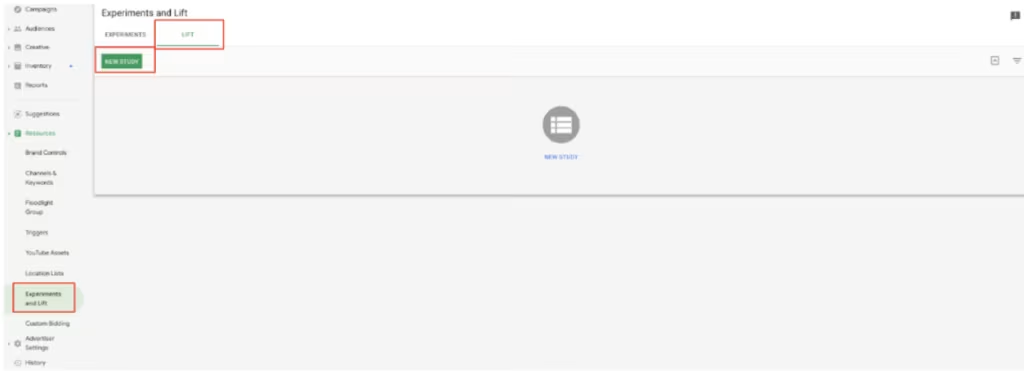
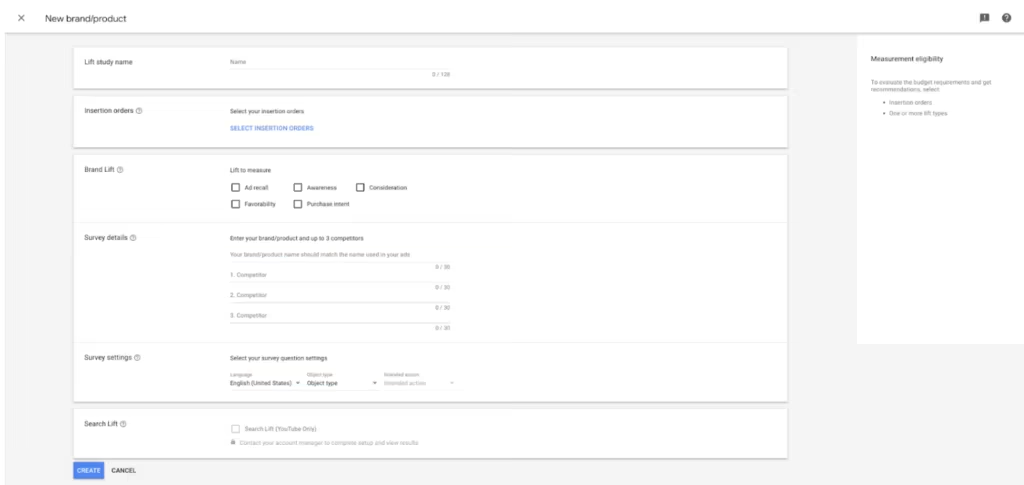 The prerequisite for a BLS is at least one activated insertion order including one or more activated YouTube line items. It is advisable to set up the required insertion orders/line items before setting up the study and make them active so that they can be selected straight away in the interface and evaluated by the budget calculator. The budget calculator is located on the left side of the interface (“Measurement eligibility”) and, when you select the insertion orders, it immediately shows whether the minimum budget has been reached.
In a further step, you must select which type of lift should be measured. Finally, the questions and answer options must be entered and some fine-tuning must be defined, such as the language of the study, product type and the “intended action” (such as “choose” or similar). The survey can then be created.
There are then some minimum requirements and important points to consider during setup. The specifications for the DACH area are described here:
FollowingMinimum requirementsmust be fulfilled:
- Country-specific minimum budgetsDepending on the number of questions and the country in which the study is carried out, different minimum budgets are required per study.
That means inROOF roomthe following:
| Minimum required budget* for 10 days on YouTube | |||
|---|---|---|---|
| Number of questions analyzed / countries | Austria | Germany | Switzerland |
| 1 question | USD 10,000 | USD 10,000 | USD 15,000 |
| 2 questions | USD 20,000 | USD 20,000 | USD 30,000 |
| 3 questions | USD 60,000 | USD 60,000 | USD 60,000 |
*Prices are in US dollars but will be adjusted in the account depending on the current exchange rate and currency specified. These budgets are minimum media budgets, i.e. minus deposited media fees.
- Sample sizeMeeting the minimum budget requirement above increases the chances of achieving results for the Brand Lift study, but does not guarantee it. The results of the Brand Lift study depend on several factors – including how many users are reached by the ad order and how many of them respond. Google states that noticeable increases can be expected from around 2,000-5,600 answers per measurement value. (Source:Google)
- Accelerated measurementAccelerated Measurement is a useful feature of BLS as it allows the study to deliver results in as little as 10 days. That’s why BLS is great for use in shorter campaigns. If the campaign flight lasts longer than 10 days, a re-measurement can take place within the campaign period. This allows data to be analyzed again during the runtime. Although accelerated measurement has many advantages, the budget and campaign period must be handled carefully. The minimum budget mentioned above is calculated for 10 days – this means the Budget Eligibility Calculator calculates a daily budget for 10 days. If the campaign is extended during the term of the BLS, it may happen that the daily budget is no longer sufficient.
An example: The minimum budget in Austria is USD 10,000 for 10 days – broken down into days, this amounts to a daily budget of USD 1,000. If the campaign duration is extended to 20 days, the daily budget will now be USD 500. This is below the required minimum daily budget of USD 1,000 and the BLS cannot continue. It is therefore important to plan the budget and duration in advance, or, in the event of an extension, to pay attention to the required daily budget. Further explanations can be found inGoogle Help Articles.
Reporting from BLS in DV360
The results of the study can be reported in DV360. It is recommended to monitor the “Lift” tab to know when the report is available and what the data collection process is currently like.
For YouTube & Partner BLS reports are also available offline in DV360 – atReports > Offline Reporting > YouTube > YouTube Default.followingMetricscan be evaluated.
- Brand Lift: Absolute Brand Lift
- Brand Lift: All Survey Responses
- Brand Lift: Baseline Positive Response Rate
- Brand Lift: Baseline Survey Responses
- Brand Lift: Cost Per Lifted User
- Brand Lift: Exposed Survey Responses
- Brand Lift: Headroom Brand Lift
- Brand Lift: Relative Brand Lift
- Brand Lift: Users
Conclusion
Brand lift studies are very suitable for measuring the brand awareness of a product/brand and generating campaign insights during the runtime. With a relatively simple setup, standard KPIs can be expanded with meaningful learnings. BLS is recommended for advertisers who want to better assess their position on the market or in comparison to their competitors.
For more information on measuring the impact of YouTube Ads on brand perception with YouTube Brand Lift Studies in DV360, simply contact our experts:kontakt@e-dialog.group
Further sources:
- Everything aroundAccelerated measurement
- Everything aroundSet up
- Everything aroundInterpretation of the data