
Data protection in marketing: Measurable success with confidence
In a digital world where trust is the hardest currency, we turn data protection from a complex obligation into your competitive advantage. We create legally compliant, future-proof solutions.

Why data protection in marketing is crucial
Data protection is more than just a legal necessity—it is the foundation for sustainable success. A transparent setup not only safeguards your legal position, but also strengthens your customers’ trust in the long term. That pays off: people who feel respected are more likely to share their data.
The GDPR (General Data Protection Regulation) and the upcoming ePrivacy Regulation set the legal framework here and require active consent from users before their data may be used for marketing purposes.

Why e-dialog is the right partner for data protection in marketing
-
01
Holistic Expertise
We do not view data protection in isolation, but always in conjunction with your entire digital strategy—from analytics and cloud solutions to creative—we find a solution that fits perfectly into your ecosystem.
-
02
Honest advice on equal footing
We are your partner and provide honest, unbiased feedback. With us, there are no empty promises—we only recommend what we truly believe in.
-
03
Results orientation is in our DNA
At the end of the day, results matter. Everything we do is geared towards generating measurable success for you.




Our approach to a privacy-compliant marketing setup
Audit
We conduct a thorough audit of your tracking and consent setup, identify weaknesses, and uncover potential.
Concept
We develop a data protection and tracking strategy tailored to you. We recommend the right technologies and outline an implementation plan.
Implementation
Our experts handle the technical implementation. Whether CMP, server-side tracking, or configuring Google Consent Mode—we ensure a legally compliant setup.
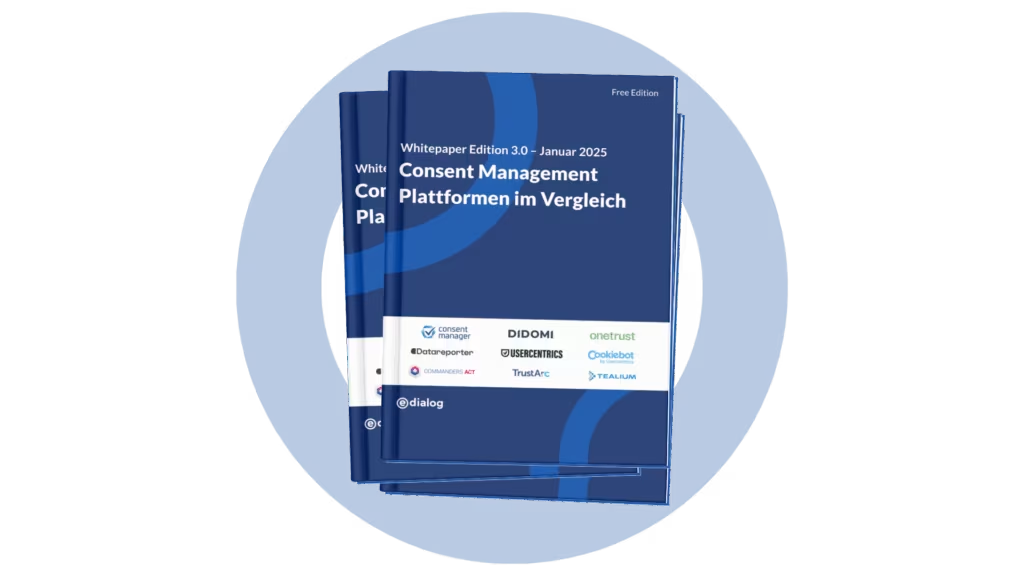
Our technology partners
We work with leading consent management platforms to provide independent advice and offer the right solution for every requirement.
Usercentrics
As a widely recognised CMP, Usercentrics offers a comprehensive platform for managing cookie consent, integrating with various analytics and marketing tools, and complying with key data protection regulations such as GDPR and CCPA. They focus on user-friendly interfaces and detailed reporting to help businesses maintain transparency and control over data collection.
Datareporter
Although less well known as a standalone CMP compared to others, “Datareporter” may refer to a specific functionality or a niche provider focused on data reporting and auditing in connection with consent management. If it is a specific product, its strength would likely lie in providing detailed insights into consent rates and data flows.
CommandersAct
This company offers a tag management system (TMS) with integrated CMP functionality. Its strength lies in combining tag management with consent management, enabling businesses to control and deploy various tags and technologies based on user consent. This integrated approach can simplify compliance for organisations that rely heavily on digital marketing and analytics.
Didomi
Didomi is a popular CMP with a strong focus on usability and compliance. It offers customisable consent banners, granular consent options, and real-time reporting. Didomi is known for its flexibility in adapting to different legal frameworks and its focus on helping businesses build trust with users through transparent consent processes.
Consentmanager.net
As the name suggests, Consentmanager.net is a dedicated CMP focused on providing a user-friendly and highly customisable solution for managing consent. It offers a wide range of features, including support for multiple languages, A/B testing for consent banners, and integration with numerous content management systems and advertising platforms. Its goal is to make consent management straightforward and efficient for businesses of all sizes.

FAQ: Frequently asked questions about data protection in marketing
What is the difference between server-side and client-side tracking?
With server-side tracking, your own server sends the data to marketing platforms instead of having it sent directly from users’ browsers. This significantly increases data security because data flows run through your own infrastructure, you have full control over them, and data minimisation is easier to implement. In addition, ad blockers that block client-side tracking are bypassed and data quality improves. The result: you get a more precise data basis for your decisions while simultaneously reducing legal risks through privacy-compliant marketing.
Do I really need a Consent Management Platform (CMP)?
Yes. As soon as you use cookies or tracking technologies on your website that are not strictly technically necessary, a CMP is essential. A CMP obtains GDPR-compliant consent from your users, manages it, and documents it. Without valid consent, personal data may not be processed for marketing purposes.
What does the “cookieless era” mean for my marketing?
The cookieless era describes the increasing decline in available third-party data due to restrictions in many browsers. This makes cross-site tracking of users more difficult and therefore also the personalisation of advertising. Future-proof alternatives such as server-side tracking and the consistent use of first-party data therefore become essential.
How can you help us comply with the GDPR?
We support you with technical and strategic consulting. This starts with a detailed audit and an evaluation of your existing setup to uncover weaknesses. Based on this, we implement a CMP, set up Google Consent Mode v2, and transition your tracking to privacy-friendly methods. Finally, we train your team so that you can apply the new solutions confidently and in a legally compliant manner.
What is personal data in marketing?
Personal data is any information relating to an identified or identifiable natural person. In marketing, this includes, for example, names, email addresses, IP addresses, and users’ behaviour on websites. The GDPR requires you to process this data only on a lawful basis—usually through the person’s active consent (opt-in). We help you use data in a targeted and restrained way to build trust and avoid risks.
What is legally compliant consent in marketing?
Legally compliant consent must be given freely, be informed, specific, and unambiguous through an affirmative action. In marketing, this often happens via a Consent Management Platform (CMP), where users can actively choose whether they consent to data processing. Opt-in procedures, where users must actively consent, are the legally safest choice. Processes such as double opt-in, for example for newsletters, are standard to clearly document consent. Valid consent must also be revocable at any time and documented. An opt-out procedure is a method in which users must actively revoke a pre-set consent, e.g. in a cookie banner, which does not meet the legal requirements of the GDPR. Without active consent, personal data may not be processed for marketing purposes—not even in pseudonymised form.
Can we book you just for consulting or a workshop?
Yes, absolutely. We support you flexibly, exactly where you need us. Whether for a one-off audit, a strategy workshop, or as a long-term sparring partner—we are here for you. We support you with technical and strategic consulting—our training offerings can be flexibly tailored to your needs: from comprehensive workshops for your entire team to specialised sessions for individual departments. We cover not only the technical implementation, but also the legal fundamentals, such as civil rights under the GDPR, the correct drafting of a privacy policy, or handling data processing agreements. This ensures that you are well positioned in all areas. (However, our consulting services do not replace individual legal advice.)