Setting the Course in Digital Marketing: AI, CTV, and Creatives in Focus at PCon in Vienna
200 Marketing Professionals at the Tenth PCon in Vienna
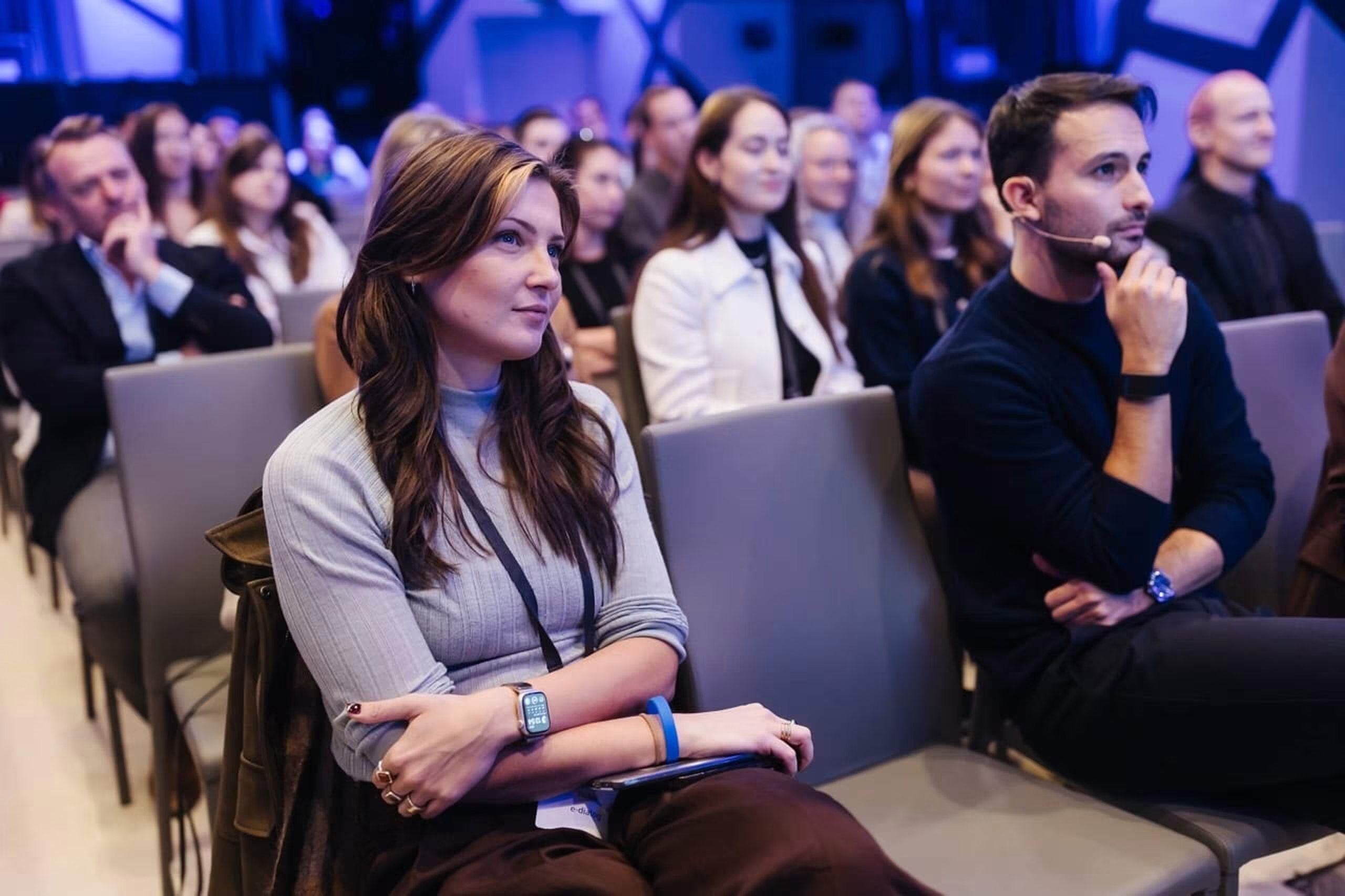
Photo Credit: Yvonne Fetz, Studio F
On October 2, the German-speaking marketing industry gathered for the conference day of the tenth PCon at Vienna’s Palais Wertheim. In twenty keynotes, deep dives, and panels, experts from across the DACH region shared current opportunities and challenges in digital marketing. On two stages, major platforms like Google, Meta, YouTube, Snapchat, and Amazon, as well as marketers, technology providers, agencies, and advertising companies such as Wiener Städtische, Manner, Holter, and Worldline, had their say.
AI Challenges Digital Strategies
In his keynote, Klaus-M. Schremser from otterly.ai posed the question: Are our websites ready for AI agents? His answer: “AI agents will independently purchase products – and soon. And they don’t care about advertising.” ChatGPT and similar tools answer questions instead of linking to websites. Google, as Maimuna Mosser, Country Director Google Austria, made clear in her keynote, is also evolving search away from pure information retrieval towards intelligent answers. While this meets user expectations, it can lead to fewer clicks on brand websites. “Traffic is shifting from a quantity KPI to a quality KPI,” noted Christian Schneider, Director Digital Marketing at Manner, in the conference’s concluding panel.
Connected TV Creates Awareness That Drives Performance
The figures from YouTube, the cases from Teads and Splicky, and the full-funnel campaign that e-dialog implemented with the Swiss ski resort Andermatt+Sedrun+Disentis clearly demonstrate: Connected TV is a proven medium that combines the reach and appeal of the home television as an advertising space with the advantages of programmatic campaigns. Advertising on streaming platforms not only increases brand awareness but can also be used to prove the influence of brand awareness on performance.
Creatives and Creators as Underestimated Superpowers
“Let’s not let AI steal our cool jobs,” appealed Christoph Schliecker-Magnani from Meta in the PCon’s social shopping panel. He pointed out that creative work is often neglected in everyday marketing. However, studies show that the quality of the creative significantly determines the success of a campaign. This fact was also highlighted by Maria Holzinger, Director Creative Media at e-dialog, in her presentation. Testing plays a major role in creatives, as a case study from the Vereinigte Bühnen Wien showed. But it is also the courage to hand over control to creatives that counts. “We content creators master the language of our platforms and often know the target audience better than the brands themselves,” clarified influencer Anna Strigl during the panel on social shopping.
Measurability: One Source Is Not a Source
Andreas Rau, Head of Agencies DACH at Meta, summed it up in his presentation: “Attribution is always wrong. It can only ever be an approximation of the truth. We must move away from the idea of a single source of truth and towards a suite of truth from many data sources.” Iris Handlsberger and Christian Reiser from e-dialog showed how this works in their talk: By combining geo-experiments, attribution, and marketing mix modeling, companies can determine the actual impact of their advertising channels. Even if this ambitious goal seems unattainable for every company, taking small steps along the way is worthwhile.
Quality Offensive for AI Content
Generative AI is both a curse and a blessing. The uncritical use of the same prompt templates repeatedly produces easily recognizable AI slop. “AI doesn’t need prompts, but good sources,” demanded Matteo Rosoli from the Viennese startup newsrooms. Bert Middendorp from Galeria and Tobias Kellner from e-dialog outlined how the German webshop has evolved with the help of generative AI in recent years – from smart search and completed product information to AI-generated product videos and virtual try-ons.
Insights were also provided by platforms such as Jentis, Splicky, adtron, Commanders Act, and adnomaly, as well as into B2B lead generation campaigns for Holter and Worldline, and the diverse possibilities of Digital Out of Home with Gewista.
At the end of the conference, the organizer e-dialog already announced the next conference date: The Google Analytics Conference will take place on April 23, 2026, in Vienna.
You can find some photos from PCon 2025 here.