Customer Data Platform Whitepaper
Get new whitepapers and updates on digital marketing topics with our newsletter
Subscribe to NewsletterTo succeed in digital marketing today, you must also make your data usable for campaigns and insights.
For decision-makers in marketing, e-commerce, sales and CRM, using a Customer Data Platform (CDP) offers benefits and opportunities.
In our recently expanded whitepaper, we explain what a CDP is and the value and benefits it can bring to companies.
Personalising the customer journey
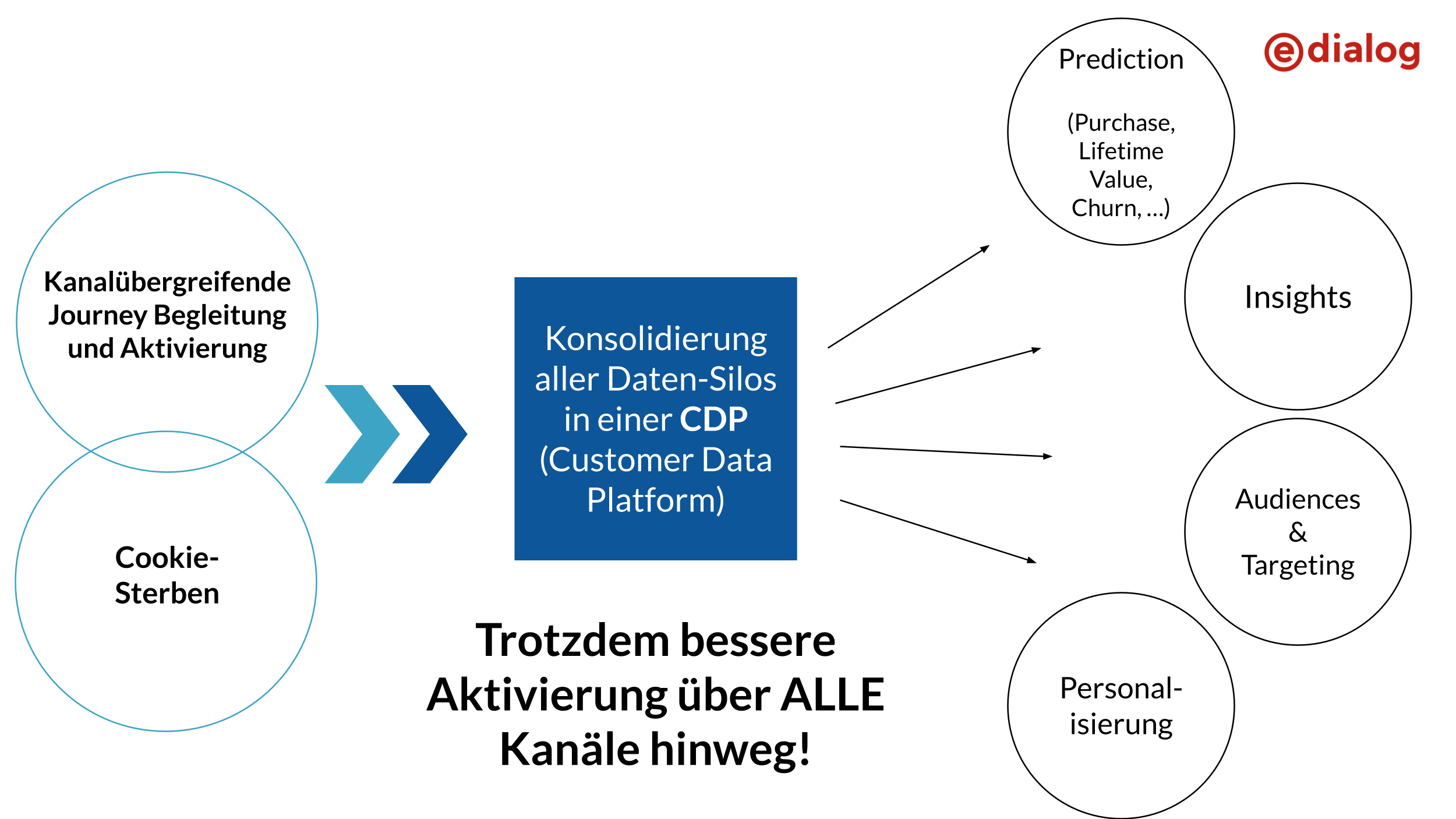
Customers want personalisation and relevant messaging across all channels. The foundation for this is your own 1st-party data—more than ever with the phase-out of 3rd-party cookies. The challenge? Internal company data is often not consolidated and therefore cannot be activated for cross-channel activation and personalised customer communication. Existing data silos also make complex machine learning approaches more difficult, such as purchase propensity or customer lifetime value modelling.
Challenge & opportunity: Not least due to the phase-out of 3rd-party cookies, activating your own customer data across all channels, in real time is more important than ever—not only for insights, but above all for activation and personalisation along the customer journey.
This whitepaper provides a guide on how to master the challenge of data consolidation, activation and personalisation along the customer journey:
This whitepaper covers:
- Introduction to the topic
- Know-how: What to look out for
- Build, buy or hybrid – which is the right approach?
- Roadmap, architecture & roll-out: How it can be implemented
- Details on the benefits of a CDP
- Outline of a typical system landscape
- Benefits of a hybrid implementation
- CDP operating model & stakeholders for introducing a CDP
- Further best-practice cases of successful CDP implementations

In a CDP, all data from a wide range of channels & sources can be consolidated to obtain as close to a 360-degree view of our customers as possible and personalise journeys accordingly. The goal is consistent, personalised customer communication across devices and channels—based on the customer lifecycle.
A Customer Data Platform acts as middleware between existing systems and the data silos of marketing and sales. It gives these systems access to the stored data for analysis and activation. Of course, implementation requires effort. But it is worth it! The result is better marketing performance through activation across all channels, including marketing automation, onsite and social media, and a better understanding of user behaviour.
Build, buy or hybrid?
As with many system decisions, choosing a Customer Data Platform also involves a difficult choice:
- Build: Use Google Cloud Platform with ad-hoc and real-time use of all Google data, plus flexible integration of your own and third-party systems
- Buy: Licensing a “ready-made” platform that often appears to offer many advantages at first glance
- Hybrid: The best of both worlds!
In the whitepaper, we outline the pros and cons of these solutions and provide an initial insight into the world of licensing providers.
Customer Data Platform whitepaper – download now!
Please complete the form below to access the free download of the whitepaper. This document is continuously updated. By downloading it and submitting your email address, you will receive all updates free of charge and automatically.
This update from 2023-01-04 – Edition 2.0 of the whitepaper – is a comprehensive revision and expansion of the CDP whitepaper. This version includes an addition in Chapter 05 on data types, sources & profiles of a CDP and explains the benefits of a CDP in detail in Chapter 09. Chapter 11 outlines the typical marketing system landscape and how it is linked to the CDP. Chapter 14 adds the benefits and opportunities of the hybrid option when it comes to the build-or-buy decision for a CDP. Chapter 15 has been expanded with additional insights on the CDP Turbo Google Ads Data Hub. Chapter 17 deals with introducing a CDP in the company and the stakeholders to consider, and Chapter 18 adds the CDP operating model. The case studies in Chapter 22 have been expanded to include the implementation for Falkensteiner Hotels & Residences.