Newsletter Open You 11 Tips On How To Increase Your Open Rates With More Effective Subject Lines

Management Summary
1. First impressions count
At first glance, the recipients of your newsletter will not only see your subject line, but also your sender name. Please note that you do not include your company name in the subject line as it is already included in your sender name.
Positive example:
Sender name: e-dialog | Online marketing advice
Re: Increase your KPIs with the same budget!
Negative example:
Sender name: e-dialog | Online marketing advice
Subject: Increase your KPIs with e-dialog within the same budget!
In our negative example, the subject line is unnecessarily drawn out. Important parts are too far back and may therefore be overlooked by the recipient.
2. First things first
As is often the case, this principle also applies to the subject in your newsletter. You don’t have enough space in your subject line to leave the important message at the end. That means: unique offers & Information with important benefits at the front, additional information at the back.
3. Short & sweet
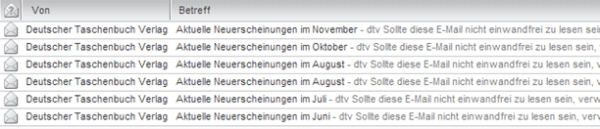
Many newsletter authors tend to want to mention everything that appears in the newsletter in the subject line. As a rule of thumb: use a maximum of around 50 characters. Technically there are no problems if the subject line is longer. What can prove to be a problem, however, is that many clients do not display the entire subject line and the end is not even readable for the recipient.
4. Communicate benefits & arouse curiosity
Why should a recipient who receives hundreds of emails every day open your newsletter? If there is no hidden benefit in the message of your subject, the recipient probably won’t do it either. Why? In any case, the recipient will not experience any benefit and therefore added value if the subject is “Newsletter 02/2015” or “Special newsletter from company x”.
5. Variety
A recipient will not react with curiosity, but rather with boredom if he always finds the same subject in all your newsletters, albeit with minor changes. “The best offers in March”, “The cheapest offers of the summer” are monotonous and slowly but surely cause the open rate to decrease over time.
6. Convey urgency
“Only a short time left” or “only 100 pieces” in combination with a special promotion make your products a scarce commodity. Often small words can make a big difference. Why not put the words “now” or “today” in your subject lines and create the feeling of a time restriction.
7. Stay grounded
Despite all the good advice, it is still important to stay grounded. Don’t make promises in your subject lines that you ultimately can’t keep. There is nothing more unsatisfying for a newsletter recipient than not finding what was promised after an exciting subject line in the mailing.
8. Avoid spam wording
Taboo in mailings and newsletters are terms and phrases that could be caught by the clients’ spam filters. These include, for example, “super cheap” or several consecutive exclamation marks in combination with phrases such as “unique chance” or “want a bargain”. Spelling errors and the announcement of unexpected top profits do not exactly indicate trustworthiness. In these cases, the likelihood increases that the spam filter will be activated and the email will not end up in the recipient’s inbox as intended.

9. Promotions, vouchers, competitions
Not too often and too provocatively to end up in the spam folder. Mentioning promotions, discounts, vouchers, competitions, etc. can help you achieve higher opening rates. It is important not to use spam formulations as mentioned in point 8 and to stick to what was predicted in the subject.
10. Test, test, test
It is important to carry out an A/B test for EVERY shipment – with enough recipients. The subject line is often useful for this. In one company, subject A works better, in another, subject B. Depending on the target group and the time of sending, your company has to find out and constantly test what resonates with its readers and what doesn’t.

Little guessing quiz: What do you think: Which subject won this test? The answer is at the end of the blog article. ;-)
11. Personalization
Address your recipients personally in the subject line. However, there are two important basic rules to follow: 1. Your data must be well maintained and 2. you must always personalize the subject in a measured and targeted manner.
All of these tips cannot be unified into an overall product with which, if you apply everything, you are guaranteed to always write the best subject. To find out what’s best for your business and your audience, you need to continually analyze, test, and optimize your emails. Time you don’t have?
We’ll help you with that. Simply contact us viakontakt@e-dialog.group
PS: In the subject test, the version said “Your subscription bill for free as a PDF!” won.