Accelerated Mobile Pages Amp How To Render Mobile Websites Today

Management Summary
Accelerated Mobile Pages (AMP) – What is it?
This also seemed to really annoy some developers, which is why they did itAMP projecthave brought into being. With this extended HTML markup you will:
- Controlled the order of content to load.
- The time when the content is loaded is triggered on the “above the fold” area.
- The number of requests is reduced, which ultimately benefits the loading speed.
Simply put: The content and the content are only loaded when they are in the visible area of the website, while the precaching or prerendering of the not yet visible content makes it feel like you are navigating in a native app.
The mobile Google search will also be switched to Accelerated Mobile Pages (AMP) this year! Underg.co/ampdemothe version can already be tried out.
When do Accelerated Mobile Pages (AMP) make sense?
AMP is NOT suitable for developing interactive mobile web applications, but it is ideal for optimizing static content. Either you create new AMP-optimized landing pages and reference them via Canonical, or you replace the already indexed pages with Accelerated Mobile Pages (AMP) code and reference the Canonical to itself.
Which requirements must be met?
There are certain rules and attributes that need to be added to the standard HTML framework: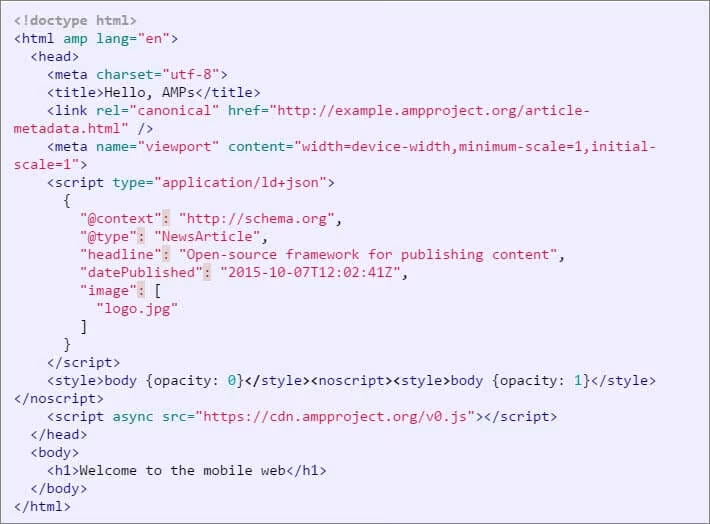 You can find more detailed information about this in theAMP documentation.
Accelerated Mobile Pages (AMP) are much stricter than classic HTML
- The code must be 100% valid, otherwise the pages will not be accepted by Google.
- In order to minimize requests, CSS can and must only be implemented in the head of the website, whereby the code must not exceed a size of 50kb.
- All JavaScript must be loaded asynchronously.
- Canonical referring to itself is mandatory.
Who should feel addressed?
 The average loading time of today’s websites is 10 seconds (!!!) while 60% of users leave after just 3 seconds. A decent free tool for measuring loading times isPingdom. As is often the case, the pioneer here is the Wikipedia website, which I ran through the tool as a test.
 The most important factors are the number of requests and the page size! So when it comes to pure content pages, I would definitely use Wikipedia as a benchmark and try to slim down as much as possible.
I use a lot of extremely high resolution images
An image is an image and of course has to be downloaded as a whole, so the best website in the world is of no use to us. Here are a few tips:
- The resolution of the images should depend on the size of the container in which they are embedded.
- Use image compression, especially for photos or jpg files -> Up to 25% of file size can be saved without loss of quality.
- Thecorrect image formatUse for the various website elements.
Expectations of today’s users
The sentence below speaks for itself, I have nothing more to add… :-)
“In 2006, the average online shopper expected a web page to load in 4 seconds. Today, that same shopper expects your page to load in 2 seconds or less.”
[Source:Cheat Sheet: Everything you wanted to know about web performance but were afraid to ask]
Page speed is an important Google ranking factor
If you have looked at the top 10 Google search rankings for a while, you will notice a certain connection between rankings, page speed and user signals. OneStudy by Searchmetricsmakes this approach even more plausible! Accordingly, the faster pages can be found in the top 4 positions, especially in the mobile SERP on Google.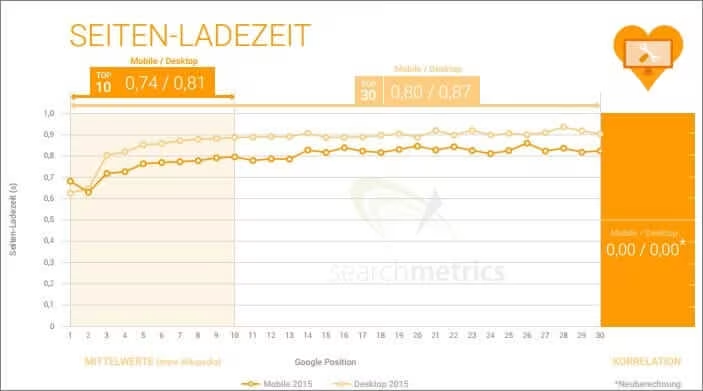 The10 most common causes of poor site speedWe have already described how you can get around this elsewhere in this blog.
Every second counts
Amazon now conducts very deep and good market research from which we can learn a lot. They managed to come up with a formula that shows to what extent page speed correlates with conversions.
Meanwhile, Google, Yahoo and Bing have found that faster load times lead to fewer searches. So it probably makes a lot of sense that Google prefers faster websites, because faster websites make users happy faster and that’s exactly Google’s philosophy.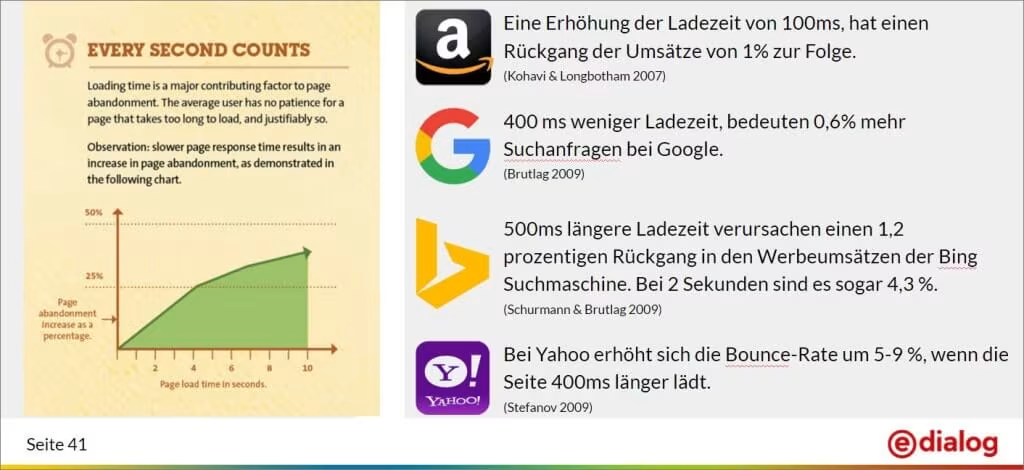 I hope I was able to give one or two readers a basis for deciding whether an investment is worthwhile or not. With that in mind – here’s to a faster 2016.