Customer Data Platform What Is It And Why Do I Need It For
Management Summary
What is a Customer Data Platform (CDP)?
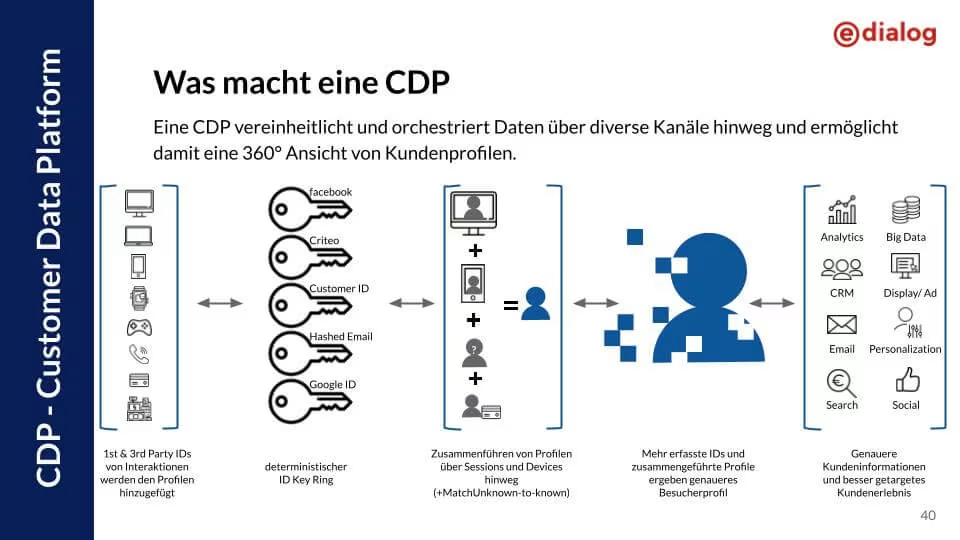
Gartner defines a CDP as“a marketing-driven solution that creates a persistent, unified user database that makes user data accessible to other solutions.”A CDP makes it possible to cleanly connect ALL company-wide data sources (onsite, offsite, CRM, BI, offline, etc.) across ALL channels (Facebook, Email, Display, Criteo, etc.). Data silos are (finally) broken down, united and thus (finally) enable a 360° view of the most important asset of every company – the customers.
Where the journey is headed is clear:The goal is a uniform, personalized, cross-device and cross-channel customer approach – based on the customer lifecycle.Because this (finally) creates what we have been talking about for so long and what we long for: individual customer experiences – across ALL devices and ALL channels. Let’s go one step further: ThisCDP Institutesdefines a Customer Data Platform as“a software package that creates a persistent and unified customer database that can be accessed by other systems.”
The following 3 criteria are therefore crucial for a CDP:
1. A CDP is a software package…
A CDP is a pre-built system, a software package that – technically speaking – meets the needs of any company. Setting up and maintaining the CDP requires in-depth knowledge – but not to the extent of a typical data warehouse. This not only reduces time, costs and risks, but also gives its users – who typically come from marketing – (much) more control over the system.
2. …that creates a consistent and consistent customer database…
A CDP creates a comprehensive view of each individual customer by collecting, linking and storing data from (ideally) ALL company-wide data sources.The big advantage:The link is based on unique IDs and these in turn on personal customer data, e.g. email address or telephone number. Only then can users be recognized and addressed in a personalized manner across devices and channels.
3. …that other systems access.
What is important is:A customer data platform does NOT replace existing company tools and platforms but rather functions as a kind of middleware between all silos in the company.
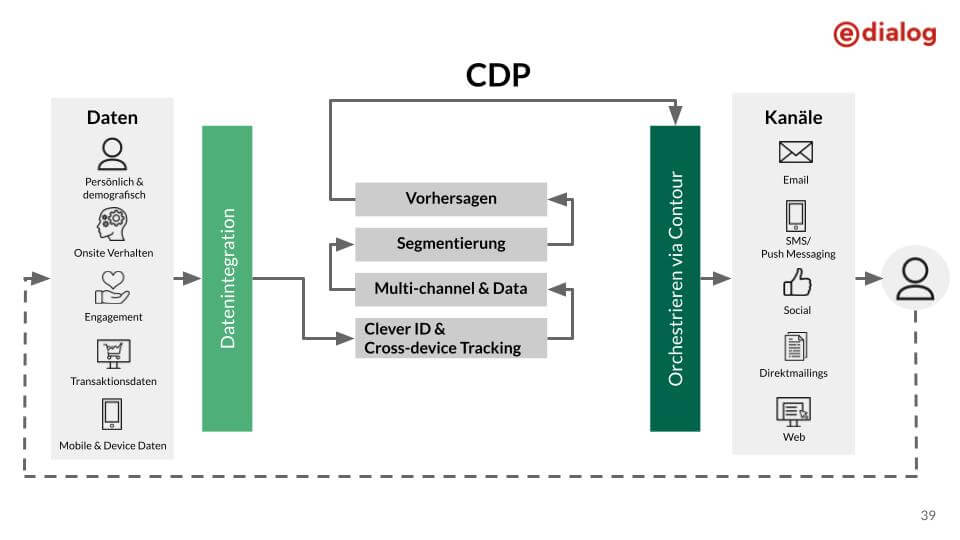
Therefore, data stored in the CDP can also be used by other systems to analyze and manage customer interactions: for example, in social networks for personalized campaigns or by Google Analytics (with Google Optimize) to control personalized website content. In the best case, a CDP provides out-of-the-box interfaces for all possible marketing systems. This lays the foundation for the primary functions of a CDP:
The basic functions of a CDP
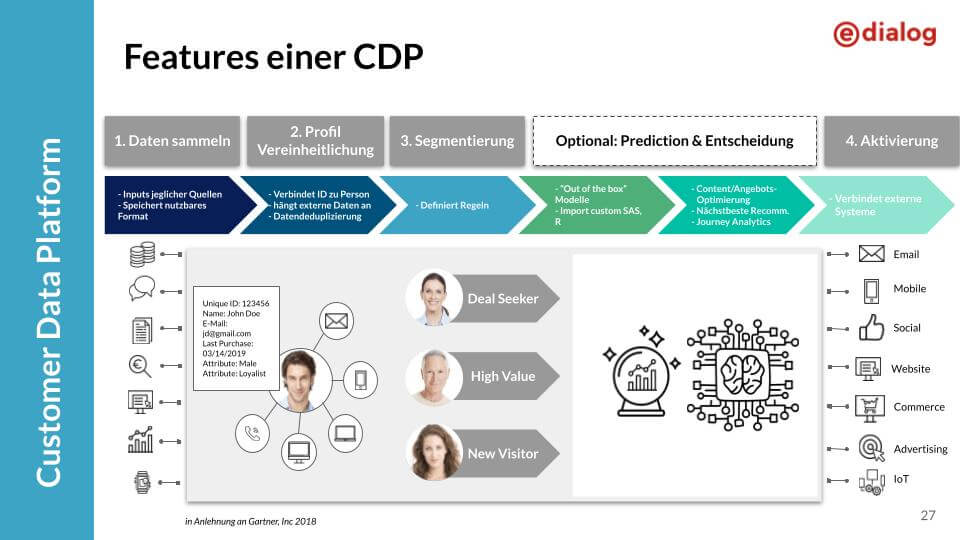
CDPs must at least fulfill the following features (although most can do much more):
- Collect data
- Unify profiles
- segmentation
- Optional: Prediction & Decisions
- Activate data
Let’s look at the features in detail:
1. Starting point: collect data
The starting point of every CDP is of course the collection of data: All 1st but also 2nd and 3rd party data is integrated into the CDP and stored in a uniform, usable format.The goal: A perfectly structured, usable data pool.
2. Central function: standardize profiles
The central task of a CDP is the standardization of customer profiles. A single, individual data set is created for each customer. To do this, all user profiles are resolved and merged across devices and channels. This is done using deterministic ID keys. Users are no longer just linemen, but people with faces, names, individual needs and understandable behavior. Only now do we know who they are and what they need at this moment. And only now can we give them what they already take for granted:A unified, personalized customer approach across devices and channels, based on the customer lifecycle.So much for the technical basics. Now the real work begins:
3. Segmentation: The be-all and end-all for the right customer approach
These data sets can now be used to create visitor segments for cross-channel segmentation strategies. The marketing team’s real work begins. And this is also where the great potential and the actual goal of CDPs lies: identifying customers who can be divided into groups based on various characteristics in order to target them specifically.The magic word is: audience management.
4. Optional but recommended: Prediction & Decisions
So much and, above all, structured data in one place: it literally calls for great data analyzes and predictions. In addition to segmentation, numerous “out of the box” models can also be used, which provide initial and, above all, excellent insights for better decisions. Programming languages such as R and Python are ideal for your own static calculations that go in the direction of data science.
5. Don’t forget: activate data
However, the pivotal point for the usability of the data is activation. Segments or audience lists and data analyzes are only relevant if they are activated. In particular, segments should return to Facebook, Google & Co. can be played and actively used there. The ultimate discipline is of course a 360° approach, i.e. using the specific customer approach in real time on ALL channels. From email to social (and not just Facebook but also advertising niches like Snapchat, Twitter & Co.), from display to onsite – a 360-degree approach is the perfect way to reach users where they are. This way you stay present and are there at the exact moment the conversion decision is made.
The advantages of CDPs summarized:
A CDP integrates and aggregates (in the best case) ALL company-wide user data, brings it together and then makes it available for ALL marketing channels such as email, display, targeting and personalization. A CDP is not a CRM system, not a data warehouse, not a DMP and not a data lake. A CDP does not necessarily replace these systems, but rather acts as a connector between all data silos in the company.>> You can find a comprehensive delimitation here.There are numerous CDPs on the market and we will also take a look at a handful of providers. Some can do more, others less. But what they all have in common are the following basic functionalities: collecting data, unifying profiles, segmenting and activating data.
CDP providers at a glance
The concept of CDPs has been around since 2013. Accordingly, there are many tool providers on the market. The CDP Institute provides an up-to-date list of all CDP tool providers on its website:https://www.cdpinstitute.org/find-a-vendor/The abundance of tools makes choosing a provider not exactly easy. It becomes even more difficult when tool providers try to differentiate themselves and do not directly describe their system as a CDP:
- BlueVennfor example is known as a “marketing automation platform”.
- Evergagedescribes itself as a “1:1 personalization tool”
- Commander’s ActandTealiumare particularly characterized by their tag management
- Tealiumitself calls its CDP “Universal Data Hub”
- segmentoffers an entire customer data infrastructure
- Treasure Dataon the other hand, an analytical infrastructure
- mParticledescribes itself as a “mobile data platform”
- Ascent360is called a “cloud-based marketing platform”
And yet they are all CDPs… Several others on the list more or less call themselves CDPs, including
- Datorama(recently purchased by Salesforce),
- Cross-engage,
- Lytics
- BlueConic
Google Analytics as CDP
And then there is also the Google world with Analytics360 and BigQuery.>> More about this here, in a separate blog post.Let us help you choose! Our analytics experts will be happy to advise you on creating your customer data platform. Contact us:kontakt@e-dialog.at