With Personalized Article Recommendations For A Better User Experience

Management Summary
Initial situation
As early as 2018, we laid the foundation for article recommendations via GoogleMachine learning with TensorFlow(more information in the blog article:Recommendation systems with Google Analytics raw data). This basic system was further developed and implemented individually in a specific publisher case.Fork.at,a news portal from the KURIER media companyThere was the following challenge: A majority of publisher customers only read one article on the website and then leave the site again. We solved this problem with aspecially developed recommendation systemtackled.
Goals of (Publisher) Recommendation Systems
Theimprovementthe so-calledUser Recirculation Rate– the percentage of users who visit another page of the website after reading the first article – is therefore the focus. Furthermore, the aim was to improve the user experience and maximize ad revenue.
Approach – Personalized article recommendations with machine learning systems
Our approach to achieving these goals is personalized article recommendations based on machine learning systems. To do this, data must be collected in the following areas: “What is the content of the article read?”(Data about the article)and “Who reads the article”(Reader data).Google Analytics served as the database, and the collected data was then used to train machine learning systems and provide personalized recommendations.
Types of recommendation systems
We differentiate between 3 types of recommendation systems:Content Based, Collaborative Filtering, Knowledge Based.
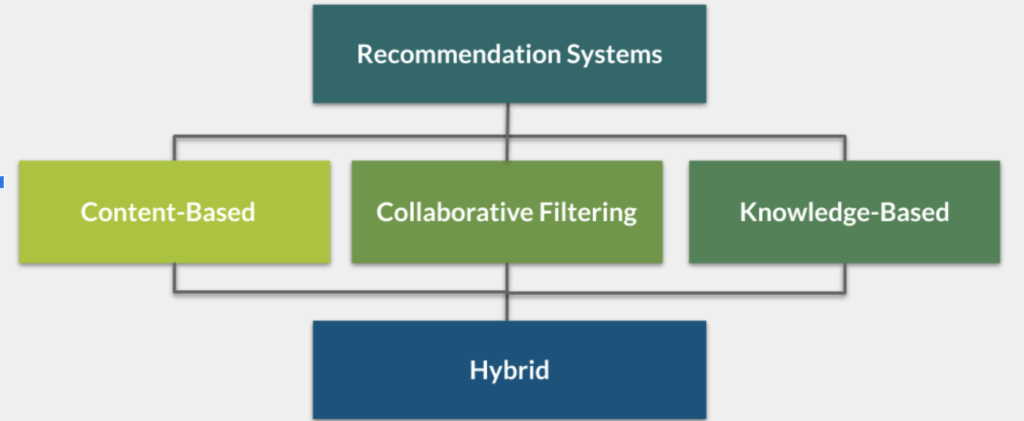
- Content based:The content of the article is the central element. The question “What is being read?” is in the foreground.
- Collaborative filtering:The user or the cookie ID is the central element. The question “Who reads the article?” is in the foreground.
- Knowledge based:Based on explicit knowledge of the product range, user preferences and recommendation criteria.
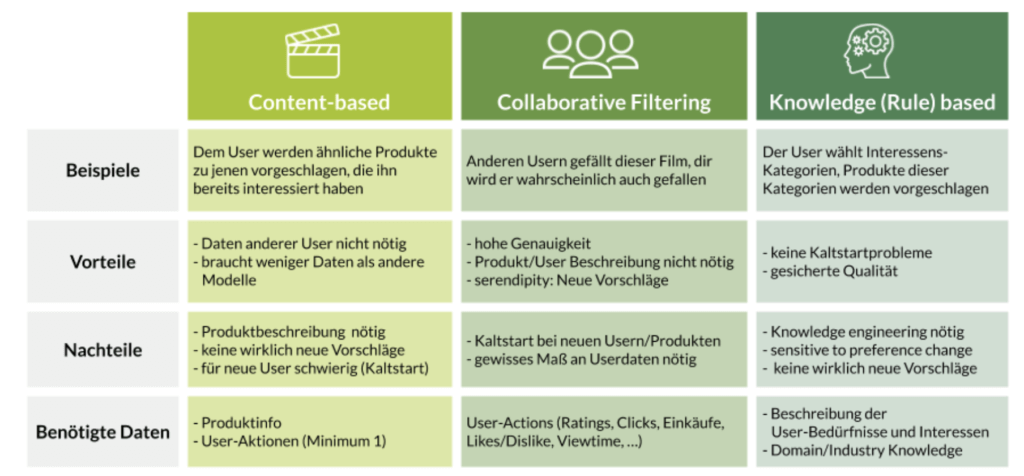
Systems in comparison:
Our system architecture
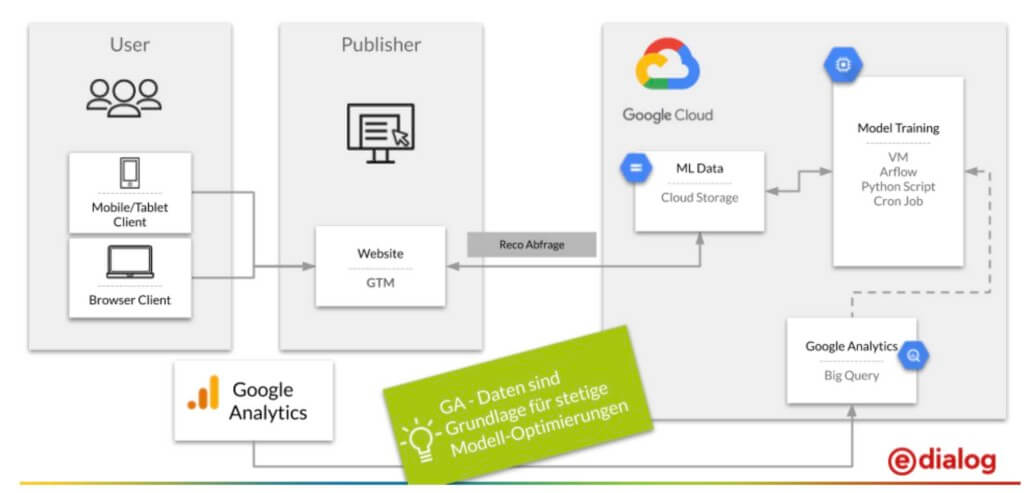
The schematic representation shows the system architecture of our recommendation engine. The machine learning script we programmed is the heart of the system.
Where does our recommendation engine data come from?
We use the complete spectrumGoogle Marketing Platformor the Google Cloud Platform. The basis is Google Analytics website data. These are saved in the Google Cloud every 15 seconds using a real time stream. The ongoing data updating and the calculation and optimization of the machine learning models take place in the Google Cloud. The recommended articles are displayed using Google Tag Manager based on Google Analytics user identifiers.
Bonus:No additional interfaces are required on the publisher side (these are automatically available with Google 360).

The results
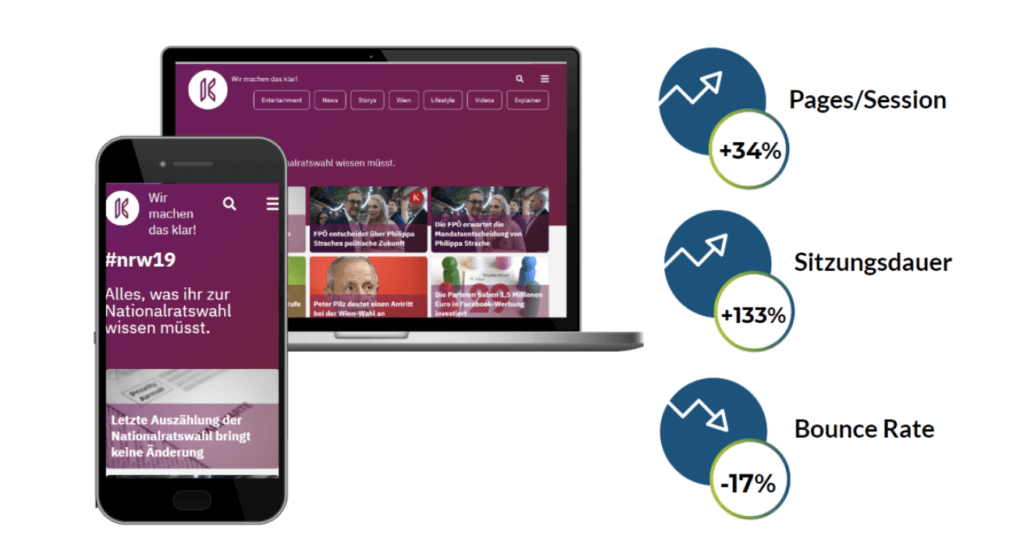
The graphic impressively shows the improvement of relevant KPIs through the use of the recommendation engine. This also means a significant improvement in the user experience, as visitors to the site are now shown content that is relevant to them. Whenever the recommendations were played out, not only was the session duration more than doubled, but the number of pages visited was also significantly increased.