Google Analytics 4 8211 A Look Into The Future
Management Summary
Better ROI through smart insights
Through the greater use of machine learning models, the Google Analytics 4 Property makes it possible to obtain deeper insights into (future) user behavior – Google Analytics even automatically notifies marketers of significant data developments.
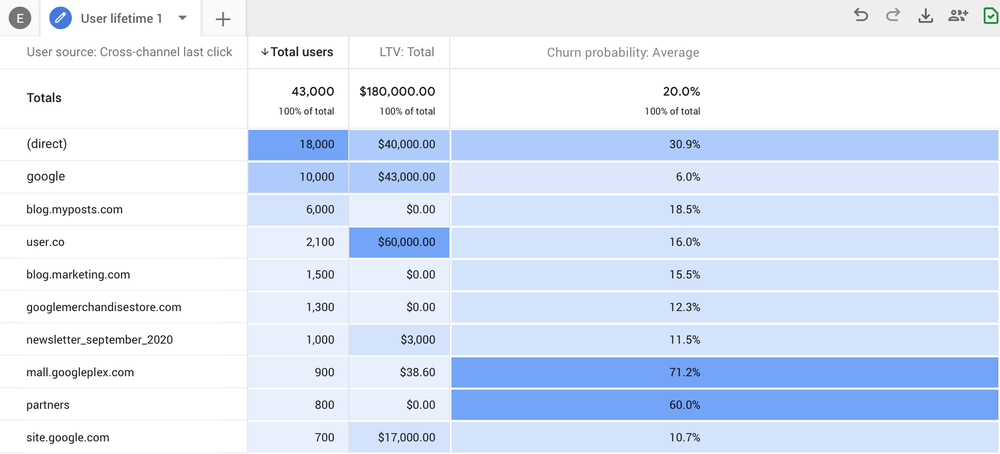
These algorithms also make it possible, for example, to calculate the user’s churn probability. The information about possible user churn, as well as the integration of other products of the Google Marketing Platform, allows Analytics not only to distribute marketing budgets more efficiently, but also to improve the return on investment.
More comprehensive understanding of user interactions
The new version of Google Analytics will focus on users when measuring, not on the various devices and platforms as before. Through various identifiers (for example: user ID or through data from Google Signals) it is possible to obtain detailed insights into the user’s customer journey. This makes it possible to analyze how users initially came to a company and what the subsequent interaction steps were. For example: a user discovers a company through an ad on the web, he/she later installs the app on his/her mobile device and makes purchases there.
This makes it possible to get a holistic picture of the user journey and customer lifetime cycle – from customer acquisition to conversion to customer loyalty.
Questions such as whether the customer will stay after the conversion no longer remain unanswered. With the help of the user acquisition reports as well as the engagement and retention reports, we can understand the interactions of our customers and determine whether they will buy/interact with us repeatedly.
Future security through new approaches
Working with cookies – especially third-party cookies – will change. The new Google Analytics is being prepared so that the use of third-party cookies will no longer be possible in the future. The new analytics will compensate for this through “modeling” and fill in any data gaps. Measuring the performance of marketing activities is thus made future-proof.
Another important approach of Google Analytics is data control, which is intended to enable simpler data management – how data is collected, stored and used.
With granular control over ads personalization, marketers can decide when to use the data to optimize ads and when to limit the data to measurement.
Conclusion
The clear recommendation is to implement the Google Analytics 4 properties as quickly as possible and to work with a “dual setup” – i.e. parallel tracking in the existing and the new Google Analytics version. This means that the existing setup remains and you also benefit from all the features and advantages of the new Google Analytics 4 properties.