Facebook Conversions Api 8211 Future Oriented 038 Browser Independent Tracking

Management Summary
How does the Conversions API work?
The Conversions API (CAPI) is a solution developed by Facebook to make data tracking browser-independent – and above all – more reliable. This enables cookieless targeting, which will be necessary in the future. Through the CAPI, the recorded events are processed via the website, sent to the customer server and then transmitted to the advertising platform via the API. In contrast, in classic client-side tracking, the browser passes the data to Facebook, which means that the signal quality of the data loses validity or information can be lost due to ad blockers.
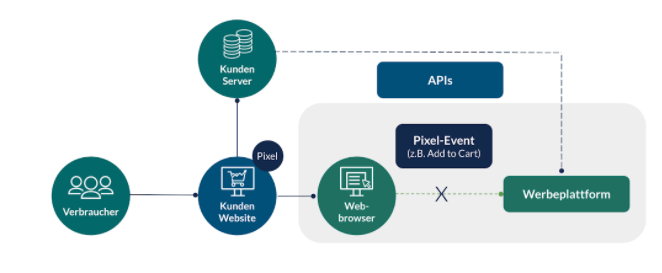
This also answers many questions about the Facebook Conversions APIBlog article.
The benefits of the Conversions API
Direct data processing via the customer server minimizes signal loss many times over compared to browser processing. Another resulting advantage is, on the one hand, control over which data is transferred to Facebook and, on the other hand, secure exchange. As a company, you decide when and what data is transferred to Facebook and in what form. For example, conversions can be supplemented with valuable information such as CRM data, product margins or offline conversions. A clear added value, as on the one hand the quality of the website signals improves significantly and on the other hand data is used that the pixel cannot currently capture.
The biggest advantage is therefore to significantly improve the quality of the data and thus the overall ad performance. Facebook states that the ROI of implementing CAPI represents a 150% improvement compared to campaigns optimized for traffic (clicks) only. Without implementing CAPI, optimizing for clicks will ultimately be the only option for advertisers.
Conversions API vs. Facebook Pixel
Like the pixel, the Conversions API is used to collect user data and ensure consistent tracking of the customer journey. Similar to the pixel, there are standard and custom conversion events, which include important events such as “Buy”, “Add to Cart” & Co. will be handed over.
But the Conversions API offers more: In addition to the standard events, events such as “purchase by new customers”, “qualified lead” or “subscription completed for X months” can be tracked. This means that even more high-performance campaigns can be set up that are optimized for company-specific goals.
Basically, there is the option of integrating the API without or, as recommended, together with the classic Pixel. The Pixel and the API form a perfect duo, allowing targeting, measurement and ultimately business goals to be perfectly optimized.
Attention: If the same web activities are recorded via the pixel and the API, deduplication of the data is necessary. The integration can take place using different variants: via a plugin, via the server-side Google Tag Manager or directly on your own server.
Conclusion
Assuming a clean implementation, the Conversions API promises significantly more efficiency and opens up great potential for data-driven campaigns: better understand customer behavior, address the right target group and experience-oriented optimization – with better data for better ROI. In view of the fact that most browsers will deactivate cookie support in 2022, in our opinion the implementation of the CAPI is a requirement (for data-driven campaigns) with which we would be happy to advise or support you.