Google Analytics Impact Of Tracking Prevention Mechanisms On User Recognition

Management Summary
In traditional implementations of Google Analytics via a client-side Google Tag Manager, the _ga cookie is used to store a ClientId and keep it available for future visits by the user. This first-party cookie comes with a storage period of 2 years and thus enables the user to be recognized over a long period of time. The expiry date of the cookie is automatically extended when the user visits again.
Limitations on user recognition
But what happens if the _ga cookie is no longer present when you visit the website again? In this case, a new _ga cookie is generated with a new ClientId, which means a new user is recorded in Google Analytics. In addition to the already known influences, such as cross-device users or the use of different browsers on one device, there are now also protective mechanisms within different browsers that make user recognition significantly more difficult. The most prominent example of this is Safari’s Intelligent Tracking Prevention (ITP), which limits the lifespan of first-party cookies written via JavaScript to 7 days.
But other browsers such as Firefox also use mechanisms such as Enhanced Tracking Prevention (ETP), which reduces the cookie lifespan in Firefox to 1 day.
Effects in practice
But what does that mean in practice? How much do these protection mechanisms already distort the user numbers in a Google Analytics setup? In order to at least look at a representative example, I would like to present real practical data to you today.
Before we look at the results, here is an overview of the test method or our test setup.
Test setup
For a large e-commerce website, we use a server-side Google Tag Manager, which creates a hashed version of the ClientId from the _ga cookie and stores it in an HTTP Only Cookie FPID. The HTTP Only flag ensures that browser-side JavaScript does not have access to the cookies marked in this way. This means that these cookies are not affected by measures such as ITP and ETP. Example ClientId _ga: GA1.2.1476844631.1648732442
Example hashed ClientId FPID: FPID2.2.RQb894iKE7ebjaQVIYEpZSQhd1L+hvCUrhTmtUC4eno=.1649247034
In addition, the “Migrate from JavaScript” option was activated in the Google Analytics client on the server-side Google Tag Manager, which means that the ClientId from the _ga cookie is used until the hashed version of the ClientId no longer matches the original ClientId.
This means that if a _ga cookie is lost for returning users, the hashed ClientId will be used from this point on. As long as the _ga exists, the ClientId from this source is preferred.
These hashed ClientIds are easy to distinguish from the original ClientIds because they not only consist of a sequence of numbers separated by a period, but also contain a sequence of letters at the beginning beginning with =. Be separated from the following number sequence.
This characteristic makes it easy to determine the proportion of these ClientIds that are used if the _ga cookie is lost.
Below you can see our results of this evaluation:
Evaluation
In this graphic you can see the total shares of the _ga ClientIds (client) and FPID ClientIds (server). As can quickly be seen, the proportion (±6%) of server-side ClientIds is very low when we look at the entire database. In addition, an increase in server-side ClientIds can be seen over our observation period.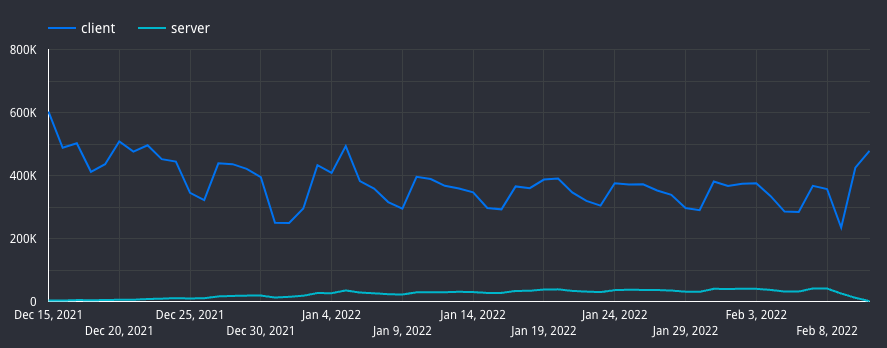 To classify these numbers, we must take into account that there is a non-negligible proportion of users who only visit the website once during our observation period. It is also important to know that browsers like Chrome do not yet use mechanisms like ITP or ETP.
Therefore, segmenting the data by browser is essential for a more accurate picture. In the following graphic you can see the data by browser, sorted in descending order by the browser’s share of the total number of ClientIds.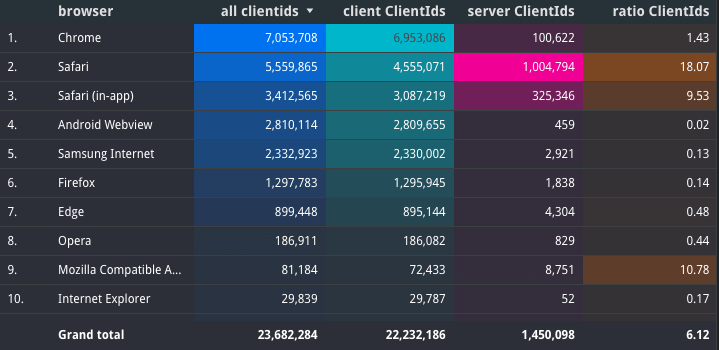 As expected, Chrome, the browser with the largest share, has a very low share of only 1.45% of server-side ClientIds.
What immediately stands out in this regard are Safari, Safari (in-app) and Mozilla Compatible Agent. These record significantly higher proportions of server-side ClientIds than other browsers in the top ten. It is therefore clearly visible that ITP and ETP can already have significant influences on data quality.
How large this proportion is depends mainly on two factors:
- Proportion of browsers such as Safari and Firefox that already use measures such as ITP and ETP
- Percentage of returning users on your website.
Conclusion
Although the total share of server-side ClientIds “only” accounts for around 6%, a detailed look at it makes it clear that certain browser versions such as Safari (18%) already have significant influences. This influence is likely to be significantly higher, especially on websites with a higher Safari share.
Since switching to server-side ClientIds is a simple step when using the server-side Google Tag Manager, from a business perspective it is clearly recommended to switch if possible. Web systems such as Google Analytics often serve as the heart of the control and evaluation of various marketing channels.
In addition, it can be assumed that further measures to protect privacy will be established in the future.
With a server-side solution, such as the server-side Google Tag Manager, you have more control over the sharing of data with other platforms such as Facebook and Google.