Impression Share Vs Click Share 8211 Meaning And Interpretation Of Metrics

Management Summary
Share of possible impressions
In order to understand what the Google metric “Share of possible impressions” says, we ask ourselves the question: What actually lies behind the metric “Share of possible impressions”? A look at the Google Ads Help provides a definition:“Impression share is the percentage of impressions you get from your ads compared to the total number of impressions you could get from your ads.”In other words – the ratio between possible and actual impressions. The next question that arises is: How big is the cake of possible impressions?
This in turn depends on various factors:
- Topic or the selected keywords
- Keyword option
- Target region & Language
- Targeting
- Seasonality
- Competition
Let’s first look at the three keywordsChanging winter tires, Christmas present 2022 and kitchenbased on keyword research in Google Keyword Planner: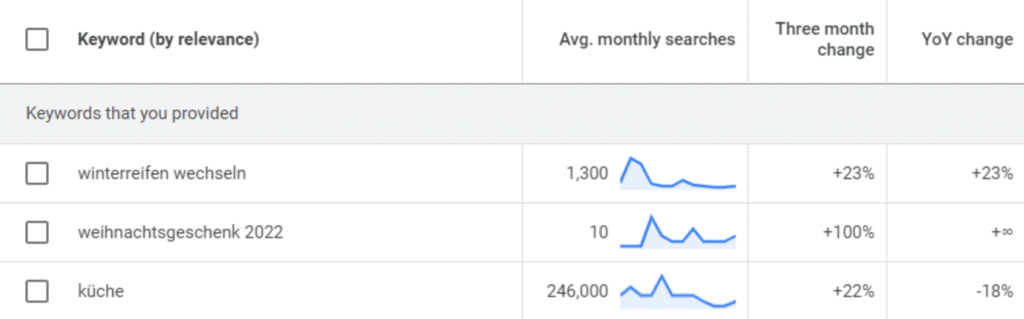 The screenshot shows data from mid-September 2022, target region Germany, language German, Google searchThe keyword “change winter tires” is comparatively specific, reached its peak in October/November last year and is currently not trending.
“Christmas present 2022” is currently not being searched for as much, although in comparison it shows the greatest growth potential.
With an average search volume of 1,300 or 10, the possible impressions are rather low compared to the keyword “kitchen” with almost 250,000 searches per month.With these keywords, for example, the thesis can be derived that an impression share of almost 100% can be achieved more easily in spring or summer with a low budget and less competition.Whether this achieves the desired campaign goal and addresses the relevant target group is a different topic!
If, as an advertiser, I only place advertising in the first district of Vienna (Inner City, Vienna) and appear very selectively with my advertising, I may, for example, have an extremely high impression share in my target region, but only achieve a low visibility throughout Austria.When considering the impression share or possible impressions, it is important to take into account not only the selected keyword set but also the campaign orientation, seasonality and competition.
Click share or share of possible clicks
Is Click Share a better and more meaningful metric to evaluate keyword performance? Let’s take another look at the Google Ads Help for a definition:“The proportion of possible clicks is the estimated proportion of all achievable clicks.”The “share of possible clicks” metric is therefore only an estimate of how many clicks our ads could have achieved.
This value can be increased, for example, by using more ad extensions, paying more per click, or increasing the budget. Adding ad extensions is certainly the easiest lever. If, on the other hand, you want to offer more per click and therefore pay more and at the same time the budget cannot be increased, it is questionable whether this will make a big difference.
More visibility metrics in Google Ads
What other metrics can we look at when it comes to keyword and ad visibility?
When the average position was eliminated in September 2019, Google simultaneously introduced new metrics to help us interpret the ad position:
- Share of possible impressions at the top position in the SN
- Share of possible impressions at the top position in the SN
- Impressions (top position) %
- Impressions (top position) %
These metrics, introduced three years ago, provide insight intowhether the ads were placed above the organic ads or even in the first place and how high their share was in each case.Compared to the average ad position, which only showed a numerical value and had no meaning about the actual position on the search results page, the new metrics created more clarity.
In addition to the share of possible impressions in the search network, there are also two columns that tell us why impressions were NOT possible:
- Share of missed search impressions (budget)
- Share of missed search impressions (rank)
The two metrics show whether the budget or the rank (ad rank) was too low. A budget increase is the easiest to explain. The ad rank, on the other hand, is a value that cannot be viewed from the outside and is a snapshot during the respective auction.
Various factors come into play here, such as quality score, ad quality, bids, location, time, user location, etc. If a limit (a kind of minimum value to ensure quality) is not reached, no ad will be shown either.The easiest adjustment is definitely to increase the bid, followed by improving the ad quality and the quality score.The last two metrics mentioned are also available in the Google Ads interface in conjunction with the top and top position.
Share of possible impressions for exact match
Last but not least, there is the “share of possible impressions with exact match” metric. With increasing account simplification and the switch from Exact Match to Broad Match pushed by Google, this value is becoming more and more exciting.
As a result of the increased use of Broad Match, the share of possible impressions in the search network will also decrease, as the stored keywords can be displayed for more and more search queries. However, the “proportion of possible impressions with exact match” creates more clarity here as to the extent to which the keywords entered into Google Ads were visible in their exact match and close variants. A high proportion of possible impressions with an exact match and at the same time a low overall impression share indicates that the visibility for the stored keywords was high, but that Google could have used the keywords for many more “other” search queries.
Level of detail and viewing options for the impression share
Most metrics presented are available at the campaign, ad group, or keyword level and can be analyzed over time on a daily basis or aggregated over time on a weekly, monthly, or quarterly basis.How should an impression share of over 80% be evaluated?It is easy for anyone to search for their own keywords on Google and check whether the ads are being served to them. As an agency, we sometimes receive feedback that our own advertisements are rarely shown if they were not visible. It is quite possible that the ads were shown to other users. At this point the question arises, what is the campaign goal and whether the ads should always be played? A blanket statement about a good impression share of over 80 or 90% does not always make sense if, for example, the goal is not impression share at all, but rather the focus is on conversions and sales and a value-based bidding approach is used. Therefore, under certain circumstances it may even be desirable for no ad to be shown at this moment.Is it just about the first position in the search results?It’s hard to deny the importance of ranking first in Google search results.
With a market share of over 90% in the DACH region, the search engine has enormous popularity and an incredible volume of highly qualified traffic. This first-position consideration has led to constant bidding wars where advertisers compete for traffic for their top search terms. In this aggressive battle, it’s easy to forget why digital advertising was a revolution and has been so successful ever since: it’s all about targeting, that is, showing our ads to the right user at the right moment, and not about how many people see them.
Our conclusion:
Which impression share metric is the right one?As described in this blog article, there are many different metrics that can help and be used when considering impression share. At the same time, impression share should not be the most important metric. There is no golden truth in this case, but rather, in addition to the performance indicators, various impression share metrics should be kept in mind over time and, if necessary, react to market fluctuations.Tip:The best way to do this is to use an impression share report created in Google Datastudio. Many of the metrics presented can be visualized as absolute numbers or over time.Would you like to find out more about impression share, interpretation or reporting? Please feel free to contact us:kontakt@e-dialog.group