Recover conversion data with Jentis Synthetic Users

Management Summary
Potential & Use Cases
Increasing regulatory challenges in collecting first-party data faced by advertisers lead to inefficient ad optimization and higher costs for return. At the same time, technical restrictions (e.g., browser limitations) are increasing and limiting the ability to obtain a complete picture of users.
Synthetic Users is an innovative solution that addresses the problem of missing data and has the potential to recover up to 100% of conversions missed due to the user’s consent decision. This is made possible through statistical methods and machine learning algorithms. As a result, ad networks receive significantly more signals, which improves the algorithmic optimization of campaigns. Ultimately, a higher ROAS and higher-quality target audiences are the result of implementing Synthetic Users.
The technology was developed under the strict condition of complying with data protection regulations within the EEA. Therefore, user privacy is protected when using Synthetic Users technology. No personally identifiable data points or identifiers need to be transmitted to ad providers when recovered conversions are sent.
The technology is perfectly capable of artificially regenerating lost conversions, even when very little consented data is available (for example, a consent rate of only 30%). This relieves companies of the need to take measures to improve user consent that could ultimately scratch the surface of what might be considered dark patterns in cookie consent banner design. Therefore, Synthetic Users not only recover conversions but also reduce the risks of data protection violations.
Prerequisites
Jentis Synthetic Users technology is natively integrated into the Jentis Data Capturing Platform (DCP), which represents a server-side tracking environment. The DCP must be in use and tagging for the relevant platforms must be set up via the Jentis DCP. At a very high level, the platform consists of
- Tools, which represent the various providers such as Google Ads.
- Tags, which send specific signals or events to the providers.
High quality and a certain volume of data are fundamental. As with other tagging solutions, a clean implementation of the tags and the respective parameters must be in place so that the Synthetic User algorithm can reach its full capacity. The most reliable and native solution is the implementation of the Jentis Datalayer on the website for communicating events to the DCP.
Theoretical Background
Mechanistic Overview
The technology is based on the following levels:
-
Standard data collection:
Data and events are collected as usual based on consent and sent to specific providers. -
Predictors:
Simultaneously, the Jentis DCP identifies so-called predictors that help segment users based on common characteristics. These can be, for example, session duration or the number of page views. -
Non-consent-based data collection:
Together with the consent-based data, the non-consent-based data forms the basis for generating synthetic users. Non-consent-based data is collected in a non-persistent manner, without personal data and parameters that allow for user recognition. -
Synthetic data generation:
Statistical methods and machine learning algorithms are used to synthetically fill the gaps in the non-consent-based data. This leads to the creation of synthetic, anonymous users assigned to specific segments based on their predictors. -
ID Pooling:
The strength of this technology lies not only in creating synthetic (anonymous) users but also in making them actually processable for advertising platforms. This is achieved through so-called ID pooling. Ad click IDs, such as the Google Click ID (gclid) from users who have given their consent, are collected and pooled by predictors. The synthetically generated users are provided with these real ad click identifiers. Pooling ensures a meaningful ID population while making the traceability of individual users highly unlikely.
Components
This section provides an overview of the technological components within the Jentis DCP that enable the use of synthetic users:
Essential Mode
Enables the collection of users without consent in addition to users with consent. Jentis does not prevent the collection of data without consent when Essential Mode is active, but treats the data differently depending on the configuration in the user interface. The user interface allows for easy control of the parameters sent to providers, which can be used to pre-process or redact sensitive information for data without consent. For example, in the case of non-consenting users, the gclid field would use a synthetic gclid provided by the ID pool instead of an actual gclid. The screenshot shows the default setting (for consenting users) on the left and the value for Essential Mode (for non-consenting users) on the right:
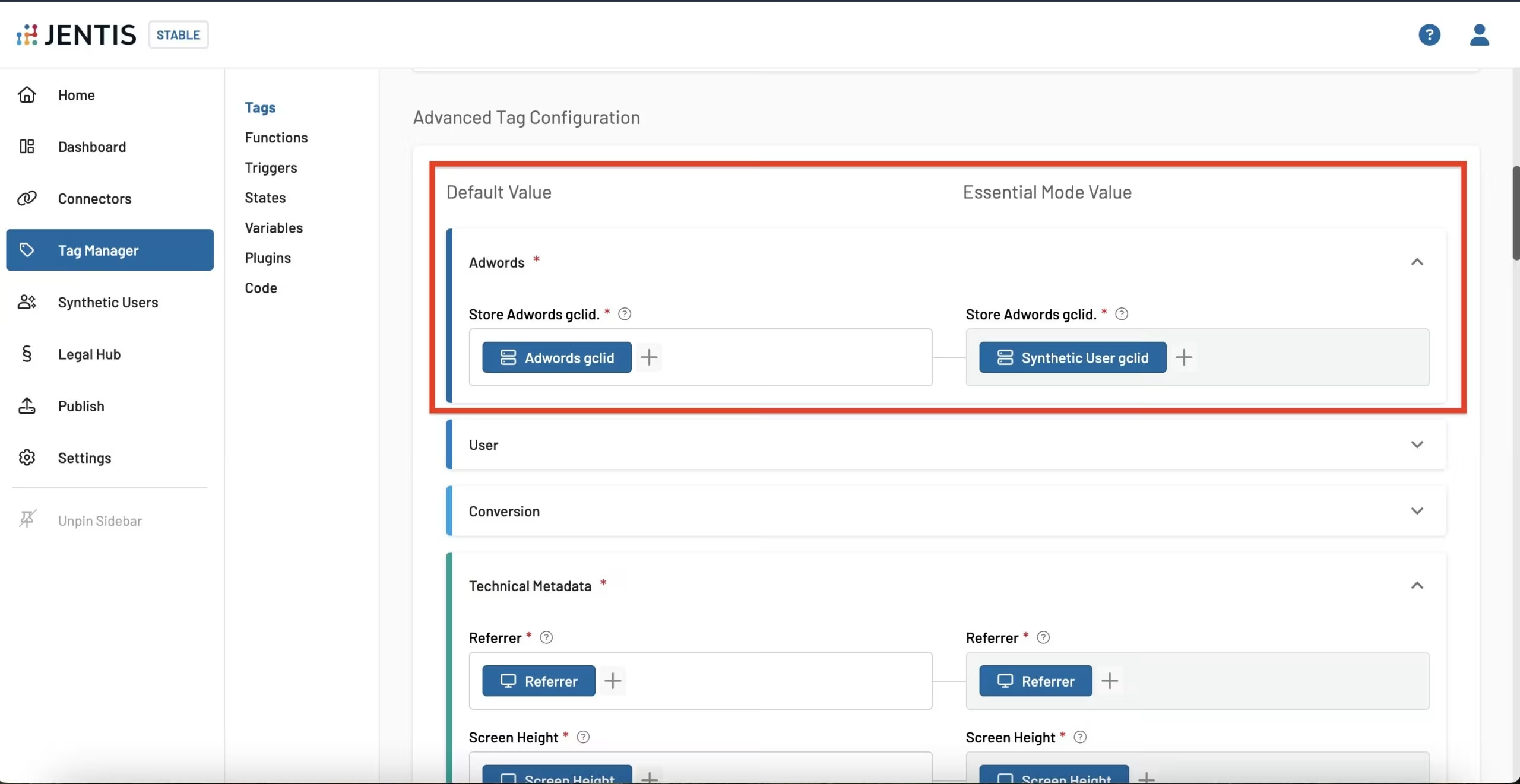
Signals in Essential Mode should not contain personal data or user recognition to comply with regulatory requirements. Together with the approved standard tracking, this forms the basis for the statistical methods applied in the background to generate the synthetic data.
Synthetic User Model
Using machine learning algorithms, the model is able to identify user clusters based on predictors of consenting users and based on the events selected for model training and behavior recognition.
The gaps in the non-consented data are filled using predictors and statistical methods to generate complete, anonymized synthetic users.
Each synthetic user is linked to pooled IDs, meaning that advertising platforms receive recognizable data to improve campaign efficiency. The model is also able to identify specific campaigns and recover conversions at the campaign level.
Conclusion
The increasingly complex challenges in data collection require innovative yet privacy-compliant methods to close the gaps created by browser restrictions and lack of consent. Through the clever use of machine learning algorithms and statistical methods, conversions can be recovered and campaigns can be optimized significantly better.

Featured image: AI-generated