Beyond Clicks: How GEO Strengthens Your Digital Identity and Becomes Visible in GA4

Management Summary
Declining clicks, rising quality? Learn how to use GEO to your advantage and identify successes in GA4
The Silent Crisis: When Search Ends Without a Click
We are observing declining organic traffic across all industries. Why? Users consume answers directly in ChatGPT, Gemini, or Perplexity without ever visiting a website. These zero-click searches have gained massive momentum due to the rollout of Google AI Overviews in Europe (March/May 2025). Where organic position 1 once reigned supreme, the generative summary now occupies the valuable “above the fold” area—often even ahead of paid ads. Today, users’ first glance no longer falls on the first organic or paid search results, but on the generative summary. If you are not mentioned as a source here, you practically no longer exist on mobile.
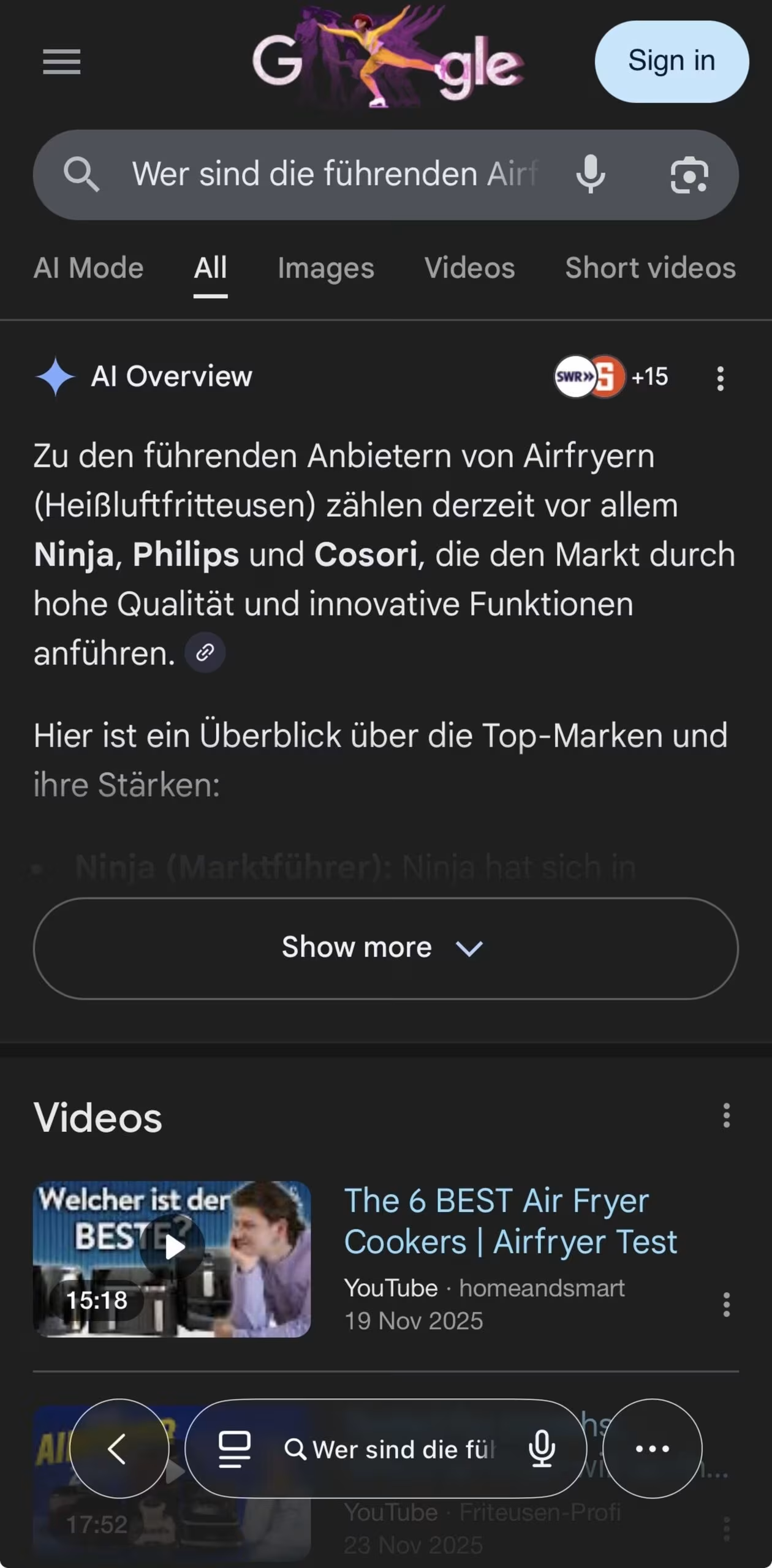
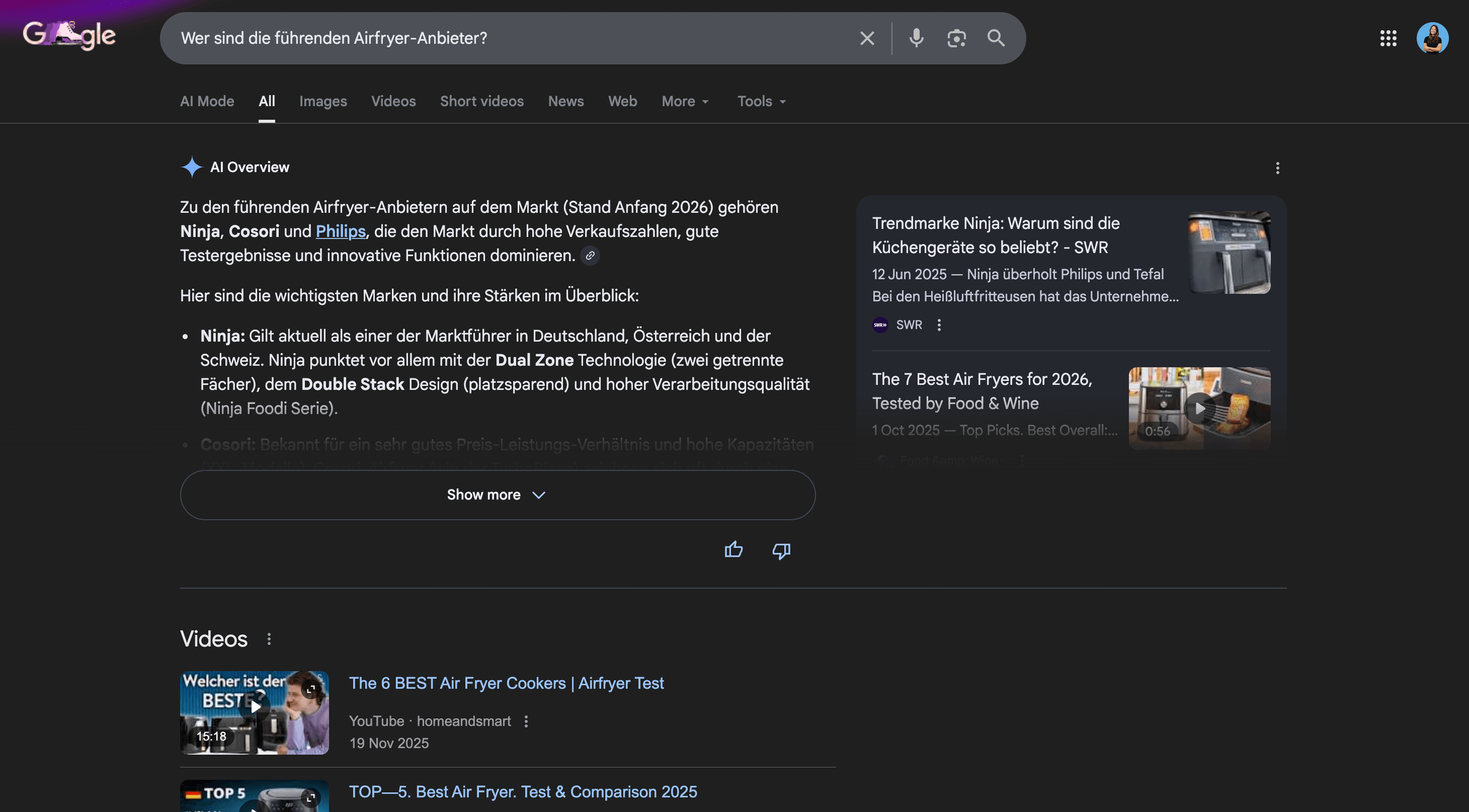
Images: Screenshot AI Mode Mobile & Desktop, Source: e-dialog
GEO – Why Digital Identity Is More Important Than Keyword Density
Amidst this development, the industry is experiencing a new SEO upswing: GEO (Generative Engine Optimization). While my colleague explains in her article how content strategy and website structure can optimize SEA campaigns, GEO aims to be perceived as a trustworthy reference by AI agents.
We are no longer just optimizing for algorithms that count words. We are optimizing for agents that understand complex contexts. It is moving away from “what am I writing” toward “who am I in the digital space.” Your brand must be positioned so clearly that the AI considers it an undisputed source. In this context, a quote in a niche professional forum is often more valuable to an AI than a generic backlink.
How do you end up in the AI response?
AI models currently use two primary sources of knowledge:
- Training data: The knowledge that the AI considered during its training up to the “knowledge cutoff.” This is where long-term brand building comes into play. If your brand has been present as an expert for years, it is firmly anchored in the AI’s “memory.”
- Real-time search & query fan-out: For current questions, the AI fans out the search, scans professional articles and news portals live, and assembles the answer along with source links.
Here, digital identity becomes a ranking factor: a quote in an expert forum or a relevant Reddit thread carries more weight than a technical link.
The Proof in the Data: How to Make GEO Success Visible in GA4
When organic traffic collapses, the burning question arises: “Does SEO even make money anymore if Google provides the answers itself?” Because while classic traffic is declining, the quality of the remaining users is increasing. Anyone who wants to understand the connection with AI traffic must look deeper into GA4 than just the acquisition overview. The answer lies in identifying qualitative traffic. We must learn to distinguish the “informational drop” (loss of clicks without purchase intent) from valuable leads.
- The Informational Drop: Purely knowledge-based search queries are migrating to AI Overviews. This leads to a decline in CTR for top-of-funnel content, but simultaneously cleanses your funnel of “fleeting” visitors without real intent. The decline in informational traffic is therefore not a sign of weakness, but confirmation of your sharpened digital identity: you are now only attracting users who go beyond pure information.
- High-Intent Referrals: Users who find your site via AI agents like Perplexity or ChatGPT have already completed the information phase. The data shows a significantly higher engagement rate here.
An exciting trend is also the increase in direct traffic through AI citations. When the AI Overview writes: “According to experts from [Your Brand]…“, users often search directly for your brand name after a delay.
Your success is therefore no longer just visible in the “Organic Search” channel, but in strengthened brand awareness, which is reflected in GA4 under “Direct” or “Branded Search.” The good news is: traffic isn’t disappearing, it’s shifting. Those who are cited in AI today win trust tomorrow and the purchase the day after.
Conclusion: Adaptation Instead of Panic
SEO is not dead; it is just becoming more intelligent. It is no longer just about being seen. Now, what matters is: you must be the undisputed source in the AI response. Those who align their strategy with GEO principles now and learn to correctly interpret the shifted data streams in GA4 will occupy the information channels of the future. Presence in an AI response is often worth more today than a fleeting click.