Better Conversion Performance Thanks To Advanced Matching

Management Summary
The advanced matching helps to better understand user behavior in Facebook and TikTok campaigns and to assign users to conversions. This post explains how this can help you build better custom audiences.
Advanced Matching – Better conversion performance thanks to advanced matching
Facebook and TikTok have recently started offering a new integration of data into their systems called “advanced matching”. With advanced matching, the customer should be identified on the website and assigned to conversions or leads. Google offers a very similar system with the so-called “Enhanced Conversions”, which we talk about in the article “Improve your Google Ads tracking with Enhanced Conversions” have already reported.
So if Facebook or TikTok campaigns are run to find users who want to buy something on your website, then this enables new ways of user recognition and thus better classification. Hence “extended matching”.
“Advanced matching” means that users are recognized based on one or more characteristics, such as their telephone number or email address, and the capture of a lead or conversion in Facebook or TikTok can be assigned to a specific person.
What are the benefits of the comparison?
- Reduce costs: Costs per conversion can be lower with Advanced Matching when ads are accurately and specifically targeted to groups of people. Facebook or TikTok records these groups of people and calculates the probability that they will carry out the corresponding actions on your website.
- Assign website visitors: Facebook and TikTok can use Advanced Matching to create custom audiences that are most likely to purchase from your site.
- Better understand campaign performance: The interaction between conversions on websites and campaigns and their advertising materials becomes more understandable by linking the conversions to the users on the portals.
- Cross browser interactions: Thanks to the extended synchronization, multiple sessions of one and the same user can be tracked on different devices. This is usually difficult if the user changes the device during the purchasing process.
What does data protection say about this?
In principle, the integration of Advanced Matching would have to be clarified with a data protection officer (DPO), as every website and every online shop is different and the data protection issue must be assessed individually.
You have to ask yourself these two questions:
1. What data is transmitted and to whom?
With Advanced Matching, the two providers Facebook and TikTok are able to record a user’s data, such as the first name, last name, email address, telephone number, gender, zip code, city and country.
As with Google, this data is first made unrecognizable using one-way encryption before it is sent to Facebook or TikTok. This means that the data is never sent to the pixel providers in plain text over the Internet.
Does this automatically mean that you can also provide this encrypted data to the pixel providers whose servers are in America (not the EU)? For advanced matching, you should sit down with a data protection expert and assess individually whether the feature can be used.
As of November 2022, the general rule in the GDPR area (EU) is that no pixels from Facebook and TikTok should be displayed for marketing purposes without user consent, as this involves, among other things, data transfer to a third country. If the user gives their consent, information about this should also be included in the data protection declaration when using advanced matching.
2. What happens to the data after data transmission?
During Advanced Matching, the data is stored for the respective conversion or event in which it is included. If a purchase event (purchase) is sent to the Facebook Pixel and the email address and telephone number are included, the Facebook Pixel first checks whether these two pieces of information are available in plain text. If so, a hashing function is applied to the values. This means that from the email address “analytics@e-dialog.group” the character string is converted as follows: e7eeaec1bd61e6234cd9d96609e8ad418fb66915c7dc37d7b2162daeec72c916. Hashing must also take place for other features (e.g. telephone number).
If these values arrive at Facebook with the purchase event, they are stored in Facebook’s internal systems. A process then runs in the background that attempts to match these hashed values with a user characteristic within Facebook’s database. If a hit is found, the user on Facebook is associated with the conversion on your website without the user having given you the URL to his/her Facebook profile.
Thanks to this comparison, conversions can be assigned and audiences can be formed.
In order to remain compliant, we recommend informing users about this process in the privacy policy and allowing them to opt out of this mechanism.
Integration and its pitfalls
Facebook and TikTok offer two ways to integrate advanced matching:
1. Automatic matching
Automatic matching is a setting option in the Event Manager (on Facebook) and in the Pixel Settings in TikTok. If automatic matching is activated in the pixel settings, the tracker attempts to automatically determine the user information from the website. This usually happens when entering forms during the checkout process.

Facebook settings
The automatic comparison only works if the pixel is installed directly on the website and is not displayed via iFrame. In addition, the forms must be simple HTML form elements for the automatic capture to work. Facebook / TikTok then try to recognize email addresses and phone numbers in form fields, which doesn’t always work.
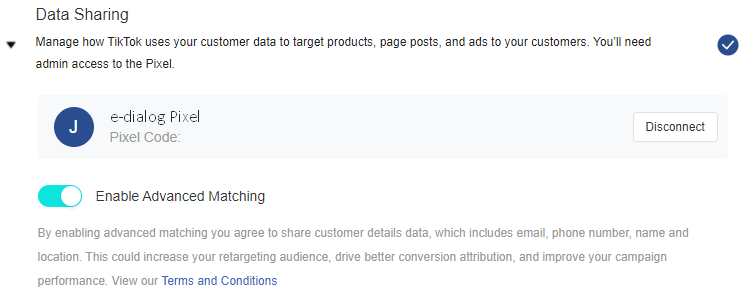
TikTok Settings
2. Manual adjustment
During manual comparison, website operators have to pass characteristics that are to be recorded to the Facebook or the TikTok pixel itself in the tracking code. Although this requires development effort, it is much more reliable because you retain control over the transfer of data.
You can then decide for yourself whether you want the data to be ready, hashed with SHA-256, transferred to Facebook or TikTok, or whether the pixel should do the hashing.
A hybrid model that uses both automatic matching and manual matching is most recommended. If user data is not recognized during the automatic comparison, this can be corrected with the manual comparison.
What happens if matching is not possible?
If a comparison based on the email address or telephone number is not possible, Facebook or TikTok tries to identify the user via the IP address and the user agent. If the matching is unsuccessful, the user is not recognized and all of the user’s actions are saved as an independent session.
Conclusion:
When running Facebook and/or TikTok campaigns, it is definitely worth using the Advanced Matching feature and implementing it. Better audience mapping helps reduce cost per conversion and can increase your sales!
We would be happy to support you with a solution tailored precisely to your needs to enable advanced matching in your campaigns.