Cdp 8211 Build Buy Or Hybrid

Management Summary
Why introduce a CDP in the company
Nowadays, no marketing department can do without a Customer Data Platform (CDP). You’ve probably read the headline one way or another before. In fact, for many companies, a CDP offers an easy way to merge, evaluate and activate 1st party data. Not only with the elimination of cookies, 1st party data provides the best arguments for better understanding customer behavior and personalizing customer contact. This personalized approach is already expected by over 70% of customers and can in turn lead to sales increases of 10-15%. (source)
Once the decision to implement a CDP has been made, the challenge for companies is usually to evaluate which CDP solution is most suitable. Therefore, below you will learn what you need to consider when choosing a CDP and whether Build, Buy SAAS or a hybrid CDP is best for your company.
Which CDP solution is right for my company?
When selecting a suitable CDP solution, all companies are inevitably faced with the question of whether they should license an expensive SAAS application or implement their own individual solution. Implementing a CDP yourself requires the appropriate competence in the company and ties up resources. At first glance, using the SAAS solution seems simple and quick to implement. However, with more complex use cases, many applications quickly reach their limits. A hybrid solution can help here. But let’s first take a look at the minimum requirements of a CDP and what this means for build and buy solutions before we take a closer look at the unique selling points of a hybrid CDP solution.
Minimum requirements for a CDP
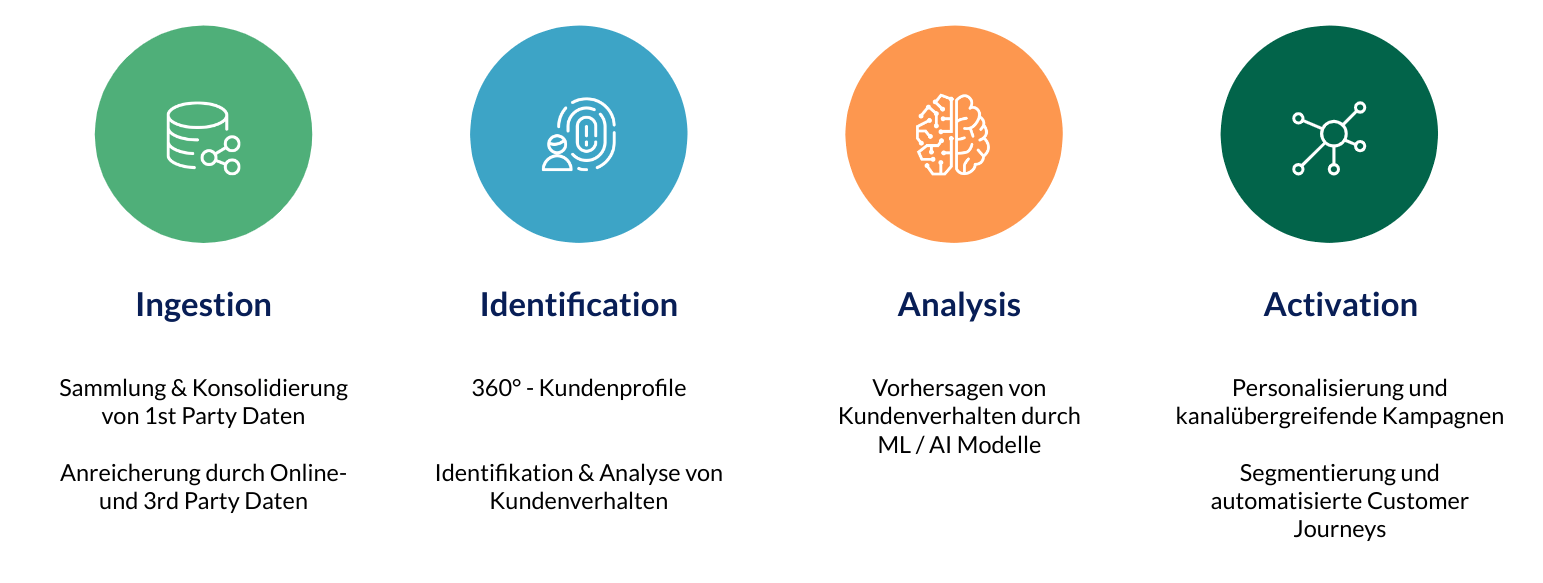
In this article we have explained what a CDP is and what it has to doArticlealready covered in detail. In summary, the minimum requirements for a CDP are the consolidation of all internal and external data sources (onsite, offsite, CRM, BI, offline, etc.) across all channels and the creation of 360° customer profiles. This holistic customer view enables a detailed evaluation of customer behavior, including corresponding affinities, and allows for further analyzes such as churn prediction or next best action (NBA). These insights can then be activated across all devices and channels for data-driven campaign control and to personalize the onsite experience. The overarching goal of a CDP from a marketing perspective is a uniform and personalized customer approach in order to optimize the brand experience and brand loyalty.
The graphic below once again illustrates the minimum requirements for a CDP.
Let’s take a closer look at the individual elements of a CDP for build and buy solutions.

Data ingestion – data integration
When it comes to data integration, SAAS CDP solutions offer the great advantage that they already provide a variety of connectors to and from common source and target systems. In addition, all solutions offer corresponding bi-directional API interfaces to set up non-existent connectors. Since Adobe and Salesforce, two of the major SAAS CDP providers, are already established in many companies, native interfaces make integration even easier.
In the case of a build solution, the corresponding connectors must of course be set up yourself, but this is usually easily possible using existing tools and corresponding API interfaces. In addition, marketplaces offer preconfigured solutions that can take some of the work off the shoulders of developers.
For both build and buy solutions, data sources must be assigned. With SAAS solutions, this usually requires a one-time mapping, i.e. assignment to a specific schema. The schema describes the structure and type of data that can be contained in each field. This standardization is necessary to ensure interoperability. As far as the build solution is concerned, the relevant data sources in the company were, in the best case, collected and evaluated before a CDP was implemented, which requires a uniform data structure. If this is not the case, it is a good time to take care of it, as this is the only way to guarantee clean data analysis.

User identification – ID stitching in the CDP
The main USP of a CDP solution is the uniform and consistent creation of user profiles. All collected data points are assigned to the user profiles in order to create a holistic user profile, the Golden Record. Since all data sources provide corresponding IDs, user identification is possible in both the build and a buy CDP solution.
Another challenge that needs to be taken into account, especially with a build CDP, is the consideration of declarations of consent. So consent to user data processing. If a user withdraws their consent to a specific service, this will be processed directly in SAAS solutions and the user will be removed from the audiences assigned to them, so that there is no violation on the part of the data processing company. The common use of consent management systems today supports build CDP solutions via API calls, with the corresponding notification of a user’s opt-out. This can then be taken into account in the corresponding user’s audiences.

Analyze 1st party data
Given the amount of user data that comes together in a CDP, there are hardly any limits to the analysis and modeling options. From simple reporting to complex machine learning models, a CDP offers the perfect platform for analyzing individual user behavior and making appropriate predictions. However, not all SAAS CDP solutions offer the same built-in functionalities and, especially for more complex ML models, you have to rely on your own data science department, cloud provider or an agency partner.
The pre-trained models from cloud providers that are interesting for build solutions are a perfect introduction to evaluating the company’s own data. These features are often chargeable for both SAAS CDPs and cloud solutions. The limitation of the available models for many SAAS solutions alone points to the hybrid CDP variant mentioned in the title. More on that later.
However, common modeling such as customer lifetime value or churn prevention can be found in almost all solutions that contain a certain stack of ML features. Further analyzes can include purchase propensity modeling, dynamic product recommendations, customer affinities or next best action predictions. If SAAS CDP solutions do not offer this or other desired modeling, you will inevitably turn to cloud providers to evaluate and scale the required analyses.
Of course, the insights from the analyzes carried out must also be used. In the last step of the functionality of a CDP, let’s look at the activation of the data in terms of Build & Buy solutions.

Activate data – personalize customer contact
Data activation involves targeted user targeting based on the actions previously taken. Onsite personalization, in which a user is shown product recommendations or promotions based on their purchasing behavior, or the assignment of users to different audiences for further targeting via relevant marketing channels are just two examples of how user data can be activated.
Data activation, like data ingestion, takes place via the respective interfaces. SAAS CDP providers, in turn, provide a variety of pre-developed interfaces. With a build solution, the desired activation channels must be connected once. Predefined solutions are also available for this, for example in GCP via the Marketplace.
A key advantage of implementing a Build CDP with GCP is the direct activation of audiences across the entire GMP.
Licensing SAAS CDP – the quick way to a CDP?
At first glance, using a SAAS CDP solution seems ideal for establishing a CDP in the company as quickly as possible. The SAAS CDP providers evaluated by e-dialog differ more in details. All SAAS CDP solutions usually come with a stylish UI to visualize user profiles and create audiences using drag and drop. They also offer common interfaces for data collection and activation and limited AI functionalities such as churn prevention. At first glance it reads like plug and play.
However, the reality is often different: Not all required interfaces are always available out-of-the-box and necessary customization increases costs and delays implementation. Of course, a SAAS solution offers the enormous advantage that the company has incorporated years of experience into the development of the solutions and that they are correspondingly well thought out and mature. However, this is also reflected in the (high) monthly license fees charged.
Build CDP yourself? Lower investment with more flexibility
An alternative to the SAAS CDP solution can be to develop your own CDP platform. Of course, this requires appropriate planning, skills and resources. It is important to first develop your own use cases accordingly and define the required interfaces. The previously defined use cases form the necessary framework for what development work is actually required in terms of UI, profile visualization, audience builder, rights management and data protection. Not all features offered in a SAAS CDP are always necessary – but sometimes there are special requirements.
A big advantage of developing your own CDP is the flexibility to implement it according to your own requirements and full control over the company’s own data.
It is important to note here that both a SAAS CDP and an in-house development require appropriate skills and resources so that the introduction of a CDP in the company is a success.
Hybrid CDP
– the best of SAAS and in-house development
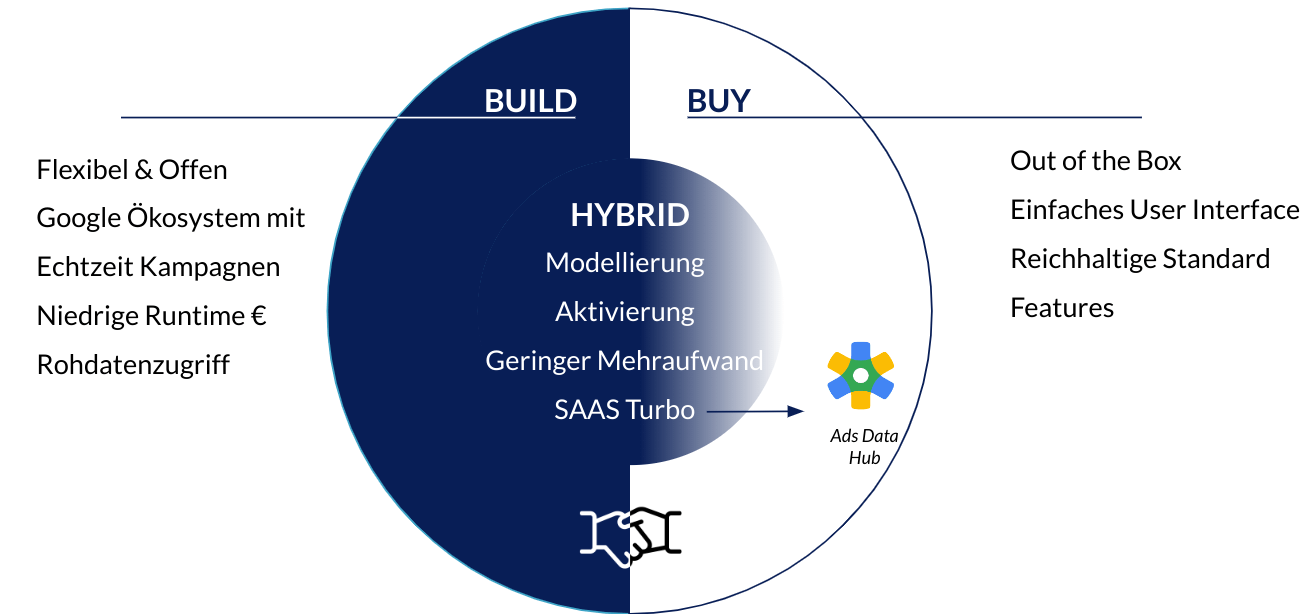
For companies that already use a CDP in the form of a SAAS or are planning to introduce one, linking it to GCP can be an extremely useful extension. Such a hybrid CDP offers the great advantage that audiences are activated directly in tools such as DV360 or Google Ads and campaign data is then combined with proprietary Google data in the Ads Data Hub (Google’s Data Clean Room) can be enriched in order to obtain even deeper conclusions about performance and your own target group. In addition, with the help of GCP and pre-trained ML models, extensive analyzes can be carried out that cannot be implemented with a SAAS CDP alone. That’s why many SAAS CDP providers such as Segment have chosen a best-of-breed approach in which they focus on one or a few strengths. In the case of Segment, this is data collection and activation. Analysis functions are not offered at all and must be implemented with other “best-of-breed” solutions such as GCP.
The graphic below once again shows the main advantages of a hybrid CDP solution.
Conclusion
The collection, evaluation and activation of company-owned 1st party data should be the top priority for every company. There is no question that a CDP can support this, whether as a SAAS, build or hybrid solution. However, before a decision can be made for a build, buy or hybrid CDP solution, a number of considerations must be taken into account. At the very beginning, this includes the development of targeted use cases, but also topics such as data governance, data taxonomy and of course the change management process associated with the introduction of a CDP. Ultimately, all stakeholders must be included, taken into account and often convinced of the added value of a CDP. No matter where you are currently, e-dialog supports you in selecting and implementing a CDP solution to get even more out of your 1st party data.