Google Ads Vs Google Display 038 Video 360
Management Summary
The former AdWords Display Network (GDN) vs DoubleClick Bidmanager (DBM)
But first, an update on the new brand names of the systems
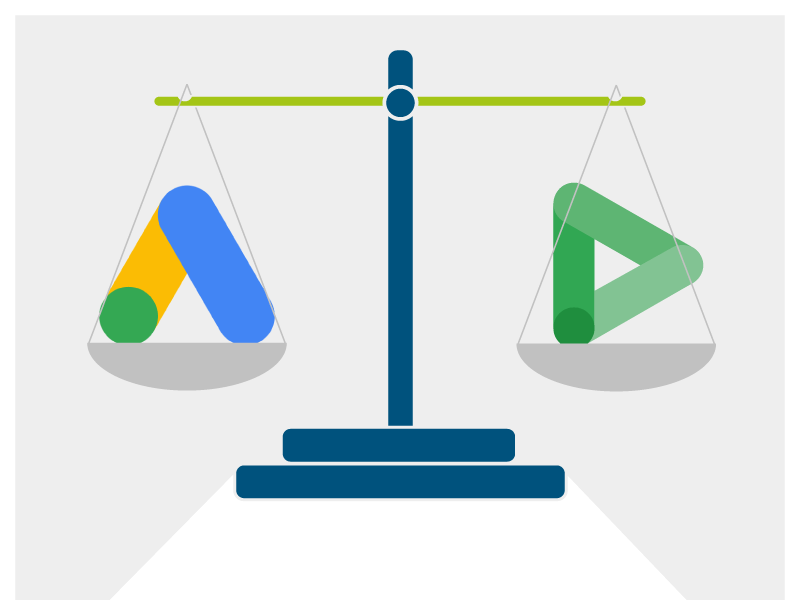
In June 2018, Google did a major rebranding. Google AdWords and the Google Display Network (GDN) becameGoogle Ads.The DoubleClick Bidmanager (DBM) becameGoogle Display & Video 360and its functions have been integrated even deeper into the Google Marketing Platform.
Google AdWords and Google Display Network (GDN) become Google Ads
 About theGoogle AdWordsFor a long time, the advertising system has not only been able to book Google search advertising – that is, text ads in the search results – but also display ads in a wide variety of banner formats and video formats (including lightbox or responsive ads). In the new Google Ads system, the advertising options have now been expanded even further and additional advertising formats have been integrated. According to Google’s latest announcement, even Google Shopping ads will be expanded to the Display Network. Google Ads will be a very powerful system and will (apparently) remain free.
DoubleClick Bidmanager (DBM) becomes Google Display & Video 360
 The DoubleClick Bidmanager is the DSP (Demand Side Platform) of the Google Marketing Platform (GMP). This controls the programmatic purchasing of display, video and native ads. Google Display & Video 360 has some new functions in campaign and audience management as well as new analysis and interface functions that enable more efficient work and better results.
The big comparison: Google Ads (AdWords GDN) vs. Google Display & Video 360 (DoubleClick DBM)
We have broken down the differences by area below:
inventory
The available inventory determineswhereAdvertising can be played anywhere!
| AdWords/GDN (Google Ads) | DoubleClick DBM(Display & Video 360) | |
| Display inventory | Exclusively GDN via Google AdExchange and cross-exchange for remarketing No access to premium inventory |
The longest range in RTB Connection to all Adexchanges Access to private deals via PMPs (Private Marketplaces) incl. Programmatic Guaranteed and Audience Guaranteed Deals |
| Video inventory | YouTube and GDN | YouTube, GDN and everything via Adexchange and Deals offered video inventory |
| GMail | GMail Ads | – |
| Programmatic audio | – | Programmatic Audio Campaigns available since 2018 |
| Inventory quality and fraud detection | Publisher Quality Team and Technology from Google
Opt-out options in AdWords for sensitive content via website categories |
Comprehensive protective measures, analyzes and reports through to the integration of 3rd-party verification services |
Advertising materials/creatives
What types of advertising materialscan be played on the platforms.
| AdWords/GDN (Google Ads) | DoubleClick DBM(Display & Video 360) | |
| Display formats | Text ads Banners (all standard formats and responsive ads) GMail Ads |
Banners (all standard formats and almost all special formats) |
| Dynamic advertising materials | Dynamic remarketing with limited design options | Dynamic remarketing with completely custom templates via DoubleClick Rich Media (DRM).dynamic advertising materialsnot only for remarketing but also with other 1st and 3rd party data (customer status, weather, affinities, day of the week and time, etc.) |
| Native Ads | Automatically integrated into responsive ads Can be used for display network, YouTube and GMail |
Native Ads available since 2017 Native video ads since 2018 |
| Video formats | TrueView In-Stream Ads TrueView Video Discovery Ads Bumper ads Out-stream ads |
YouTube TrueView YouTube bumper ads Pre/mid/post roll Native video Outstream Vertical video |
| Audio formats | – | Pre-Stream Audio Ad In-stream audio ad Audio ad and display |
Bidding & Targeting
These options represent thatTargeting and bid optimizationavailable.
| AdWords/GDN (Google Ads) | DoubleClick DBM(Display & Video 360) | |
| bidding | Bidding algorithms that are optimized primarily for the lower funnel and deliver low CPMs and CPCs | Bidding algorithms that have apparent weaknesses in the lower funnel, but already allow bidding modifiers and further optimizations, see Complexity Algorithm can be optimized according to:Favor Spend:entire budget is spent taking the goal into account (e.g. minimize CPC)Favorite goal:Algorithm optimized for target achievement (e.g. CPC of x euros) without a focus on budget |
| Purchasing types/optimization | Types of purchases:– CPM -CPC – CPV (for YouTube) – CPE (Lightbox Ads)Optimization on:– Target CPA – Target ROAS – Maximize clicks – Visible CPM – manual CPC (auto-optimized) |
Types of purchases:– CPM – viewable CPM – CPV (for YouTube)Optimization on:-CPA -CPO -CPI -CPC – viewable CPM – Video complete in View Audible – Video time on screen 10 seconds |
| Frequency cap | No cap or single-level restriction on day, week or month per ad/ad group or campaign | Granular control of frequency caps on campaigns, insertion orders & Line item level, e.g. FC 18 for the duration of the campaign but max 3x/day… |
| Targeting 1st party data | Website visitors (AdWords / Analytics Pixel), YouTube users, Customer email addresses, Mobile app users |
DoubleClick floodlight AdWords Audiences Analytics 360 Audiences YouTube Audiences and Facebook Custom Audiences (via DS) and all DMPs and data import |
| Targeting 2nd party data | – | Use via Deals or Floodlight
Use to adapt advertising materials via Publisher Pass |
| Targeting 3rd party data | Google data (demographic, affinities, in-market) Custom Intent |
Google data (demographic, affinities, in-market) – Custom Affinities – Custom Intent – All well-known 3rd party data providers available – Additional data providers can be linked |
| additional targeting categories | – Placements – Content (topics, keywords) – Devices / device models – Operating system – Cellular provider/WiFi – Advertising scheduler – language |
– Apps/URLS – Keywords – Content Categories – Environment – Viewability – language – Geography, Business Chain & Proximity (Hyperlocal Targeting) -Day & Time – Demographics – Browsers -Device – Connection speed – Carriers & ISP |
Data and Audiences
The data stack describes how audience data can be collected within the system itself.
The raw data, how collected data can be used for detailed analysis, migration and further use.
| AdWords/GDN (Google Ads) | DoubleClick DBM(Display & Video 360) | |
| Data stack | AdWords Pixel: good but limited | DoubleClick Floodlight: individually customizable, can replace a DMP, can be used across channels (e.g. newsletter tracking) |
| Raw data | Via Ads Data Hub | via Ads Data Hub |
| Social | – | Synchronization of Facebook Audiences and DoubleClick Audiences in both directions; Auto Tagging, Reporting & Attribution (via DS) |
| DMP, Audience Sharing | – | Connection to all well-known DMPs and the Google Marketing Platform (GMP) |
| Connectivity | Mainly used by search management tools | Almost all major tools have connectivity to DoubleClick / Display & Video 360 |
Analysis and reporting
How do the systems represent the performance data?
| AdWords/GDN (Google Ads) | DoubleClick DBM(Display & Video 360) | |
| Runtime analysis | Overview of performance data across predefined dimensions & Segments | Comprehensive overview of performance data and other information such as pacing, viewability and much more directly in the controller |
| Reporting | In the AdWords interface or via the limited report editor Google Analytics Google Data Studio limited API |
In the tool Google Analytics & 360 Google Data Studio Comprehensive detailed reports, dimensions and metrics both in the tool and via API (e.g. audience availability, cross-xxx, xxxdaten-inschau-report, …) |
| Customer Journey & Attribution modeling | limited to AdWords pixels, single channel viewing In Analytics on a click basis |
all DoubleClick channels including organic search, multi-channel viewing, including view attribution |
| Google Attribution free & 360 | Connection to Google Attribution for both measurement and bid optimization | Connection to Google Attribution for both measurement and bid optimization |
Handling and special features
How are the systems to be operated and what special features do they offer?
| AdWords/GDN (Google Ads) | DoubleClick DBM(Display & Video 360) | |
| Usability | Seemingly simple, usable by everyone, wide range of training, tips, agencies and specialists | More complex: you have to know what you are doing in order for it to develop its power. Not everyone who claims to be able to do it is really an expert (feel free to ask usTraining, onboarding or full service!) |
| Special feature | AdWords Scripts offers the ability to automate simple processes or repeated processes using JavaScript. Many basic scripts are available, do not require any programming knowledge and can be used directly. The use of external data sources/libraries significantly increases the range of applications.
Store visits – measurement of store visits |
Integration of all digital channels
A/B testing targeting and bidding strategies |
Costs and budgets
How are the tool costs calculated and at what budgets does DoubleClick pay off?
| AdWords/GDN (Google Ads) | DoubleClick DBM(Display & Video 360) | |
| Cost | Intransparent: many believe it is free – but in fact the tech fees are implicitly included in the CPM | Transparent: Tech fees are explicitly shown, but budgets and CPMs are managed gross |
| Minimum campaign budget | Can be used with any budget size | Theoretically none, but the DBM develops the power from a reasonable budget |
| Availability | Anyone viaadwords.google.com | Own license with data ownership exclusively via certified GMP sales partners (i.e. us,-) Used by agenciesLicensesdo not inherit data ownership and do not allow customers their own access. More aboutGDPR |
Conclusion:
For a quick overview, we have briefly summarized the most important assistance here:When definitely DoubleClick DBM / Google Display & Use Video 360?
- If you have a certain company size and/or marketing budget.
- If you want to connect to a DMP or other systems such as data warehouse or CRM.
- If you already work properly with audiences, customer journeys, storytelling and much more.
- If you want to have clear data ownership and have to meet compliance.
- If you have (real) experts in-house or at your agency.
- If you also plan and work in the upper funnel (awareness, reach, engagement).
- If you want to control cross-channel journeys.
- If you want to consolidate classic media bookings and play them out programmatically.
- If you want to use premium inventory via deals and PMPs.
- If you also want to calculate attribution modeling on view contacts (which you should,-)
When should you definitely use AdWords GDN / Google Ads?
- If you want to take the first steps yourself
- For smaller budgets
- With less complexity
- If you only want to use the standard functionalities
- If you are (still) in the lower funnel, ie. think exclusively about performance
When should you weigh up between the two systems?
- You can always use both systems in parallel, so to speak, best of both worlds…
- But be careful: You should then ensure a clean sync of the audiences between the stacks and a clean, consistent recording of the customer journey.
Further and detailed information on the topic:The online targeting compendium for RTBPrivate DealsHow does RTB work?