Social Ads On Facebook And Instagram 8211 The Guide For Beginners

Management Summary
Once a Facebook page exists, anyone can open an advertising account, create a campaign with just a few clicks and then evaluate the results. But with the necessary know-how, you can get significantly more out of the campaigns. Facebook and Instagram stand out from other platforms, especially thanks to their optimization algorithm and extensive targeting options.
Advertising goals in Facebook
The first setting you make when creating a new Facebook or Instagram campaign is one of the most important. With a simple click you select the campaign goal, which determines the optimization algorithm for the entire campaign. This selection cannot be changed afterwards and is very crucial for performance. In the auction area, the following campaign goals are available to choose from, which are roughly divided into three funnel levels: Awareness, Consideration and Conversion: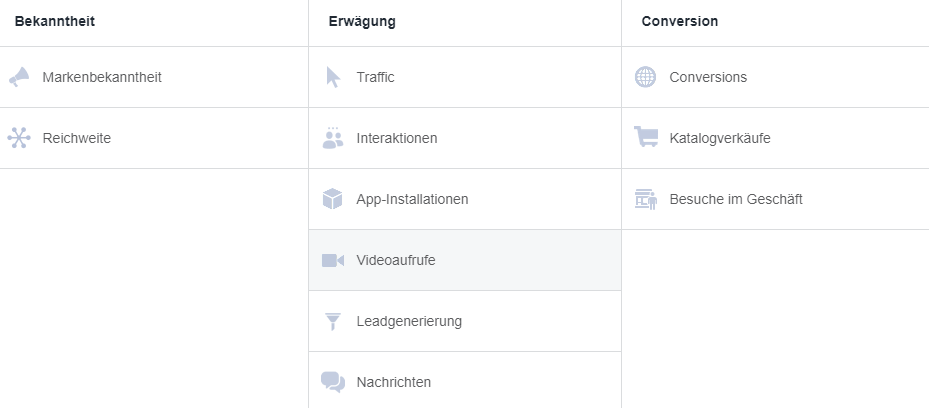 While the awareness phase with the sub-goals of brand awareness and reach is about creating interest in a product or service, active actions such as clicks, video views or purchases are desired in the following phases of consideration and conversion. The prerequisite for campaigns with the advertising goal conversion is functioning conversion tracking via the Facebook pixel.
Why do I need a Facebook Pixel?
In short: without pixels there is no data. The installation of the Facebook pixel on the website is a prerequisite for targeted and efficient campaigns. The base code is a simple Java script code that is built into the header of the website. Depending on the goals that are to be measured on the site, it may need to be expanded to include additional events. For e-commerce companies, this is, for example, the view content event when product detail pages are viewed, the add to cart event when something is added to the shopping cart or the purchase event when making a purchase. Newsletter registrations, submitted contact forms, etc. can be recorded in a similar way.
Facebook now offers a very wide range of 17 standard events. If these are not enough, additional self-defined goals – so-called custom conversions – can be created.Tip:The more granular the events and goals are recorded, the better for analysis and optimization!
The classic remarketing of website visitors would also not be possible without the Facebook pixel, as they would not be recognized on Facebook. With additional parameters that are passed in the pixel, visitors to certain categories or users who have viewed products from a certain brand can even be reached again with corresponding products from this brand or category. In many cases it is also important to exclude users from targeting based on their actions, e.g. purchase. This information also often comes from the pixel.
How do I reach the relevant target group?
Targeting is one of the biggest levers in campaign optimization. Depending on the advertising goal, it may be desirable to achieve the greatest possible reach or to address a very small target group. The following limitation options are available:
- Core audience:Segmentation of the target group based on demographic factors, location, interests and behavior.
- Custom Audience:Users who already have a relationship with the advertising company. For example, you were on the website, interacted on social media or the customer information was provided.
- Lookalike audience:These users are very similar to the Custom Audience and are therefore particularly relevant. The higher quality the base Custom Audience is, the higher the performance of the Lookalike Audience will be.
The target groups are defined when the ad groups are created. It is important that the individual target groups do not overlap. This can have a negative impact on performance.Tip:Take time for a clean structure & Structure the target groups and also remember to exclude irrelevant target groups.
Where can advertisements be displayed?
When you talk about Facebook Ads, you often only think about the ads in the news feed or stories. But the Business Manager currently offers 17 possible placements, some directly in the platforms such as the right column on the desktop and the Facebook Marketplace or in other platforms such as Messenger or the Audience Network. Since the advertising materials are displayed differently in the different placements, the creatives can be adapted to the individual placements when the ad is created. Which placements are suitable is entirely individual. The best way to find out is to take a test.
Which advertising formats are available?
Link Ad? Video? Or maybe a collection ad? What is best for my campaign? The different types of advertising media are just as extensive as the targeting options. An overview of the common advertising formats including tips for creating them fills a separate blog post:Facebook Ads – performance-oriented.
Videos – whether in stories, in the feed or as an element in other advertising media – are becoming increasingly important. There is no need for “glossy commercials”; it is much more important to communicate in the customer’s language in order to get attention. In order to maintain this, a certain speed is required; if it moves too little or too slowly, the user is gone. While texts in static advertising media should be avoided, there is nothing wrong with strong messages in videos.
In order to gain the attention of users, it also helps to involve them. For example, via poll sticker ads in stories and in the mobile feed as well as playable ads and augmented reality directly in the advertising material. As in other areas of online advertising, this also applies to advertising materials: There is no one right way. Every customer reacts differently and therefore requires different formats and imagery.Tip:Use several different creatives within an ad group to give the algorithm more flexibility.
How are results measured?
After the campaign has been created, including targeting and advertising materials, it’s time to take a deep breath. But immediately afterwards we start optimizing the ongoing campaigns. Are there target groups or advertising media that clearly stand out from others – positively or negatively? What makes this different from others? Is there something that the particularly good advertising materials have in common – can you derive a hypothesis and test it specifically?
Depending on the goal being pursued, different KPIs are used for the evaluation. In campaigns that are optimized for reach, it makes no sense to evaluate conversions and in return you cannot expect a high reach from any conversion campaign. Depending on the funnel level and the chosen advertising goal, other KPIs can be used for evaluation: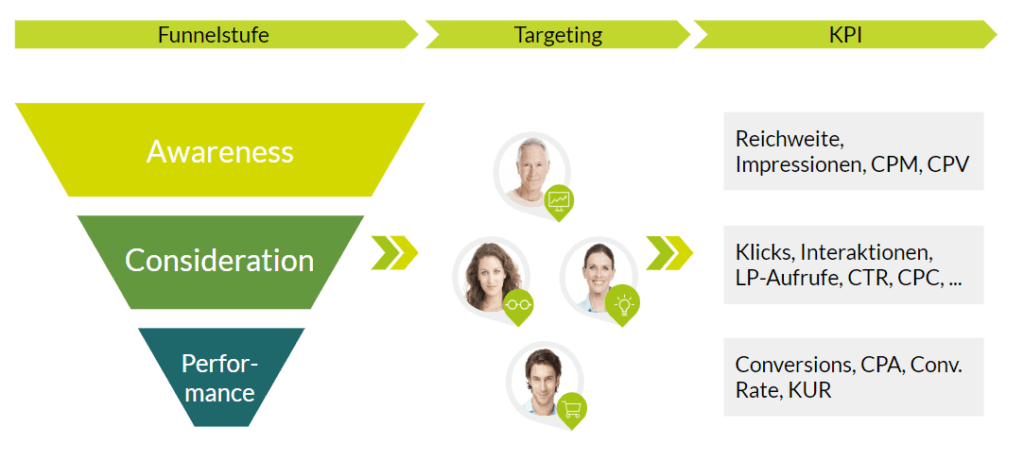 Tip:Put together an individual set of columns so that you always have the most important KPIs in view.