Tracking Outside the (Black) Box: JENTIS Essential Mode

Management Summary
The requirements for clean tracking have become significantly stricter. Lower consent rates, restrictive browsers, and regulatory requirements mean that traditional client-side setups are becoming less effective. Google Consent Mode is one approach to closing these gaps. At the same time, approaches such as JENTIS Essential Mode follow a different logic: Here, the focus is not on estimation, but on a combination of modeled depth and reduced, real-world measurement.
The Tension Between Modeling and Measurability
Advanced Consent Mode allows Google to collect cookie-less signals (pings) even before consent is granted, which serve as the basis for conversion and behavioral modeling. Once consent is granted, these are supplemented with real measurement data. As a result, the data set is based on a combination of actual interactions that have taken place and modeled values.
In practice, however, the Basic Consent Mode is often used. In this case, Google tags are loaded only after active consent has been given. Google receives no signals prior to consent and thus has a significantly limited data set for modeling based on historical trends. This, however, assumes that sufficient data is available in the first place.
While platform-based modeling can provide a more complete picture for campaign optimization and reporting, it does not directly measure actual interactions. This is exactly where Essential Mode comes in, by making real—albeit limited—first-party data trackable.
What makes JENTIS Essential Mode different?
With Essential Mode, JENTIS takes a different approach to data collection. Instead of using modeling to fill in missing data points, it allows for the collection of reduced but real data—even without consent.
Essential Mode defines not only how data is processed, but also what data may be collected and shared in the first place:
-
Fallback logic:
Depending on the consent status, only predefined, limited data points are collected. -
Minimizing Data Loss:
The goal is measurability without traditional tracking mechanisms, such as cookies or unique personal identifiers.
A detailed technical description of this can be found in the official JENTIS documentation.
Why is data transformation the key element?
The key difference lies in the active data processing that takes place before the data is transferred. Data is not simply mirrored one-to-one into the tools, but is instead specifically transformed, reduced, and standardized on the server side.
The functions typically supported by Essential Mode to implement data minimization, data transformation, and obfuscation include, for example:
- IP Masking & Truncation: Shortening the IP address directly on the server.
- Data Transformation & Conversion: The conversion and standardization of event names or the targeted rewriting of URLs.
- Anonymization & Deletion: The early, irreversible removal of direct personal identifiers such as user IDs or email addresses.
- Data Reduction & Control: Cleaning up URLs (removing query parameters) and the dynamic, consent-based sharing of data.
The goal is to process personal information at an early stage using the measures described above, so that only the information necessary for the respective processing purpose is transmitted to downstream systems, while at the same time maintaining data quality for analytical purposes.
Thanks in particular to its customizable transformation rules, Essential Mode enables in-depth data transformations and conversions. For example, companies can define their own event mappings and map different event names to a standardized schema. However, the specific configuration of these rules is not automatic; rather, it is set up in accordance with the respective tracking and data strategy.
A simplified illustration shows how data is processed and modified even before it is forwarded. This creates a controlled database that remains usable regardless of individual platforms and enables greater control over one’s own data pipeline.
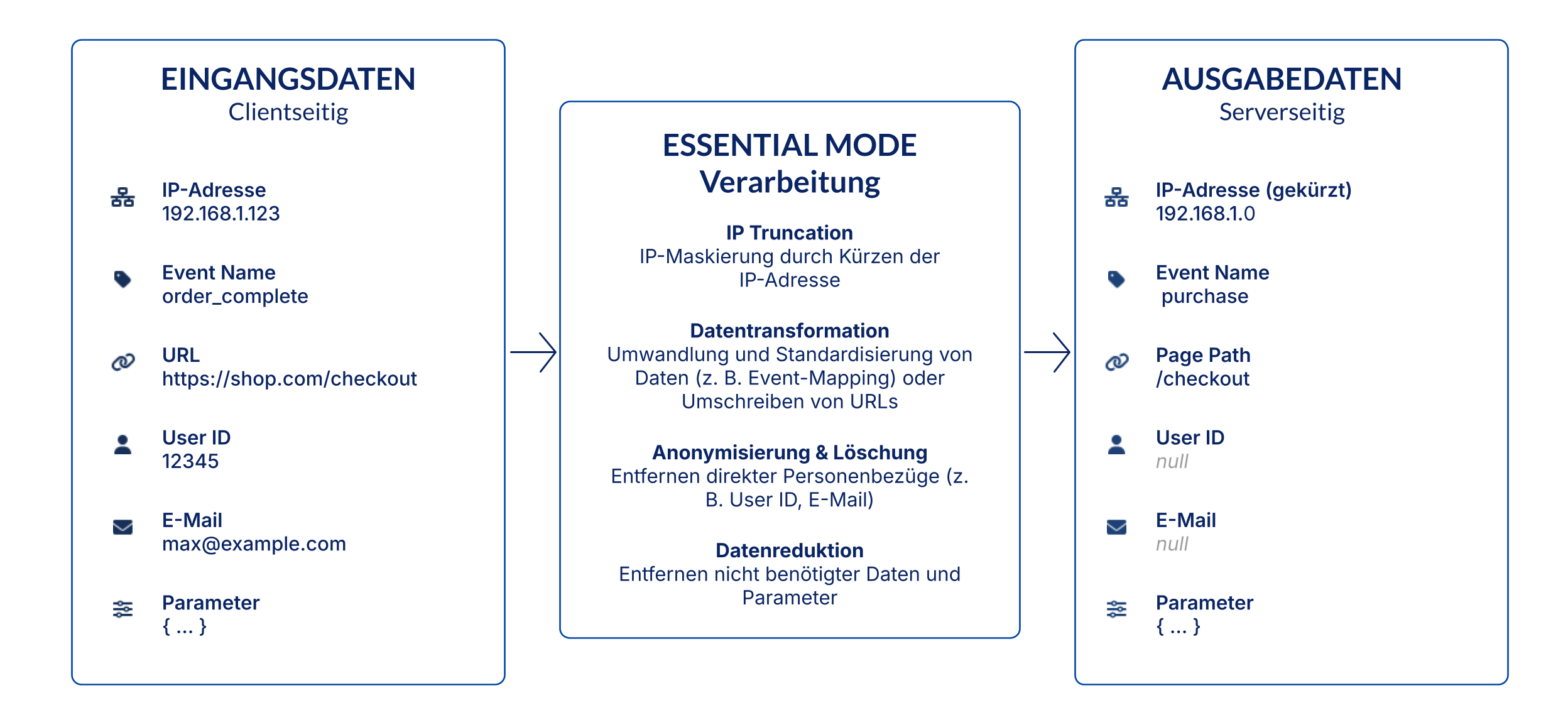
Image: JENTIS Essential Mode reduces, transforms, or removes data before it is forwarded to analytics and marketing platforms; Source: e-dialog
Anyone interested in learning more about the interplay between JENTIS, consent management, and data strategy will find out in this article why data protection doesn’t have to be an obstacle, but can actually be a real driver for your company.
What impact does this have on data quality?
While client-side approaches depend on the browser, Essential Mode shifts processing to a controlled server environment. Although this involves greater setup complexity, it provides more control over data flows. The underlying technology is similar to that of other server-side setups.
In this hybrid collaboration with Google, there is a clear division of roles:
JENTIS Essential Mode
operates at the data-routing level. It actively defines in advance which data is collected and in what form (anonymized or minimized) it is actually transmitted to Google.
Google Consent Mode
It then determines, at the level of Google’s platforms, how Google processes the data it receives and to what extent missing data must be modeled.
Two Perspectives – One Big Picture
This division results in two distinct data advantages: Essential Mode ensures reduced but real interactions for a company’s own first-party data set. Google, on the other hand, uses these signals to calculate the “big picture” through modeling for campaign reporting.
How seamlessly these worlds intertwine depends largely on the setup:
Basic Google Consent Mode & JENTIS Essential Mode:
Before consent is given, the browser blocks all Google signals, which means Google does not count the session until consent is granted. JENTIS Essential Mode bridges this gap: It collects anonymized basic data in advance (such as referrers or campaign parameters) and maintains seamless session continuity from the very first second.
Advanced Google Consent Mode & JENTIS Essential Mode:
Although Google receives cookie-less pings in advance, it links these sessions based solely on modeling. Here, JENTIS uses Essential Mode to ensure a consistent, reliable session structure on a first-party basis. To avoid double data reduction, the setup can be configured so that Google can directly utilize the signals—which have already been minimized on the server side—in an optimal way for behavioral modeling.
The chosen setup plays a decisive role in determining how well companies can strike a balance between maximum data sovereignty, seamless session continuity, and precise campaign modeling. Google Consent Mode remains relevant for Google Ads and attribution, while JENTIS Essential Mode provides additional real-world data streams and strengthens a company’s own first-party data base. These data streams are often consolidated in a central data warehouse.
Conclusion
Essential Mode is not an alternative to Consent Mode, but rather a complementary component within a modern tracking architecture. Its strength lies not in an “either/or” approach, but in the targeted combination of both approaches. The central strategic question here is: What data should actually be measured, and where and to what extent is modeling a meaningful component of one’s own data strategy?