Tracking Concept The First Step To Data Driven Decisions

Management Summary
Why should I track my website/app?
Without tracking, there is no overview of how successful a website or app really is. Tracking ensures that well-founded, data-based decisions can be made. It allows for continuous improvement of the user interface (UI) and usability as it becomes clear how users interact with the platform. It is equally important to recognize long-term trends, be it in user behavior, the performance of features or the purchasing process.
Data should answer questions
The goal of tracking data is to answer key questions. A well-thought-out tracking or event concept ensures that not only any data is recorded, but that targeted events (=interactions on the website or in the app) are defined that are tailored to specific business questions.
- Where do users exit in the checkout process?
- Which feature is used most frequently on the website/app?
- At what level do I set my call-to-actions?
- etc.
The basis for successful tracking – a concept
The tracking or event concept is the heart of every successful tracking strategy. It ensures that the right data is collected in the right places to answer key questions and enable informed decisions.
In a well-structured concept, all relevant events are listed individually, including the parameters that should be recorded with each event. Each event is provided with a clear description showing exactly where and when it is triggered. Supported by screenshots and precise instructions, the concept serves as a guide for developers and ensures that all stakeholders – from marketers to engineers – have a consistent understanding of which events are being tracked.
DOS
- Detailed list of parameters:
Creation of a separate overview of all parameters that appear in the tracking concept. Each parameter should contain a clear description of what content should be passed, as well as an example value showing what data is expected here.
For example
Name: item_name
Description: Passes the product name
Example value: Google Sea Glass Bottle - Include screenshots: For each event, a detailed description should be provided with a screenshot showing exactly where it should be triggered.
- Use the comment function: Especially when working with various stakeholders, it is helpful to comment on and clarify open questions directly in the document.
- E-commerce events: Even without a classic e-commerce business, predefined Google Analytics e-commerce events can be used. However, care should be taken to ensure that these are used in a meaningful context.
Example:
Successful course registration -> purchase
Watches a course -> view_item - Cross-team voting: Before the event concept is finalized, it is important to coordinate with all relevant teams (marketing, IT, analysis).
- Actuality: If new events are added in the further process, this should be added to the concept to ensure that they are up to date.
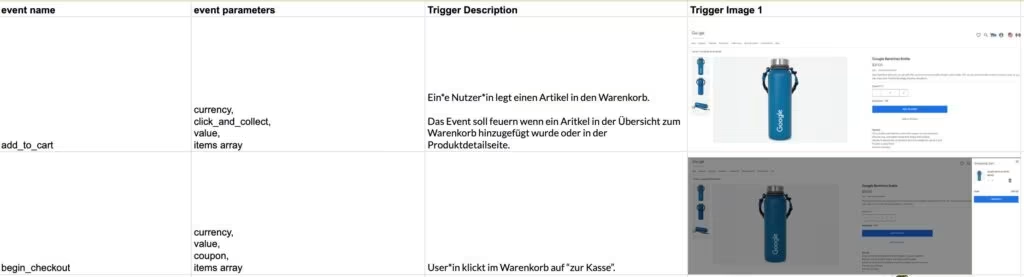
Dos for event tracking. Source: e-dialogue
Don’ts
- No uniform naming convention for event names: Avoid capital letters, special characters and spaces in the namings. Instead, all event names should be structured in lowercase letters and with underscores. This makes later work in the analysis tools easier and prevents confusion.
Event name length: 40 characters (GA4)
Length of event parameters: 40 characters (GA4) - Unclear event descriptions: Every event should have a precise description that is understandable for everyone in the team.
- Track everything: Please don’t just track everything! Focus on the most important questions and, if necessary, add the tracking at a later point in time.
- Personal Data: For data protection reasons, no personal data from users may be included in the respective tools.
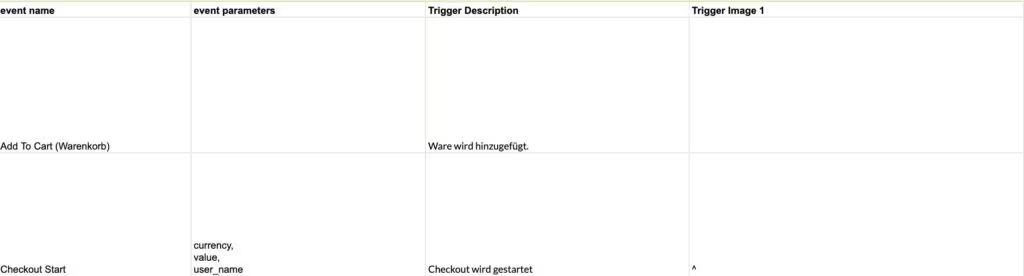
Don’ts for event tracking. Source: e-dialogue
Conclusion
A tracking concept is the cornerstone for successful tracking and analysis of data. Not only does it help answer important business questions, but it also provides clarity and structure in implementation and evaluation. With a well-thought-out concept, not only can technical implementations be made more efficient later, but targeted optimizations can also be made to the website or app.