20 percent less organic traffic in the DACH region
Management Summary
e-dialog Traffic Study, Update for the First Half of 2026
The market research firm Gartner predicted some time ago that traffic from traditional search engines would decline by 25 percent by the end of 2026. The latest figures from the e-dialog Traffic Study confirm that we have almost reached this point. The reasons for this drop in traffic are equally clear: the rise of AI-powered answer engines—from ChatGPT to Google AI Mode —and a shift in user search behavior, driven in part by social discovery.
The Numbers at a Glance
Since 2024, we have been tracking changes in website traffic. The analysis is based on data from 74 websites in Germany, Austria, and Switzerland—a total of 1.2 billion sessions. The first e-dialog traffic study analyzed the years 2024 and 2025. We now have an update for the first half of 2026.
Here are the key findings for the first half of 2026
-
01
The traffic slump is here
In the second quarter of 2026, organic traffic fell by 20.3 percent. This represents a significant drop compared to the -4.2 percent reported in our first study. Since mid-2025, the pace of this decline has been accelerating significantly.
-
02
AI traffic is skyrocketing, but it cannot offset the loss
Traffic from AI chats tripled in the first half of 2026. Nevertheless, less than one percent of total traffic comes from AI search. Organic search remains the most important source, accounting for just under 65 percent. At the same time, this is the type of traffic that is declining the most.
-
03
The financial sector is taking the biggest hit
The decline in traffic is not evenly distributed across all industries. The finance and insurance sector suffered the greatest loss in 2026, with organic traffic plummeting by 39.3 percent. The education and telecommunications sectors also saw significant declines.
The Results in Detail
Total traffic has hit a new low
Compared to the previous peak in the fourth quarter of 2024, total traffic across all websites analyzed has fallen by 21.7 percent. Organic search remains by far the most important channel, accounting for 64.6 percent of traffic—and at the same time, it is the channel experiencing the sharpest decline. Paid search is seeing a more moderate decline. The trend of offsetting lost organic traffic with higher budgets for search ads has not continued. However, budget cuts at some large companies due to the economic situation likely played a role here as well. AI referrals are the only channel showing strong growth, though their share of total traffic remains a negligible 0.9%.
The loss in organic traffic amounts to several million sessions per quarter. AI referrals bring back a few hundred thousand. The decline in traffic is not a shift in channels, but rather a structural displacement caused by zero-click results.
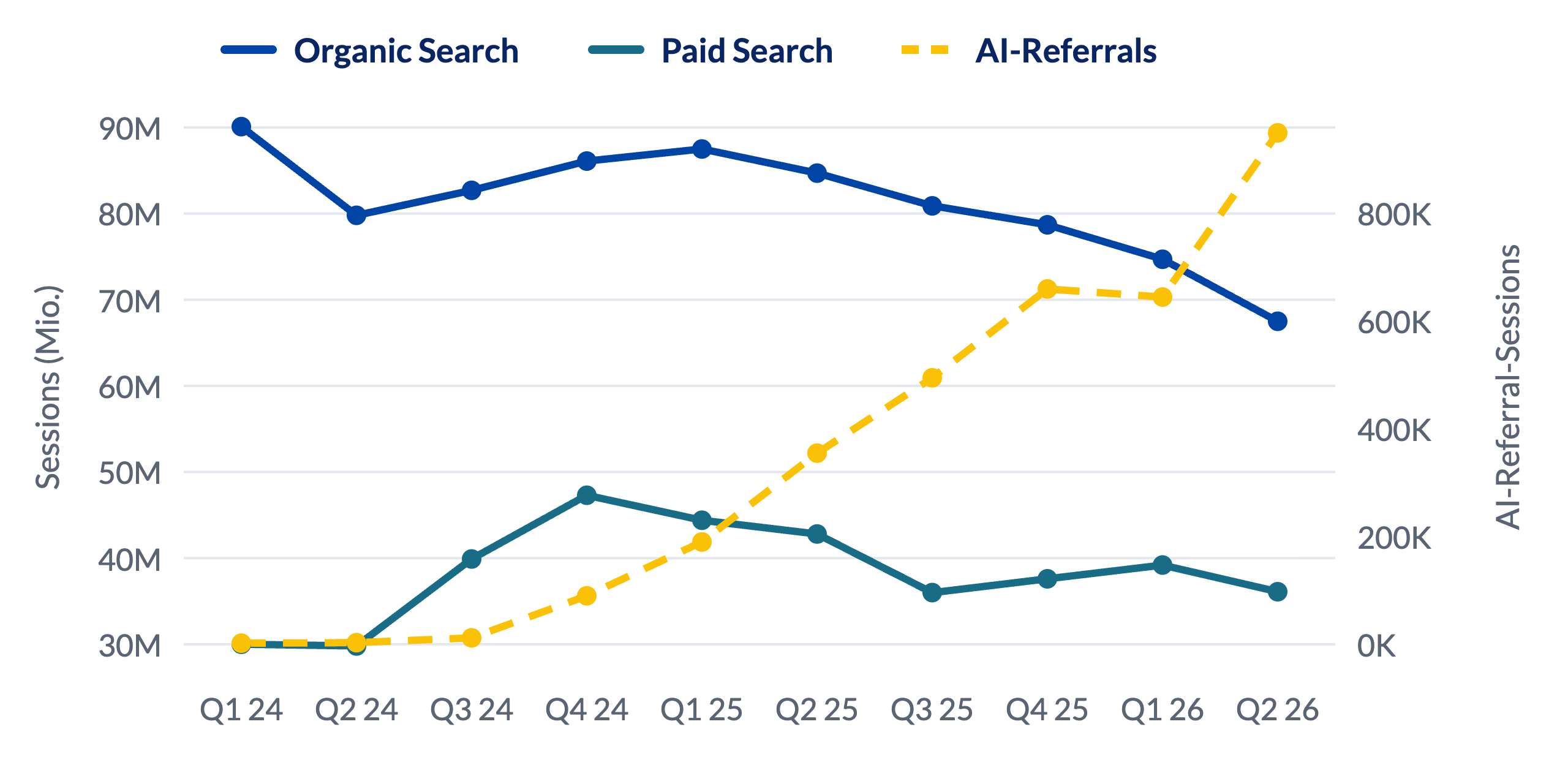
Organic Search and Paid Search (left axis, in millions of sessions) compared to AI referrals (right axis, in thousands of sessions), Q1 2024 – Q2 2026.
The decline has been accelerating since mid-2025
What matters is not only the magnitude of the decline, but also its rate of change. The year-over-year comparison becomes more negative from quarter to quarter: in the third quarter of 2025, total traffic was down 4.3 percent; in the fourth quarter of 2025, it was down 12.3 percent; in the first quarter of 2026, it was down 13.3 percent—and by the second quarter of 2026, it had already fallen by 18.2 percent. For organic search alone, the decline is even steeper: from minus 2.2 percent in the third quarter of 2025 to minus 20.3 percent in the second quarter of 2026.
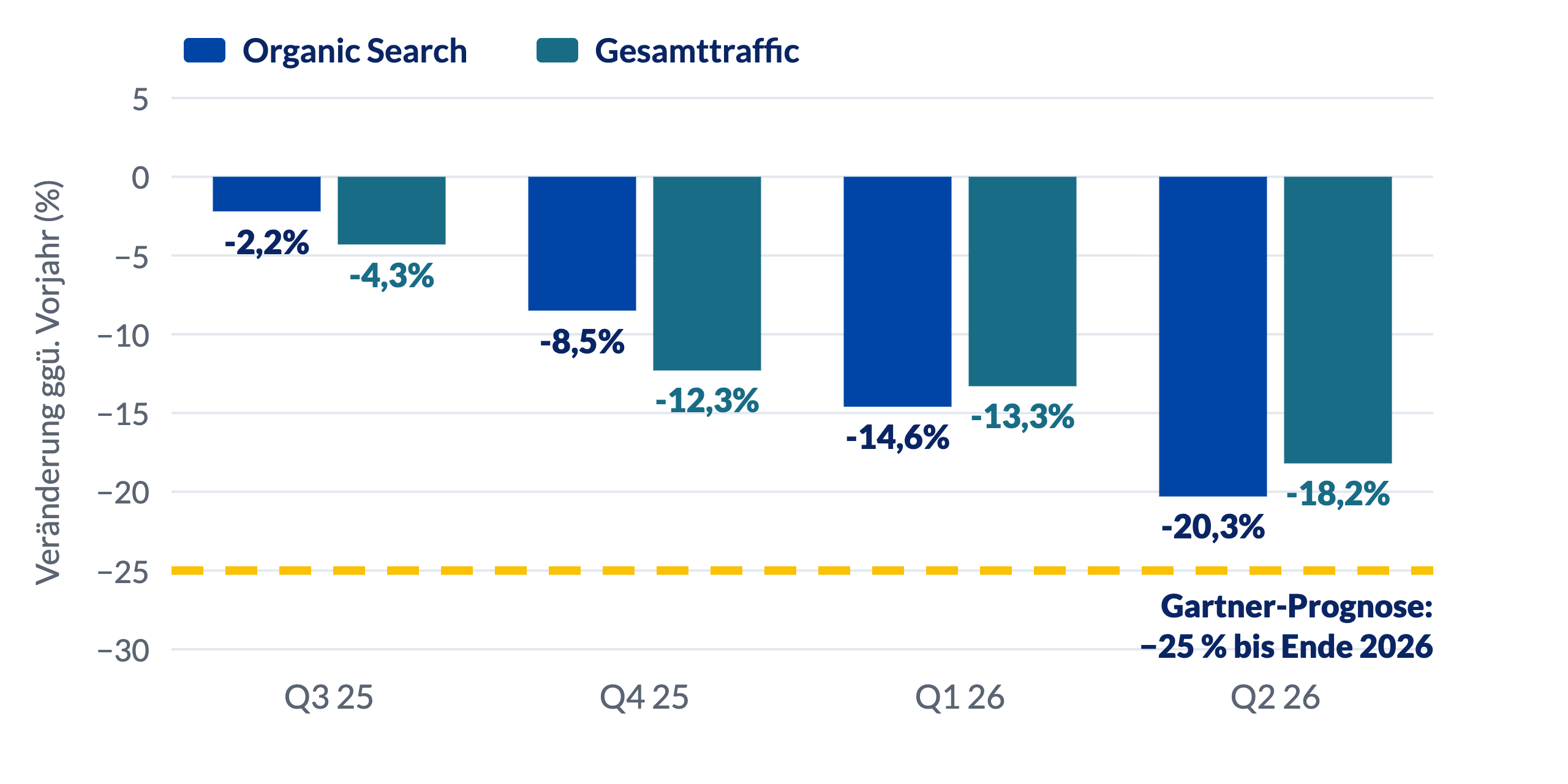
Change compared to the same quarter last year: Organic search is declining faster than overall traffic.
This is also evident in a direct quarter-to-quarter comparison: The transition from Q1 to Q2 2026, at minus 8.8 percent, marked the sharpest quarterly decline of the entire observation period—significantly greater than the decline from Q4 2025 to Q1 2026, which stood at minus 2.1 percent.
Not all industries are affected to the same extent
The decline varies widely across industries. The finance and insurance sectors, as well as education, have been hit hardest, with organic declines of just under 40 percent and over 30 percent, respectively, in the first half of 2026 compared to the first half of 2025. Tourism is also seeing a significant decline of just under 20 percent. The decline is most moderate in the industrial, technology, and retail sectors—where organic traffic continues to decline at a rate in the low single-digit to low double-digit percentage range.
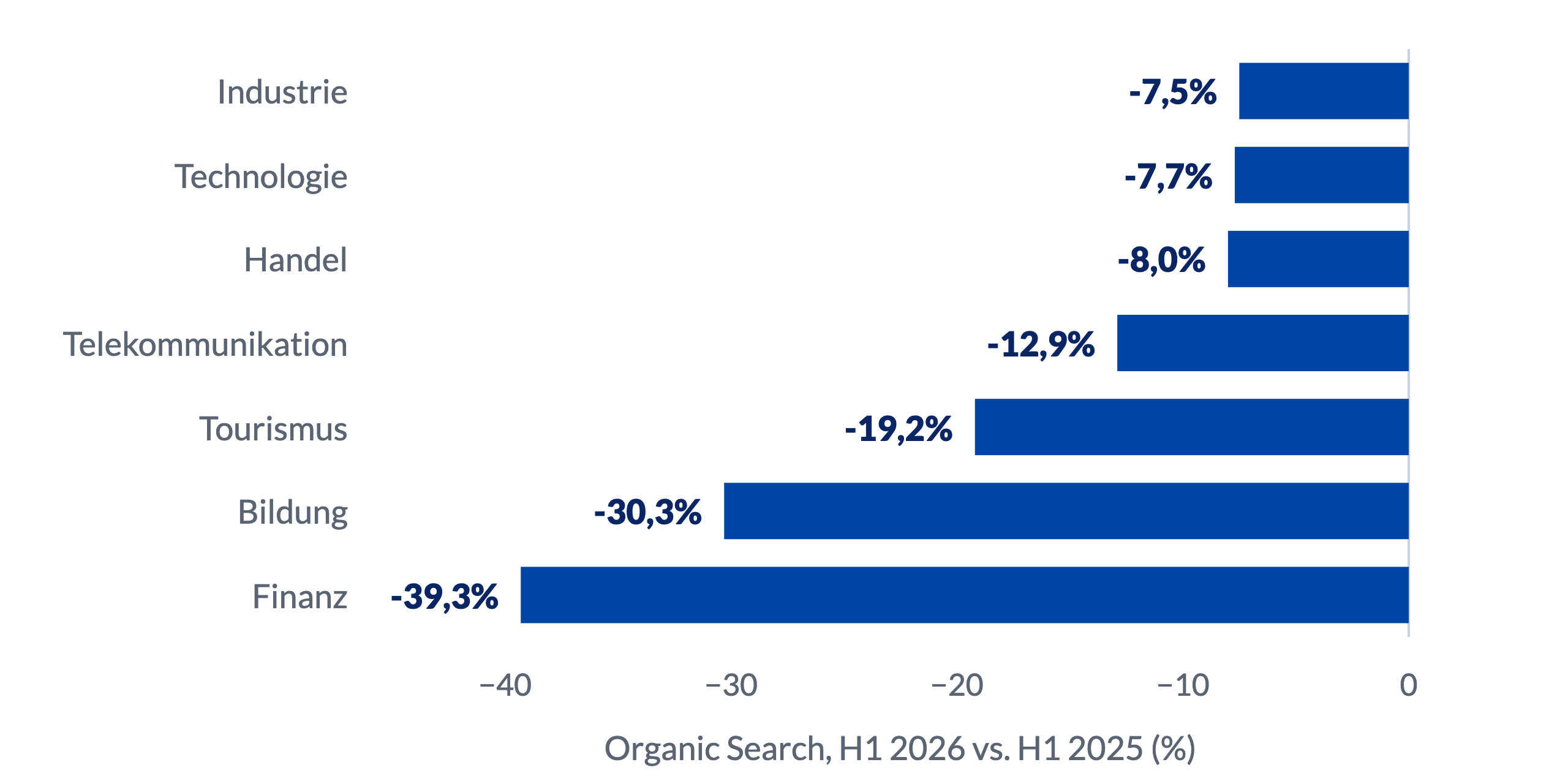
Organic Search by Industry, H1 2026 vs. H1 2025.
In the retail sector—the industry that faced the most pressure in our original study—the organic decline eased slightly to minus 8.0 percent in the first half of 2026 compared to the same period a year earlier, while paid search declined by 19.9 percent. This decline in paid search is primarily driven by a handful of large websites that have cut their Google Ads budgets. At the same time, the largest retail website in the dataset actually saw significant growth in paid search. This is therefore not an industry-wide, uniform retreat from paid search, but rather divergent budget decisions by individual large advertisers.
A Comparison of Countries: Germany Shows the Sharpest Decline
A cross-country comparison confirms the findings of our first traffic study: The existing trends are more pronounced in Germany than in Austria and Switzerland. In the first half of the year, the websites surveyed in Germany saw a 19.2 percent decline in total traffic, while the decline in Austria was only 8.1 percent. Switzerland, which was still very stable in 2025, appears at first glance to have lost a massive 18.7 percent of its total traffic. However, this is due to a few statistical outliers. Once these are corrected, Switzerland fares best in the cross-country comparison with a traffic loss of 3.5 percent.
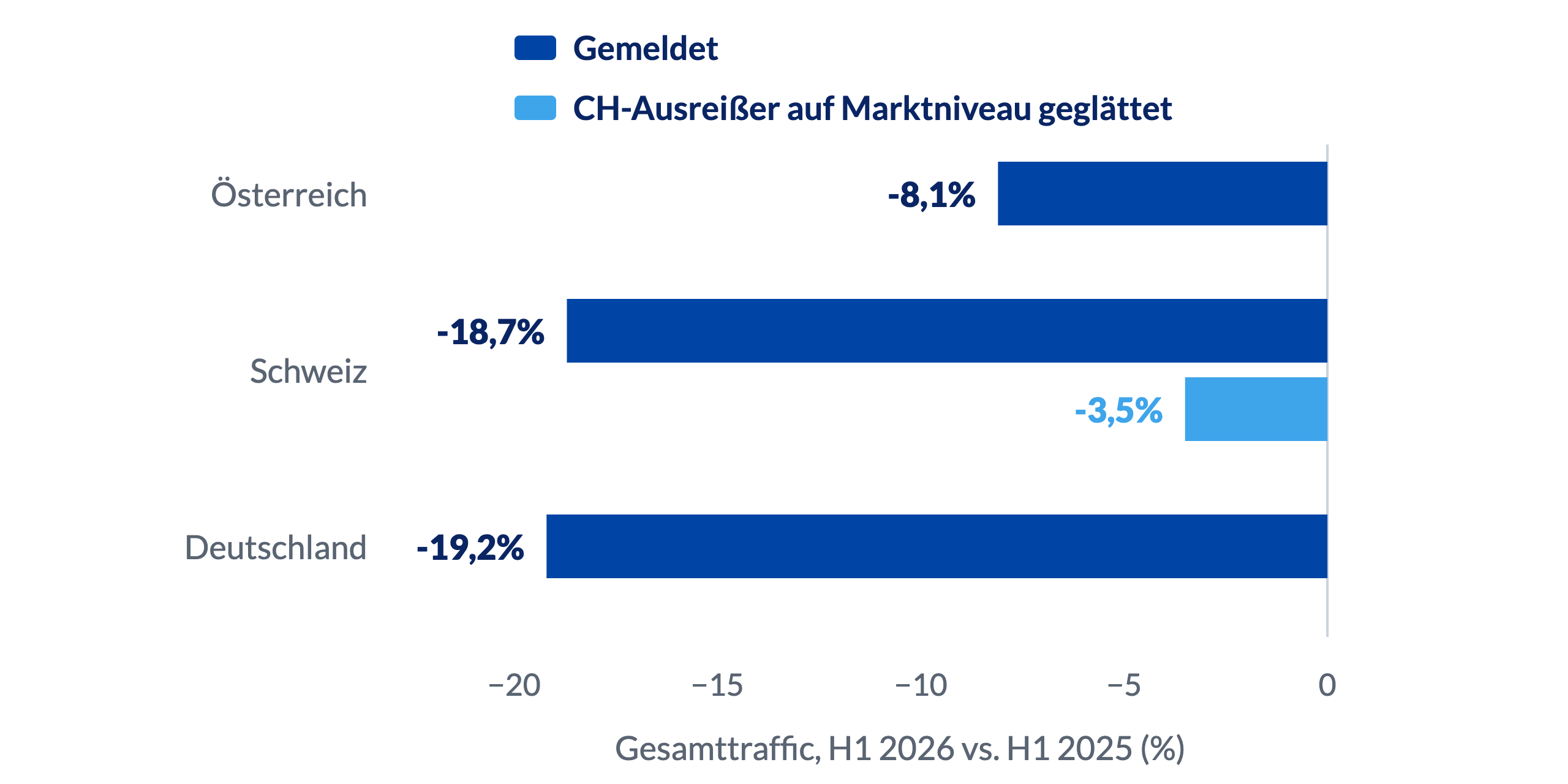
Total Traffic, H1 2026 vs. H1 2025 (%)
What These Numbers Tell Us
The updated figures for the first half of 2026 confirm and reinforce the trend identified in our original study. We are seeing an accelerated decline in organic traffic, while AI answer engines—though growing strongly in percentage terms as a traffic source—remain a niche channel in absolute terms, accounting for less than one percent of traffic. The second quarter of 2026 marks the sharpest decline to date over the entire observation period, with a drop of 8.8 percent compared to the previous quarter and 18.2 percent compared to the same period last year. So if Gartner is predicting a traffic slump of as much as 50% for the year 2028, then based on our study, that also seems realistic for the DACH region.
The Implications for Your Marketing Strategy
We are witnessing a significant shift in digital marketing. Over the past 20 years, traffic to a company’s or brand’s website has been one of the most important metrics, and search engines—especially Google—have been the primary driver. Users would find inspiration on social media, search for products and services on search engines, and then compare and purchase them on portals, in online stores, and from brands. With the rise of AI-powered answer engines, this typical customer journey is changing radically. Not only do Google AI Overviews and Google AI Mode provide answers directly in search results without requiring a user to click on a link, but the entire discovery phase—from the initial problem to the recommendation and ultimately the decision—can now take place within an AI chat. Purchases still take place in online stores, but with Agentic Commerce, even the future of that final click is uncertain.
When a company’s own website becomes the final destination for checkout, it loses the valuable data that has driven an entire digital ecosystem. From personalization to audience insights to retargeting—without meaningful traffic, none of this will work as well as it used to. At the same time, AI chatbots are currently completely opaque. With traditional Google rankings, I know exactly where my brand stands compared to the competition. With ChatGPT or Google AI Mode, there are metrics showing how often my brand or product is mentioned or recommended through third-party providers.
So the most interesting figure in our study is the one that’s missing: a brand’s visibility and popularity in AI chats. What’s clear, however, is that marketing teams need to pay attention to this metric. The takeaway from the study, then, is not so much to drive traffic to one’s own website by any means necessary. Rather, it’s more about adapting one’s marketing strategy to the evolving customer journey.
Above all, this means strengthening your brand’s presence throughout the entire digital ecosystem. When people talk about your brand on social media, in forums, on comparison sites, in videos, podcasts, and the media, it becomes relevant to both users and AI chatbots alike. At the same time, it’s important to gain as much clarity as possible about your own status in AI search and to lay the technical groundwork so that your messages and offers are easily readable and understandable not only by humans but also by machines.
A technical foundation and a strategy that addresses all touchpoints: These are the two prerequisites for digital marketing to remain a key driver of brand awareness and performance—even when website traffic declines.
Data source: 74 websites across twelve industries in Austria, Germany, Switzerland, and internationally; quarterly data from Q1 2024 through Q2 2026; channels: organic search, paid search, and AI referrals. All data is anonymized and aggregated.